
If you’re a business owner focused on growth, building a driven and ambitious A-team is likely high on your priority list. But in such a competitive job market, finding the right talent isn’t always easy. In fact, we found that 72% of business owners are experiencing progression delays due to staffing issues, while 32% plan to significantly invest in recruitment over the next twelve months.
To better understand the current landscape, the team at Adobe Express surveyed 1,000 UK adults about their current career motivations and workplace preferences. We also asked business owners about the biggest recruitment challenges they’re currently facing.
This allowed us to uncover what job seekers are really looking for, and how employers can better align with these needs. We’ve also revealed the areas where business owners can look to find top talent!
Key takeaways
- UK small businesses face major hiring challenges, with competition from larger companies, high salary expectations, and a lack of qualified candidates slowing growth.
- Employees prioritise higher pay, better work-life balance, and career development opportunities, with flexible and hybrid working emerging as top preferences.
- A strong company culture focused on wellbeing, transparency, and collaboration is key to attracting and retaining talent across industries and regions.
What do business owners think candidates want?
According to our survey, most business owners (67%) believe that candidates value a good work-life balance the most, with 50% also mentioning the importance of a competitive salary.
Flexible working arrangements (including remote and flexible working hours) was cited by 18% of business owners, with 14% also mentioning opportunities for growth and development.
What’s more, 13% believe that a strong company culture is the most important factor.
What challenges are business owners facing in finding new talent?
Employers face various hurdles when building a strong team, but what are the most common challenges? Well, for small businesses, competition from larger companies tops the list (36%), with many struggling with visibility.
Other challenges include high candidate salary expectations (30%), a lack of qualified candidates (26%), and difficulty finding candidates with specific skills (19%).
12% also mentioned uncertainty about future business needs, while 10% brought up the cost of recruitment. Fewer people (9%) highlighted the difficulty of assessing candidates remotely.
What are job seekers really looking for?
On the candidate side, priorities are clear. When asked about their primary motivation for job hunting, 23% revealed they are chasing a better salary, while 21% are looking for a better work-life balance.
11% cited career growth and development as their primary motivation, while 10% crave more challenging work. A supportive company culture is important to 5% of employees, while 3% are on the hunt for better job security.
Other reasons employees are jumping ship include a desire to work for a more ethical company (3%) as well as seeking a role in a specific industry (2%).
The importance of flexible working
It’s no secret that flexibility is becoming more important than ever in the workplace, with nearly half of participants favouring flexible start and end times to their working day. 45% also highlighted the importance of hybrid working arrangements, with 19% preferring fully remote work altogether.
14% look for companies who offer work from anywhere schemes, while 16% mentioned compressed work weeks. On top of this, job sharing is a key factor for 6% of people.
Company culture
Beyond flexibility, company culture plays a crucial role in attracting and retaining top talent. Half of respondents mentioned the importance of employee wellbeing, while 40% said that they value open and transparent communication.
A collaborative environment is key for 35% of people, while 31% mentioned the importance of social interaction and team building opportunities.
A clear sense of company purpose matters to 31%, and a further 26% care that ethical standards are in place. Many job seekers value a commitment to diversity, equality, and inclusion (21%) as well as a company that invests time in innovation (21%).
What motivates job seekers in different UK cities?
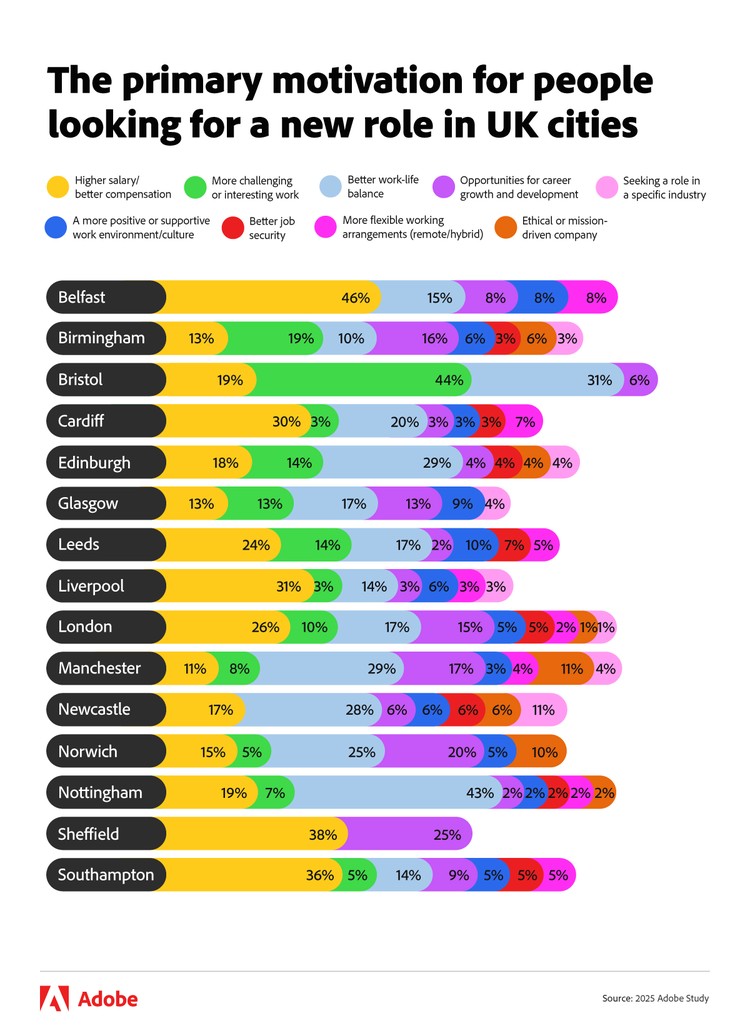
Interestingly, we found that employee priorities vary from city to city too. In Belfast for instance, 46% of job seekers prioritise higher salaries, while Bristol leads the way for candidates seeking more challenging roles (44%).
Nottingham stands out as a city where better work-life balance is a top concern (43%), whereas those in Sheffield seem particularly interested in career development (25%).
In Leeds, a more positive work environment is a leading motivator (10%) with better job security also ranking higher than in other cities (7%). Looking at the landscape in Manchester, we found that 11% are drawn to ethical or mission-driven companies, whereas in Newcastle, 11% are
looking for a role in a specific industry.
What are the top industry-specific motivations?
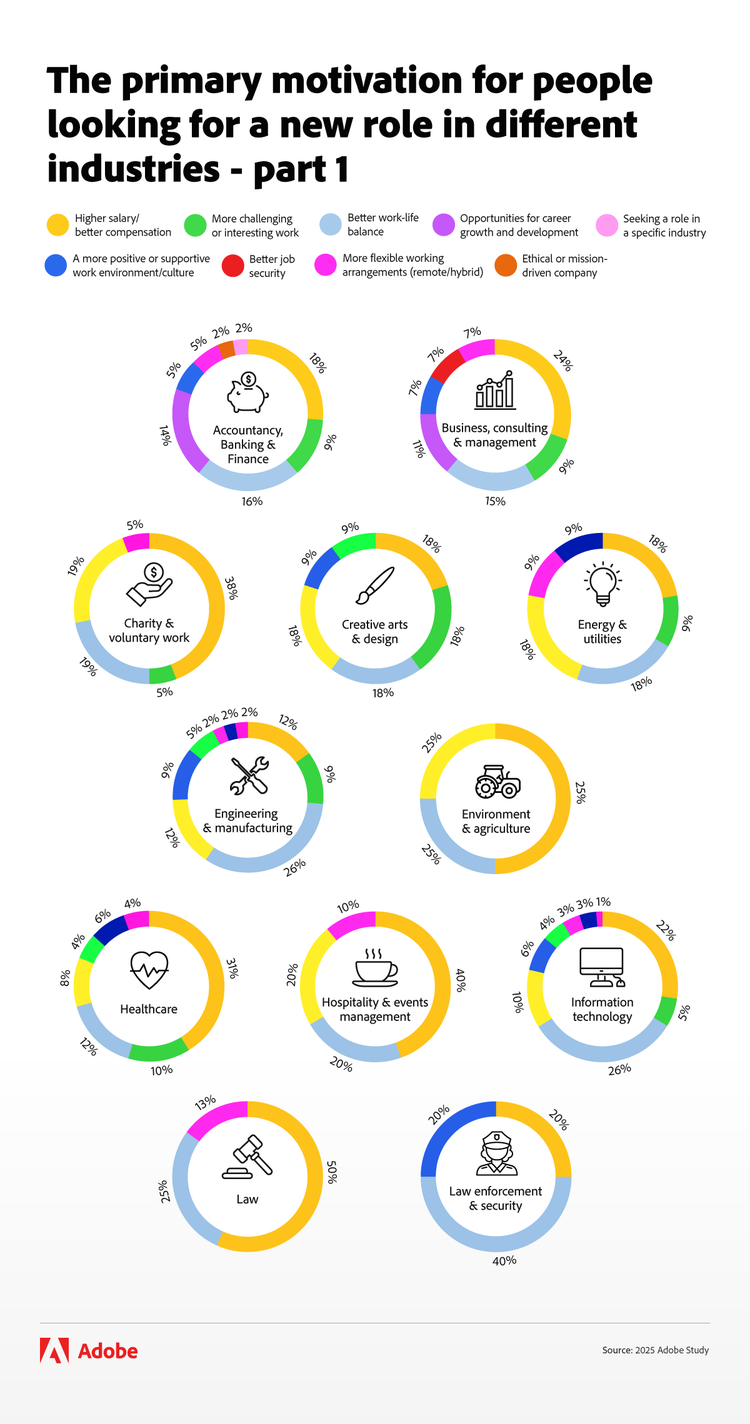
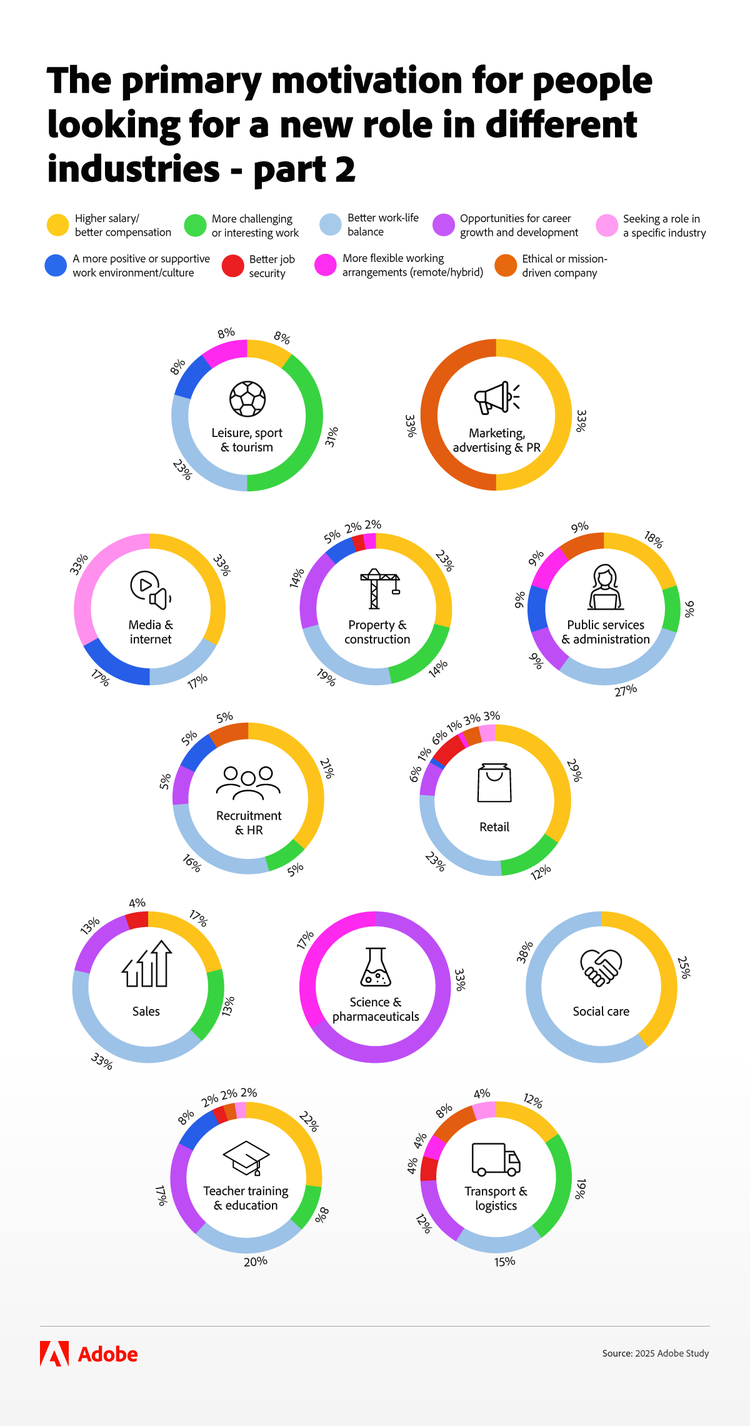
Just as motivations vary by location, they also differ from industry to industry. In Law and Environment and Agriculture, half of participants are chasing higher salaries, while in Leisure, Sport, and Tourism, more challenging work matters the most (31%).
Better work-life balance is a priority for those in Law enforcement and security (40%), while career growth is crucial in Science and Pharmaceuticals (33%).
Creative Arts and Design employees are focused on job security (9%), while those in
Marketing, Advertising, and PR are looking to work for a more ethical company (33%).
Finally, Law professionals are seeking more flexible working arrangements (13%), compared to just 9% of those in Public Services and Administration.
Top tips on how to find and retain the best talent.
Whether you’re launching a small business or scaling a growing brand, attracting and retaining top talent is crucial. With this in mind, here are some tips on how you can stand out as an employer:
- Tailor your job descriptions: Your job ad is usually the first impression a candidate has of your business, so it’s important to make sure it accurately reflects the role and your offerings. From unique growth opportunities to flexible working, highlight what sets you apart in the industry.
- Foster a positive company culture: Today’s job seekers value transparency, employee wellbeing, and a positive working environment, so it’s important to invest time and energy into building a culture that supports your team. Small businesses are in a unique position to offer a close-knit, supportive environment, so be sure to keep this a top priority.
- Boost brand visibility: If you’re competing with larger companies for talent, a strong brand presence can help you stand out. From scroll-stopping social media posts to polished business cards, our business tools are on hand to help. And if you’re looking to streamline the process, check out our latest AI advancements.
Well, there you have it: our insights on the hiring landscape across the UK, as well as the tools you need to connect with the talent that’s right for your business.
If you’re looking to build your A-team, don’t forget to bear the above tips in mind to fine-tune your hiring strategy. And if you’re a job seeker, you can make sure your CV is up to scratch with our CV templates. These are designed to help you stand out in a pool of applicants, no matter the role or sector.
Finally, if you’re looking for additional insights, inspiration, and creative career advice, head over to the Adobe Express blog.
recipe
recipe
Methodology:
Adobe Express conducted a national survey via TLF. The survey polled 1,000 UK adults between 24.04.2025 and 01.05.2025. The questions in the survey are displayed throughout the above content, and the data includes splits across age groups (18-24, 25-34, 35-44, 45-54, 55-64, 65+), city (Belfast, Birmingham, Bristol, Cardiff, Edinburgh, Glasgow, Leeds, Liverpool, London, Manchester, Newcastle, Norwich, Nottingham, Sheffield, Southampton), gender (male, female, non-binary or alternative identity) and career industry (24 industries including Accountancy, banking and finance, Business, consulting and management, Charity and volunteer work, Creative arts and design, Energy and utilities, Engineering and manufacturing, Environment and agriculture, Healthcare, Hospitality and events management, Information technology, Law, Law enforcement and security, Leisure, sport and tourism, Marketing, advertising and PR, Media and internet, Property and construction, Public services and administration, Recruitment and HR, Retail, Sales, Science and pharmaceuticals, Social care, Teacher training and education, Transport and logistics).