


JUMP TO SECTION
- How to write a resume in 8 simple steps
- 1. Choose the correct resume format
- 2. Write a resume headline, summary, or objective
- 3. How to write your work experience section
- 4.What to include in a resume education section
- 5. Skills to put on a resume
- 6. Formatting for an ATS-friendly resume
- 7. Proofread your resume
- 8. Do I need a cover letter?
A resume is often the first impression you make on a hiring manager, and a strong one can determine whether you move forward in the interview process. Whether you're writing your very first resume, updating an old one, or tailoring your resume for a specific job, understanding the fundamentals of how to write a resume is essential. This guide walks you through the steps from how to start a resume to how to make your resume stand out, with strategies that work for all experience levels.
Key takeaways
- A strong resume includes a clear format, a compelling summary, distinct work experience, relevant skills, and ATS‑friendly structure.
- Resumes can follow different structures: chronological, functional, or combination.
- Choosing the right format is essential, especially if you're a job seeker wanting to know how to write a resume with no experience or navigating career changes.
- A strong headline or summary helps hiring managers quickly understand your value.
- Writing clear, metric‑driven bullet points makes your experience stand out and improves ATS readability.
- AI tools like Adobe Acrobat AI Assistant can help you answer common questions like "What should I put on my resume?" or "What skills should I include on my resume?"
- ATS optimization and tailoring your resume to a job description may be helpful when you are feeling stuck, for example wondering why your resume is not getting interviews.
How to write a resume in eight simple steps.
Writing a resume can feel overwhelming, especially if you're unsure what to include or how to format it. This step‑by‑step guide breaks the process into manageable parts so you can build a resume that is clear, professional, and tailored to your goals. Whether you're a student, a career changer, or an experienced professional, these steps will help you create a resume that hiring managers want to read, and that ATS systems can easily scan.
1. Choose the correct resume format.
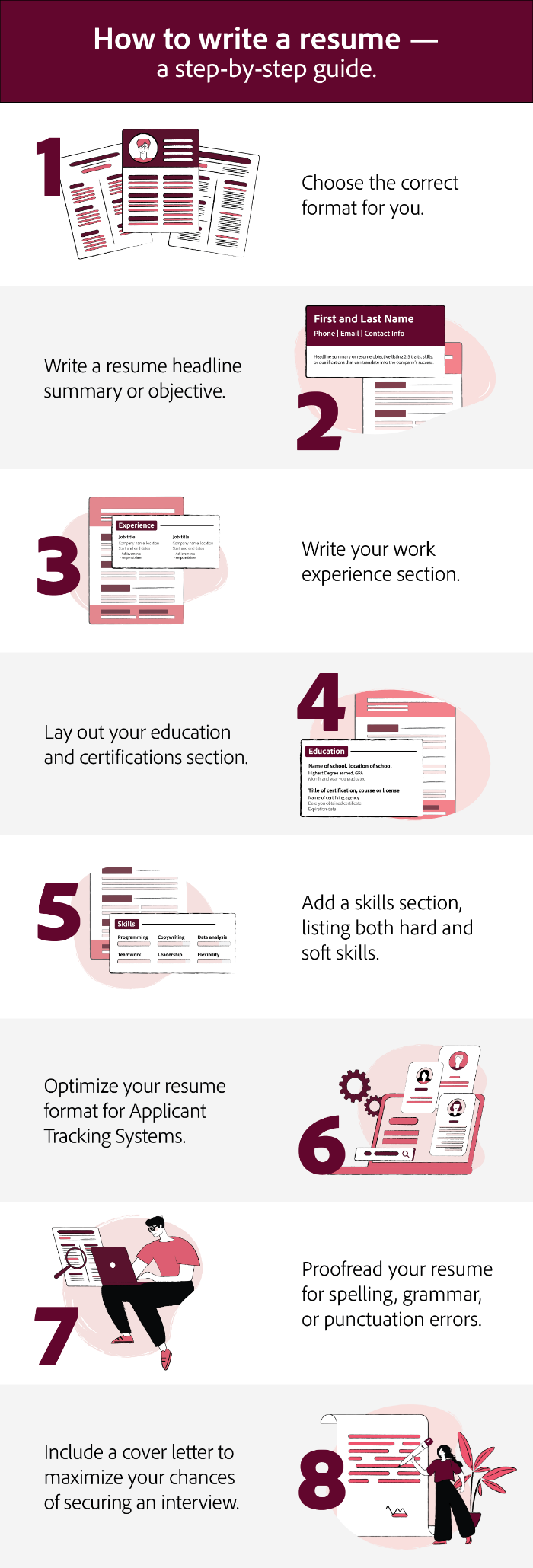
Choosing the right resume format is the foundation of effective resume writing. The format you choose determines how your experience is presented and how quickly a hiring manager can understand your strengths. This section is especially helpful for users wondering what is the best resume format or how to start a resume.
The three main resume formats:
- Chronological- Typically in reverse order in with your most recent position first. Best for candidates with steady work history.
- Functional- Highlights your skills and training instead of work experience and history. Ideal for career changers or those with limited experience.
- Combination- Using both of the previous formats, great for experienced professionals who want to highlight both skills and experience.

Contact information to include and leave out.
Your contact information should be clear, professional, and easy to find.
Include:
- Full name
- Phone number
- Professional email
- LinkedIn URL
Leave out:
- Home address
- Photos
- Date of birth
- Multiple phone numbers or emails
2. Write a resume headline, summary, or objective.
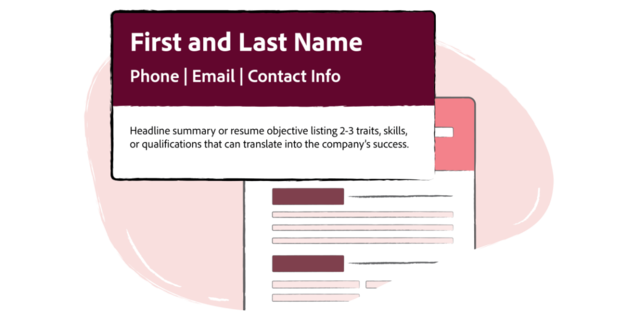
Your headline or summary is one of the first things a hiring manager sees, making it a valuable chance at a first impression. If you're wondering how to make a resume that stands out, a genuine and interesting headline can help. A strong summary highlights your strengths, experience, and value in 2–3 concise sentences.
Tips for writing a strong summary:
- Start with a descriptive adjective
- Highlight key skills or accomplishments
- Tailor it to the job description
- Write what you hope to do for the company
- Keep it brief (preferably under 50 words) and impactful
Since recruiters and hiring managers usually spend less than two minutes reviewing a resume, a headline summary is likely one of the first things their eyes will land on, as it is at the top of the page. A resume headline is a brief, impactful phrase that summarizes your professional identity and value. Placed at the top of your resume, it helps recruiters quickly understand who you are and what you bring to the table.
Example resume headlines for different roles:
Marketing
• Data-Driven Digital Marketing Strategist with Proven ROI Results
• SEO Specialist Focused on Organic Growth and Content Optimization
Engineering
• Innovative Mechanical Engineer Specializing in Sustainable Design
• Full-Stack Developer with Expertise in Scalable Web Applications
Entry-Level
• Recent Business Graduate with Internship Experience in Market Research
• Aspiring IT Support Specialist with Hands-On Training in Network Systems
3. How to write your work experience section.
Your work experience is the heart of your resume, and the section hiring managers spend the most time reviewing. It is essential to know how to describe your work experience on a resume. Tools like Acrobat AI resume builder can help tweak and improve these with simple prompts like "Can you rewrite my resume?".
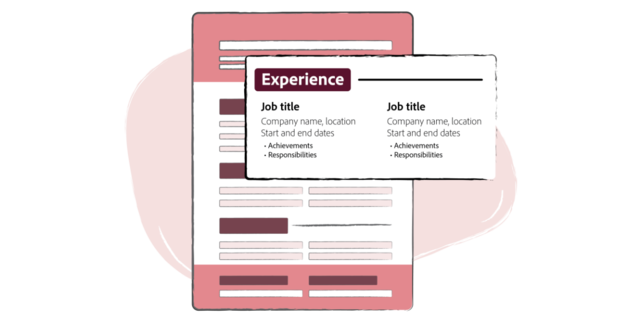
Each job entry should include:
- Company name + location
- Job title
- Dates of employment
- Bullet points with achievements and responsibilities
Use action verbs and metrics to make your accomplishments stand out.
Career gaps are common and can be framed positively to reflect personal growth, skill development, or life priorities. The key is to be honest, clear, and confident in your explanation. Here are a few ways to format and phrase different types of gaps:
Caregiving
• Career Break for Family Care
January 2022 – August 2023
Provided full-time care for a family member while maintaining professional development through online courses in [industry-relevant topic].
Education
• Full-Time Student
September 2021 – May 2023
Completed [Degree or Certification] at [Institution], focusing on [relevant skills or subjects].
Travel or Sabbatical
• Professional Sabbatical
March 2020 – December 2020
Traveled internationally to gain cross-cultural experience and broaden global perspective; engaged in freelance projects and language study.
By framing gaps with purpose and relevance, you show employers that your time away from traditional employment was intentional and enriching.
4. What to include in a resume education section.
An education section will be especially helpful and valuable if you have limited work experience or if you’re transferring to a new industry.
You should always include this section, although where it appears depends on your individual circumstances. If you are just starting out in your career, it’s generally a great idea to include your education section near the top of your resume. However, if you’re a few years into your career, your education can appear at the bottom of your resume. This is because your work experience will be more relevant to potential employers at this point in your career. Unless you’re applying to a job where the emphasis is on education — such as academia, law, or medicine — most job seekers will opt for adding this section at the bottom of their resume.
Below you can find what every resume education section must include:
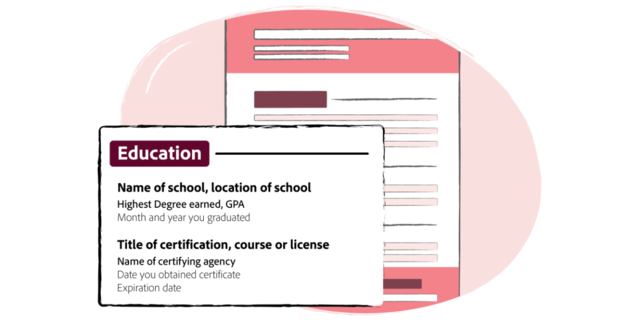
- The name of the university, community college, or school. Put your highest degree first. Only include high school or GED if you’re a high school student or didn’t attend university.
- Location of the school. Write the city and the state.
- The month and year you graduated. If you haven’t graduated yet, then write the expected graduation date.
- The type of degree you received or expect to receive and the program.
- Your GPA. This is good to include if it is higher than 3.5 and you just graduated college or if it’s required. You might also consider adding relevant coursework, honors, scholarships, and recent awards, such as the dean’s list.
How to include certifications, licenses, and training.
Professional certifications are a way to validate your skills and knowledge in a particular area. They can be helpful when you’re looking for a job or trying to move up in your current company. You can list your certifications right under your education information.
To put certifications on your resume, be sure to write the following elements in the order below:
- The title of the certification, course, or license.
- The name of the certifying agency or body.
- The date you obtained each certificate.
- The expiration date of your certificate or, if it is in progress, add the expected date of completion. If the certification is still valid, you can also mention that.
5. Skills to put on a resume.
Your skills section helps hiring managers quickly understand what you bring to the table. It also helps with ATS optimization, providing a scannable summary of how your knowledge aligns with the demands of the job.
Hard skills examples:
- Programming
- Data analysis
- Graphic design
- SEO
Soft skills examples:
- Communication
- Leadership
- Teamwork
- Problem‑solving
Optional sections like volunteer work, certifications, languages, and publications can help your resume stand out, especially for early‑career applicants.
6. Formatting for an ATS-friendly resume.
Formatting your resume correctly is important if you want to get more job interviews. Nowadays, your resume most likely will go straight into Applicant Tracking Systems (ATS), a computer database used to manage high volumes of job applicants. ATS scans your resume, scores your qualifications based on the description for that position, and ranks your application.
If your resume can’t be read by the ATS due to formatting issues, then all your hard work may have been for nothing.
ATS formatting tips:
- Use simple fonts
- Avoid tables, columns, and graphics
- Use standard section headers
- Include keywords from the job description
- Save as PDF unless otherwise instructed

What is the x, y, z method for resume writing?
The x, y, z method for resume writing consists of including in one sentence: what you’ve accomplished (X) + the qualitative results (Y) + the skills or experience you utilized to achieve the outcome (Z).
This is an easy-to-read, concise, and practical way to provide context and flow. This method is useful and important because it helps you hone in on specific achievements so that your hiring manager can find your accomplishments more easily. It also helps work well with ATS, as you will be able to include specific keywords.
To write your resume using the x, y, z method, follow these simple guidelines:
- X. Start with an active verb that helps provide clarity to the reader about what you achieved.
- Y. Describe how the achievement was measured. Use facts, numbers, or figures to help add credibility and insight into your strengths.
- Z. Following this, write how you achieved it — what you did and how you did it — which helps the reader focus on the most relevant experience and results.
An example of the x, y, z method would be:
Reduced business costs and increased profit (X), reducing food costs by 15% (Y) by reviewing purchased items and negotiating with suppliers (Z).
7. Proofread your resume.
Before you submit your resume to your prospective employer, you should review your resume for spelling, grammar, and punctuation errors. You can read your resume backward to notice errors you hadn’t identified before, you can have your friends, colleagues, professors, and family members review it as well, or you can use free online proofreading tools.
If, after writing your resume, you notice that it is more than one page, consider ways to consolidate or shorten each section by removing filler words or extraneous information. Remember to proofread and update your resume before sending it off since it could make all the difference in whether or not you get a job interview.

How to tailor your resume to the job.
Different industries value different resume styles, formats, and content. Tailoring your resume to meet those expectations can significantly improve your chances of landing interviews.
1. Creative Fields (Design, Writing, Marketing)
• Use a visually appealing layout that reflects your personal brand.
• Include a portfolio link or samples of work.
• Highlight creative tools (e.g., Adobe Creative Suite, Figma) and campaign results.
2. Technology (Engineering, IT, Data Science)
• Prioritize technical skills and certifications (e.g., AWS, Python, Agile).
• Use bullet points to showcase project outcomes and metrics.
• Include GitHub or project links to demonstrate hands-on experience.
3. Healthcare
• Focus on licenses and certifications (e.g., RN, BLS, CNA).
• Emphasize patient care experience and compliance with regulations.
• Use clear, structured formatting to highlight clinical roles and responsibilities.
4. Education
• List teaching credentials and subject specialties.
• Include classroom management strategies and student outcomes.
• Mention experience with remote learning tools or curriculum development.
5. Entry-Level or Career Change
• Use a strong summary to highlight transferable skills.
• Include volunteer work, internships, or relevant coursework.
• Consider a functional resume format to emphasize skills over chronology.
8. Do I need a cover letter?
Although some job posts and companies may list cover letters as optional, it is often best to include one to maximize your chance of securing an interview.
The purposes of a cover letter are to demonstrate to potential employers that you are interested in the position, explain your unique qualifications, and persuade the hiring manager that you are the best fit.
If you choose to submit a cover letter along with your resume, consider adding a greeting, an opening, the body, a closing, and making sure it is not longer than one page.

Frequently asked questions.
How long should a resume be?
While most employers typically consider it best to stick with one-page resumes, they’re not the best for every situation.
If you have tons of experience and achievements that relate directly to the position you’re applying for, you might want to make sure the hiring manager sees every impressive detail. In this case, it’s okay to go onto two or even three pages.
However, before working on that third page of accomplishments, make sure everything you add is completely relevant and impressive. Only include information that will set you apart from the other applicants or that emphasizes your qualifications for that particular position. Most multi-page resumes are for jobs that require 10 or more years of experience, like manager, executive, or other high-level positions.
Recruiters and hiring managers have spoken about this issue, and most of them agree that they won’t really look at a resume that is longer than one page. In fact, a great deal of them spend less than a minute reviewing a resume. If you are just fresh out of college, you will want to make sure your resume is the appropriate length, meaning not longer than one page.
That said, you should also strive to make your one-page resume not crowded but still include enough information to fill the page.
Should I include personal interests on my resume?
If you have the space and you think your personal interests are relevant information for the position you are applying for, it can be a good idea to include them to make your resume stand out and be more personalized. These personal interests or hobbies can help you stand out and be memorable to the hiring managers, as well as say something about you that is not included in your job experience.
How do I address any gaps in employment?
Whether the reason for your gaps in employment were raising your children, going back to school, or traveling, you will most likely need to explain why there is a gap on your resume. Without explaining gaps in employment, a recruiter may assume the worst. To address a gap, simply state in two lines or less that you were doing during that time. You can share the value you picked up along the way by including a list of qualities you learned from that time. Above all, don’t try to hide your employment gap, assume that the hiring manager will find it and get ahead of the game by addressing it briefly.
How do you write a good resume?
Make sure you proofread your resume before you submit it or send it to the hiring manager. A typo or misspelled word can make you come across as unprofessional or not detail-oriented and could potentially cost you the job. You should also update your resume every time you are applying for a new job to include your latest position and accomplishments. You can do this manually, or use a resume writing AI tool to easily keep it up to date and improve it over time.
Keep exploring
title
How to write a resume — a step-by-step guide.
cardImageAltText
A woman in an office writes her resume.
cardImage

primaryTag
caas:content-type/article
Tags
caas:content-type/article,caas:products/acrobat,caas:business-unit/document-cloud,caas:topic/edit-pdf,caas:topic/word-to-pdf,caas:topic/convert-pdf,caas:topic/resume-ai,caas:topic/students,caas:topic/job-search

