How to write board meeting minutes efficiently
Ever feel like you’re spending 20 hours a week in meetings? Taking care of meeting minutes and action items for multiple meetings starts to add up. Learn how to capture accurate, actionable board meeting minutes, both with and without AI tools.

What are board meeting minutes?
Board meeting minutes are the official written record of what happens during a board of directors meeting. They document the discussions held, motions made, votes taken, and decisions reached. Far from being a verbatim transcript, effective minutes distill the substance of a meeting into a high-level summary that any reader — whether they attended or not — can quickly understand.
Why do board meeting minutes matter? First, they serve as a legal record. In many jurisdictions, nonprofits and corporations are required by law to maintain minutes of board meetings. Regulatory bodies, auditors, and courts may request them to verify proper governance. Second, minutes are invaluable for future meeting preparation and recaps — board members who missed a session can review them to catch up, and attendees can confirm action items. Third, they create accountability. When a motion is recorded along with the proposer's name and the vote outcome, there is no ambiguity about who is responsible for what.
If you are wondering what exactly goes into a complete set of board meeting minutes, here are the required elements that are recommended to capture:
- Date, time, and location of the meeting
- Type of meeting (regular, special, or emergency)
- Name of the presiding officer and the secretary or minute-taker
- List of attendees and absentees (noting whether a quorum was established)
- Corrections or amendments to the previous meeting's minutes
- Approval of the previous meeting's minutes
- Current agenda items discussed
- Motions made, including the name of the person who moved and seconded each motion
- Votes and their outcomes (passed, failed, or tabled)
- Action items with assigned owners and deadlines
- Time of adjournment and the date of the next scheduled meeting
Understanding what meeting minutes are and the elements to include is the first step toward writing them with speed and confidence.
How to take minutes for a board meeting.
In most organizations, the board secretary is the person officially responsible for taking and distributing board meeting minutes. Some boards rotate the responsibility among members, and others assign the task to a dedicated administrative professional. Regardless of who holds the pen — or the laptop — the process of how to take minutes for a board meeting follows four essential steps.
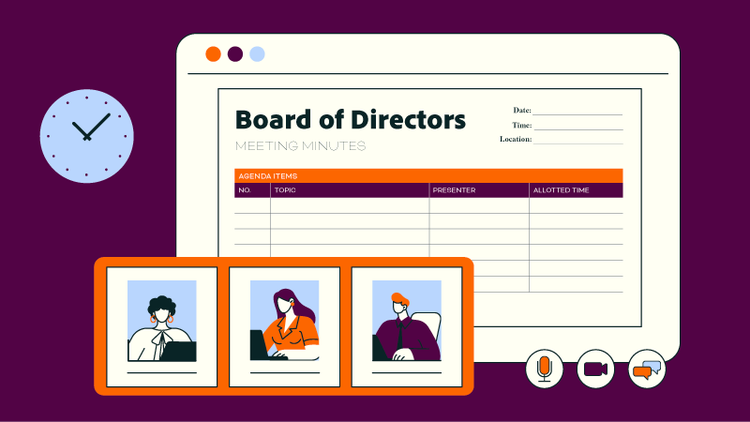
Board meeting minutes template and examples.
A reliable board meeting minutes template gives you a repeatable structure so you can focus on content rather than layout. Below is a written-out example based on a fictitious company.
Greenfield Technologies Inc. Minutes of the Regular Meeting of the Board of Directors
Date: Thursday, March 13, 2025 Time: 10:00 a.m. – 11:45 a.m. (Eastern Time) Location: Greenfield Technologies headquarters, Conference Room A, 500 Innovation Drive, Austin, TX 78701 Presiding Officer: Maria Chen, Board Chair Secretary: David Okonkwo, Corporate Secretary
Directors Present: Maria Chen, David Okonkwo, Sarah Patel, James Whitmore, Linda Nakamura, Robert Alvarez Directors Absent: Carla Jennings (excused)
Call to Order: Board Chair Maria Chen called the meeting to order at 10:02 a.m. A quorum of six out of seven directors was confirmed.
Approval of Previous Minutes: The minutes from the February 6, 2025, regular meeting were reviewed. Sarah Patel noted a correction to the revenue figure on page two, which should read $4.2 million rather than $4.0 million. James Whitmore moved to approve the minutes as corrected. Linda Nakamura seconded the motion. The motion carried unanimously.
Financial Report: CFO Emily Thornton presented the Q1 financial summary, reporting total revenue of $12.8 million — a 9% year-over-year increase — and operating expenses of $10.1 million, within budget. Robert Alvarez moved to accept the report. David Okonkwo seconded. The motion carried unanimously.
New Business — Product Expansion Proposal: Maria Chen introduced a proposal to expand the Greenfield Cloud Suite into the European market. After discussion, Sarah Patel moved that the board approve a $1.5 million budget allocation for a European market feasibility study, with a report due to the board by September 2025. James Whitmore seconded the motion. Vote: 5 in favor, 1 opposed (Robert Alvarez). The motion carried.
Action Items:
- Emily Thornton to distribute the final Q1 financial report to all directors by March 20, 2025.
- Sarah Patel to form a three-member subcommittee to oversee the European feasibility study and report nominees at the April meeting.
Adjournment: There being no further business, Linda Nakamura moved to adjourn. Robert Alvarez seconded. The meeting adjourned at 11:45 a.m.
Next Meeting: Thursday, April 10, 2025, at 10:00 a.m.
Respectfully submitted, David Okonkwo, Corporate Secretary
How to write board meeting minutes with AI.
AI is transforming how professionals handle documentation, and board meeting minutes are no exception. Here is how to write board meeting minutes more efficiently with AI-powered tools.
- Record and upload. Start by recording your board meeting (with participants' consent) or compiling your handwritten and typed notes into a single document. Upload the recording transcript or notes file into an AI-enabled workspace.
- Summarize with AI. Use an AI meeting notes summarizer to distill a lengthy transcript into key points. AI can identify motions, votes, action items, and discussion summaries far faster than manual review. Acrobat AI Assistant lets you ask targeted questions — such as "What motions were made?" or "List all action items" — and receive instant, citation-backed answers.
- Draft and refine. Take the AI-generated summary and refine it into your official minutes format. The generative AI capabilities in Acrobat can help you rewrite sections for clarity, adjust tone for a professional audience, and flag inconsistencies. Because the AI references the source document directly, you can verify every extracted detail against the original transcript.
- Share, collaborate and finalize. Share the draft with the board chair and reviewers. PDF Spaces in Acrobat lets multiple stakeholders review, comment on, and ask questions about the document in a single shared environment, eliminating email back-and-forth and version confusion.
- Plan ahead. AI is not only useful for documenting past meetings — it can also help you prepare for the next one. Use an AI-powered meeting agenda tool to generate a structured agenda based on unresolved action items, recurring topics, and board priorities, ensuring nothing falls through the cracks.
Best practices for accurate board meeting minutes.
Even experienced secretaries can fall into habits that undermine the quality and usefulness of their minutes. Here are the most important best practices to keep your board meeting minutes accurate, professional, and legally sound.

Be objective and factual. Minutes should read like a neutral record, not a narrative. Use third-person language and past tense throughout. For example write "Director Patel recommended increasing the marketing budget" rather than "Sarah passionately argued that the marketing budget was too low." Your role is to document decisions, not to characterize the tone or emotion of the discussion.
Know what not to include. A common question is what should not be included in board meeting minutes. The answer: personal opinions, side conversations, off-topic remarks, and verbatim dialogue. If a heated debate takes place, what is most important is to record the resulting motion, vote, and outcome. Avoid attributing statements to individuals unless the statement is a formal motion, second, or official objection. Unnecessary detail can create legal liability and distract from the minutes' purpose.
Use a consistent format. Whether you use a formal template or a custom layout, stick with it meeting after meeting. Consistency makes your minutes easier to navigate, compare across sessions, and audit. Standard elements — header information, agenda item summaries, motion records, action items, and adjournment — should appear in the same order every time.
Record motions with precision. For every motion, document the exact wording, the name of the mover and seconder, and the outcome. If a vote is not unanimous, record the count (for example, "5 in favor, 2 opposed"). For roll-call votes, list each member's vote individually. This level of detail protects the organization and provides a clear record of governance.
Distribute promptly. Share draft minutes within one week of the meeting. Prompt distribution signals professionalism and gives board members time to suggest corrections while details are fresh.
Review before approval. Always proofread minutes for typos, factual errors, and unclear language before circulating them. A second pair of eyes — whether the board chair's or a fellow administrator's — can catch mistakes you might overlook.
Frequently asked questions
How long should board meeting minutes be?
Who approves board meeting minutes?
Can board meeting minutes be amended after approval?
Are board meeting minutes public records?
How should board meeting minutes be stored for compliance?
You may also like