


An ellipsis is one of the most misunderstood punctuation marks in the English language. You've likely seen it, a series of three dots that can signify anything from a pause in dialogue to an omitted section of a quote. But understanding its correct usage is key to clear and effective writing. Whether you're a student, a professional, or a creative writer, mastering the ellipsis can add a new layer of nuance to your work.
At first, the ellipsis might seem like just a trio of dots you toss in when you're unsure what to say next. But don’t let its simplicity fool you—this punctuation mark plays a subtle yet powerful role in writing. Whether you're quoting someone, adding dramatic pause, or hinting at something left unsaid, the ellipsis helps shape tone and meaning in ways that can surprise even experienced writers. In this article, we’ll break down what an ellipsis is, what it means, and how to use it effectively in your own writing.
Ellipsis meaning & definition
Before you can use the ellipsis correctly, it's important to understand what it is and how it's formed. The ellipsis meaning goes beyond just three dots on a page; it's a tool for precision and tone.
What is an ellipsis?
Formally, an ellipsis is a punctuation mark consisting of three consecutive periods (...). Both the Chicago Manual of Style and the Modern Language Association (MLA) Handbook acknowledge its primary role in indicating an omission of words from a quoted text. It can also be used to indicate a pause, hesitation, or an unfinished thought.
Many people type an ellipsis as three separate periods, but most modern word processors and design software use a single, pre-composed glyph (…). This special character ensures consistent spacing and prevents the dots from separating at the end of a line.
Pro Tip: Not sure if your punctuation is perfect? Using an online grammar checker can help you verify your use of ellipses and other punctuation, ensuring your writing is polished and professional.
How is an ellipsis formed?
The formation of an ellipsis can vary slightly depending on the style guide you follow. Some guides recommend spaces between the dots (. . .), while others prefer the single glyph with no spaces (…). The most common and easiest method is to use the single Unicode character.
Here's how you can type the ellipsis character on different devices:
- Windows:
Alt + 0133(using the numeric keypad) - Mac:
Option + ; - iOS/Android: Press and hold the period key on the virtual keyboard.
Consistency is key. Whichever method you choose, use it consistently throughout your document for a clean, professional look.
Historical background
The word "ellipsis" comes from the ancient Greek word élleipsis, meaning "to fall short" or "omission." Its use in print dates back to the 16th century, where printers used a series of asterisks or dashes to indicate missing text in manuscripts. Over time, these marks evolved into the three-dot ellipsis we use today. Its function has also expanded from a simple mark of omission to a versatile tool in both formal and creative writing.
When to use an ellipsis
Knowing when to use an ellipsis is just as important as knowing what it is. While it may seem like a simple punctuation mark, its use can vary widely depending on the context, and that’s where things get interesting. From formal academic writing to casual social media posts, the ellipsis serves different purposes: it can signal omitted text, create suspense, or reflect a speaker trailing off. Understanding when it's appropriate to use an ellipsis helps you avoid confusion, maintain clarity, and add nuance to your writing. In this section, we’ll explore the key moments when an ellipsis makes sense—and when it’s best to leave those three dots out.
1. Omitting words in quotations
The most formal use of an ellipsis is to show that you have removed words from a direct quotation. This is common in academic and legal writing, where you need to shorten a quote to its most relevant parts without changing its original meaning.
For example, consider this original quote from a long document: "The committee, after much deliberation and considering all the available data, concluded that the project was, for all intents and purposes, a resounding success."
To shorten it, you could use an ellipsis: "The committee … concluded that the project was … a resounding success."
When you're working with lengthy source materials, it can be challenging to pull out the exact information you need. You can use a tool that lets you chat with PDF documents to quickly find and verify quotes, making your research process much more efficient.
2. Showing a pause or trailing thought
In creative writing, dialogue, and informal communication, an ellipsis is often used to create a pause for dramatic effect or to show a thought trailing off. This can make writing feel more natural and conversational. It invites the reader to fill in the gap, creating a sense of shared understanding or suspense. This technique is especially powerful in fiction and scriptwriting, where conveying subtext is crucial.
Here are a few examples:
- "I was just wondering … maybe you'd like to join us?" (hesitation)
- "He looked out at the horizon, lost in thought …" (trailing off)
- Social Media Post: "Just had the best coffee of my life … you won't believe where."
- Marketing Copy: "Our biggest sale of the year is coming … soon."
3. Indicating unfinished lists or cliff-hangers
An ellipsis can also be used to suggest that a list of items is not complete or to create a sense of suspense. This is a popular technique in persuasive and marketing copy to pique the reader's interest and encourage engagement. It implies that there is more to discover, prompting the reader to continue.
For instance:
- An AI resume builder can help you highlight your skills in communication, teamwork, leadership…
- The season finale ended with the hero cornered, and then…
Common mistakes to avoid
While versatile, the ellipsis can be misused. Here are some common mistakes to watch out for:
- Overuse: Using too many ellipses in your writing can make it feel choppy and unprofessional.
- Inconsistent spacing: Stick to one style for spacing around your ellipsis.
- Multiple ellipses: Never use two or more ellipses in a row (e.g., "......"). One is always sufficient.
- Altering meaning: When omitting words from a quote, ensure the ellipsis doesn't change the original author's intended meaning.
Ellipsis vs dash and colon
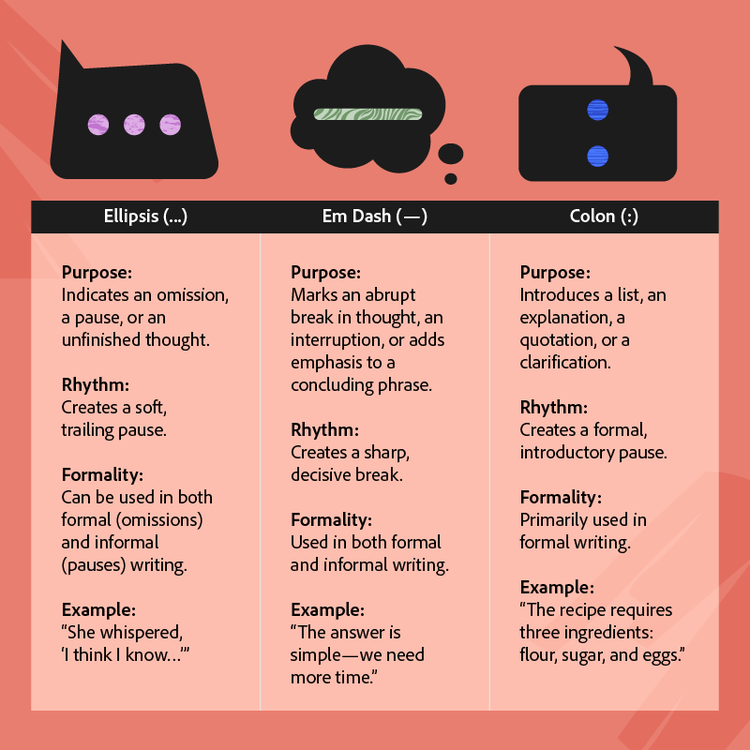
The ellipsis is not the only punctuation mark that can create a pause or separate ideas. Dashes (both en and em) and colons have distinct uses that sometimes overlap with the ellipsis, but they are not interchangeable.
When a dash is clearer
Use an em dash for an abrupt interruption or to add emphasis. An ellipsis would be too soft.
- With an ellipsis: "I was about to leave when … oh, never mind." (Feels hesitant)
- With a dash: "I was about to leave when—oh, never mind." (Feels more sudden)
When a colon is clearer
Use a colon to formally introduce a list or explanation. An ellipsis would create ambiguity.
- With an ellipsis: "We need a few things from the store … milk, bread, and cheese." (Feels like an incomplete thought)
- With a colon: "We need a few things from the store: milk, bread, and cheese." (Clear and direct)
To master these distinctions, practice is key. You can use a flashcard maker to help you study the different uses of punctuation marks and solidify your understanding.
Ellipsis FAQs.
Yes, an ellipsis itself is always three dots. However, in formal writing, if the omitted text comes after a complete sentence, you will see four dots. This is the period for the preceding sentence followed by the three-dot ellipsis. For example: "The report was complete. … The team moved on to the next phase."
The use of an ellipsis varies by context.
- In a quotation: "The manual states that 'the device … should be handled with care.'"
- In dialogue: "I'm not sure… I guess we could try."
- In an academic paper: "As Smith (2021) notes, 'the findings were inconclusive … further research is needed.'"
The simple definition of an ellipsis is a punctuation mark of three periods used to show that words have been left out of a text or to indicate a pause or unfinished thought.
An ellipsis should look like three evenly spaced dots. For the most professional appearance, use the single ellipsis glyph (…) available in most word processors. This ensures the spacing is correct and the dots won't break across lines.
Keep exploring.
title
What is an ellipsis: definition and when to use it
cardImageAltText
A speech bubble displays an ellipsis in it.
cardImage
Tags
caas:content-type/article, caas:products/acrobat, caas:topic/chat-pdf, caas:topic/students, caas:topic/edit-pdf,

