How do teachers check for AI
As artificial intelligence tools become common in classrooms, teachers look for signs of AI-generated writing so they can support honest learning and fair grading for every student.
How do teachers detect AI?
As artificial intelligence (AI) tools become more accessible, educators have developed sophisticated methods to identify AI-generated content in student work. Understanding how teachers detect AI helps students navigate academic integrity expectations while developing their authentic writing skills.
Key Takeaways:
- Teachers use a combination of AI detection software, pattern recognition, and comparison to past work to identify AI-generated content
- Red flags for AI use include unusually polished language, generic analysis, and inconsistencies between written work and verbal explanations
- AI detection tools are not 100% accurate and should be used alongside human judgment for fair assessment
The question of how do teachers detect AI has become central to academic integrity discussions across educational institutions worldwide. As AI writing tools have grown more sophisticated, so too have the methods educators use to identify their output. Understanding these detection approaches provides valuable insight into maintaining academic honesty while learning to use AI responsibly.
Why it's important for teachers to check work for AI
Academic integrity forms the foundation of meaningful education. When teachers verify that submitted work reflects genuine student effort, they protect the value of credentials and ensure fair assessment. A student who completes assignments authentically develops critical thinking and writing skills that AI shortcuts simply cannot provide.
Beyond fairness, checking for AI preserves the learning process itself. Writing assignments exist not merely to produce a final product but to help students organize thoughts, develop arguments, and communicate effectively. These skills transfer directly to professional environments where original thinking and clear communication remain essential, regardless of available AI tools.
The rise of AI in education has created new opportunities for learning, but it has also raised important questions about what constitutes authentic student achievement. Teachers who check for AI help students understand the difference between using technology as a learning aid and using it as a replacement for genuine intellectual engagement.
Red flags for AI-generated work
Teachers have learned to recognize several telltale signs that suggest AI involvement in student submissions:
- Unusually polished or formal language that seems inconsistent with a student's typical writing style or skill level
- Generic, surface-level analysis that lacks personal insight, specific examples, or original perspectives
- Abrupt shifts in writing style, tone, or vocabulary within the same document
- Repetitive sentence structures and predictable paragraph patterns that follow formulaic templates
- Absence of personal anecdotes, unique experiences, or genuine voice that typically characterizes student writing
- Perfect grammar and mechanics combined with a lack of nuanced understanding of the subject matter
- Responses that address a topic broadly without directly engaging with the specific assignment prompt or instructions
- Overuse of transitional phrases, hedging language, and qualifiers that create a cautious, non-committal tone
- Factual errors or outdated information presented with confident authority
These indicators alone do not confirm AI use, but they prompt teachers to investigate further using additional methods.
Methods teachers use to check AI usage
Educators employ a combination of technological tools and human judgment to identify AI-generated content. Understanding how AI detectors work reveals that these programs analyze writing patterns, sentence structures, and statistical probabilities to estimate the likelihood of AI involvement.
Detection software represents just one approach. Many AI detection tools used by colleges integrate with learning management systems, allowing teachers to screen submissions automatically. However, experienced educators rarely rely on software alone.
Pattern recognition plays a crucial role in detection. Teachers who read hundreds of student papers develop an intuitive sense for authentic student writing. They notice when a submission lacks the typical struggles, growth patterns, and individual quirks that characterize genuine student work.
Comparing current submissions to past work provides valuable context. A student who has consistently written at one level but suddenly submits dramatically different work raises questions worth exploring. Teachers maintain mental and sometimes written records of each student's writing development.
Finding inconsistencies between written work and verbal explanations often reveals AI use. A student who cannot explain the reasoning behind their own arguments or who seems unfamiliar with their submitted content may have relied too heavily on AI assistance.
Strategies for teachers to combat AI misuse
Beyond detection, educators implement proactive strategies to discourage inappropriate AI use and promote authentic learning:
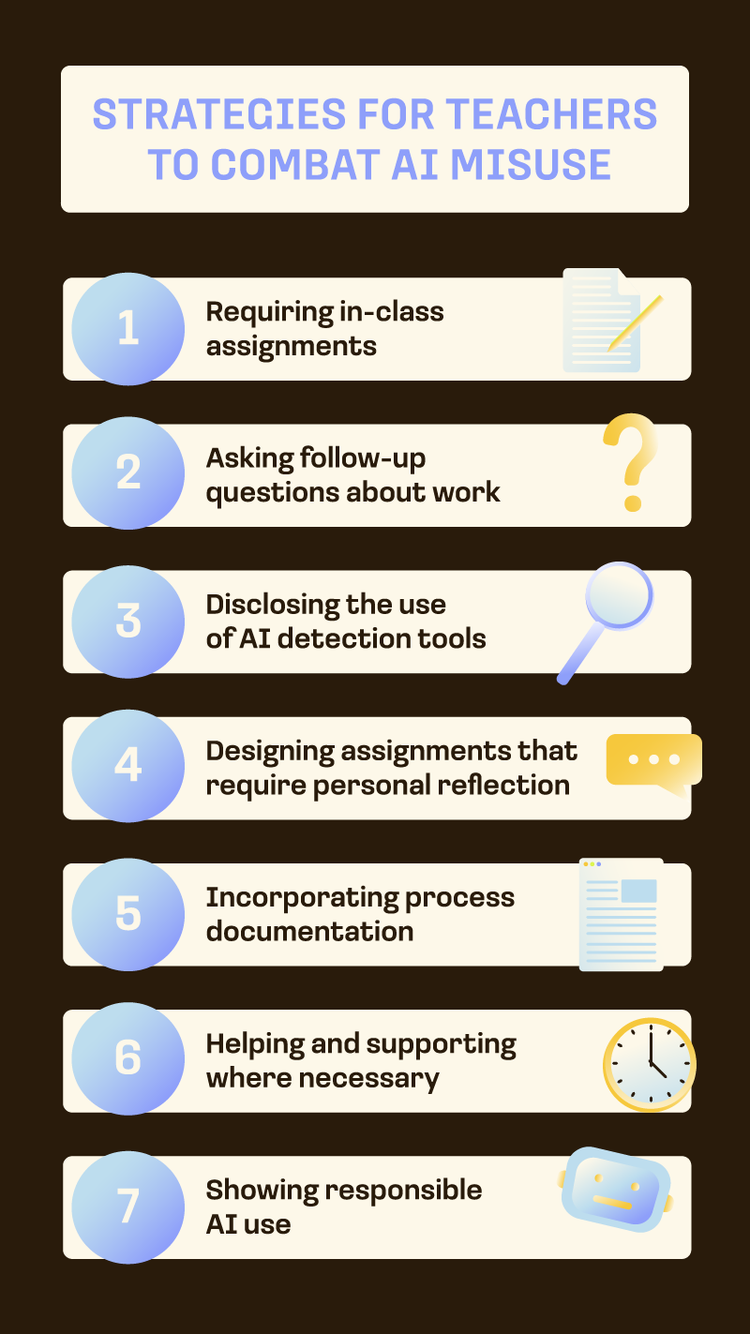
- Requiring in-class writing assignments establishes a baseline for each student's authentic voice and skill level. When teachers know what a student's genuine writing looks like, detecting anomalies becomes much easier. These supervised sessions also ensure students develop writing skills they will need beyond the classroom.
- Asking follow-up questions about submitted work tests genuine understanding. Teachers may request that students explain their thesis development, discuss sources they found most compelling, or describe challenges they encountered during the writing process. Students who truly engaged with their work can answer these questions naturally.
- Disclosing the use of AI detection tools creates transparency and serves as a deterrent. When students know their work will be screened, they must weigh the risks of AI misuse more carefully. This disclosure also opens conversations about academic integrity expectations.
- Designing assignments that require personal reflection makes AI assistance less effective. Prompts asking students to connect course material to their own experiences, analyze local examples, or respond to specific class discussions produce work that AI cannot easily replicate.
- Incorporating process documentation requires students to submit drafts, outlines, research notes, and revision histories alongside final submissions. This paper trail demonstrates genuine engagement and makes it difficult to substitute AI-generated content at the last minute.
- Being available for help and support reduces the temptation to take shortcuts. Students who feel overwhelmed or confused may turn to AI out of desperation. Teachers who offer office hours, respond to questions promptly, and create supportive learning environments give students better options.
- Teaching responsible AI use helps students understand appropriate applications. Rather than treating AI as entirely forbidden, educators can show students how to use these tools ethically for brainstorming, research, or editing while maintaining responsibility for original thinking and writing.
Common misconceptions about AI detection
As AI detection has become more prevalent, several misconceptions have emerged about how these tools work and what they can actually accomplish. Understanding these limitations helps both teachers and students approach AI detection with appropriate expectations.
AI detectors are not 100% accurate
Perhaps the most important misconception to address is the belief that AI detection tools provide definitive answers. In reality, these tools offer probability assessments rather than certainties, and their accuracy varies significantly.
False positives occur when detection software flags authentic student work as AI-generated. This can happen when students write in formal, academic styles or when they have strong command of standard English conventions. Non-native English speakers may be disproportionately affected, as their careful, deliberate writing sometimes triggers false positives.
False negatives happen when AI-generated content passes through detection unnoticed. As AI writing tools improve and as users learn to modify outputs, detection becomes more challenging. No tool catches every instance of AI use.
Detection accuracy varies considerably depending on the specific tool, the type of writing being analyzed, and how the AI content was produced or modified. Short passages present particular challenges, as do texts that blend human and AI writing.
For these reasons, responsible educators use detection tools as one component of a broader assessment approach rather than as definitive evidence. A high AI probability score prompts investigation and conversation, not automatic accusations.
Additional misconceptions
Several other misconceptions persist about AI detection and how can teachers detect AI-generated work:
Many students believe that making minor edits to AI-generated text will evade detection. In reality, sophisticated detection tools analyze underlying patterns in sentence structure, word choice, and statistical regularities that persist even after surface-level modifications. Simply changing a few words or rearranging sentences rarely disguises AI origins effectively.
Some assume that AI detection software represents the only way teachers check for AI. This overlooks the significant role of human judgment. Teachers who know their students well can often identify anomalies based on their understanding of each individual's writing patterns, knowledge level, and typical engagement style.
The belief that all AI detectors work identically leads to misunderstanding. Different tools use different algorithms, training data, and analytical approaches. A text that passes one detector may be flagged by another. This variation means that results from any single tool should be interpreted cautiously.
Finally, some students think that paraphrasing tools completely mask AI use. While these tools can modify surface text, sophisticated detection methods may still identify characteristic patterns. More importantly, teachers using multiple verification methods will likely notice other indicators of AI involvement.
Challenges in using AI in the classroom
The integration of AI into educational settings has created complex challenges for students, teachers, and institutions alike. Navigating this evolving landscape requires understanding the difficulties faced by all stakeholders.
Challenges for students
Students today face genuine uncertainty about what constitutes acceptable AI use. Policies vary dramatically between institutions, departments, and even individual instructors. What one teacher encourages, another may prohibit. This inconsistency creates confusion and anxiety for students trying to act ethically.
Competitive pressure compounds this challenge. When students suspect their peers are using AI to gain advantages, they may feel compelled to do the same simply to keep pace. This dynamic undermines the collaborative learning environment that education should foster.
The availability of AI shortcuts can make developing authentic skills more difficult. When a tool can generate passable work instantly, investing time and effort in genuine learning requires discipline and long-term thinking. Students must recognize that skills developed through struggle have lasting value that AI-assisted shortcuts cannot provide.
Learning to use generative AI tools for PDFs as productivity aids rather than thinking replacements represents a new skill itself. Students who master appropriate AI use will be better prepared for professional environments where these tools are common but where original thinking remains essential.
Additional challenges
Beyond individual students, AI presents systemic challenges for academic integrity that institutions continue to address. Understanding how can teachers tell if you use AI requires examining these broader concerns.
Technology evolves faster than policy. By the time institutions develop guidelines for one generation of AI tools, new capabilities emerge that raise fresh questions. This constant evolution makes comprehensive, lasting policies difficult to establish.
Enforcement remains inconsistent across institutions and even within them. Some schools invest heavily in detection infrastructure while others rely primarily on honor systems. This variation means that students transferring between institutions or taking courses from multiple departments may encounter vastly different expectations.
Ethical considerations around surveillance and trust complicate detection efforts. Subjecting all student work to AI screening can feel presumptively accusatory, potentially damaging the trust between teachers and students that supports effective learning.
Balancing innovation with academic standards requires ongoing negotiation. AI offers genuine benefits for learning, research, and productivity. Institutions must distinguish between uses that enhance education and those that undermine it. Tools that help students chat with PDF documents or generate summaries of lengthy materials can support legitimate learning when used appropriately.
Perhaps most significantly, educators must prepare students for workplaces where AI use is not only accepted but expected. Teaching students to use AI ethically and effectively may ultimately prove more valuable than simply prohibiting its use entirely.
Frequently asked questions
How can schools check if you use AI?
How do I prove I didn't use AI?
What website do teachers check for AI?
How does Canvas check for AI?
Can AI detection tools be wrong?
What happens if you're falsely accused of using AI?
Are there legitimate ways to use AI for schoolwork?
You may also like