How to cite a movie (APA, MLA, and Chicago)
Properly citing movies helps you credit directors, studios, and key details so readers can locate the exact film versions you reference in essays, reports, and research projects across disciplines.
How to cite a movie in various formats
Accurate movie citations form the backbone of credible academic writing. When you reference a film in an essay, research paper, or thesis, your readers need enough information to locate that exact source themselves. A missing director or incorrect release year can undermine your credibility and make it impossible for others to verify your claims.
Before you begin formatting your citation, gather these essential elements from the film:
- Director
- Producer
- Studio
- Year
- Format
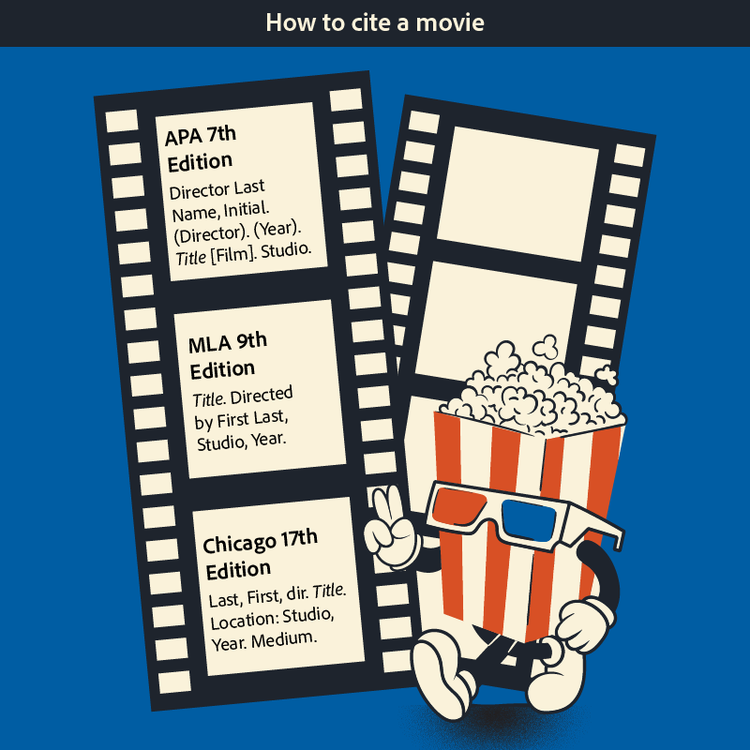
Each citation style arranges these elements differently and applies unique formatting rules. APA style emphasizes the release year early in the citation and uses parenthetical in-text references. MLA style leads with the title and provides flexibility for contributor emphasis. Chicago style offers detailed footnotes and bibliography entries that accommodate extensive film credits.
Understanding these differences helps you write a report or essay that meets your instructor's exact requirements. The comparison below shows how the same film appears in each major citation style, giving you a quick reference point before diving into the detailed formatting rules.
How to cite a movie in APA style
APA 7th edition treats films as audiovisual media, requiring you to identify the director as the primary contributor. This style works well for psychology, education, and social science papers where films often serve as case studies or cultural artifacts.
The basic format for a theatrical film follows this pattern: Director Last Name, First Initial. (Director). (Year). Title of film [Film]. Production Company.
Theatrical film example:
Gerwig, G. (Director). (2023). Barbie [Film]. Warner Bros. Pictures.
When citing a film you watched on a streaming platform, include the streaming service name and URL when available. This helps readers locate the exact version you referenced.
Streaming film example:
Coogler, R. (Director). (2018). Black Panther [Film]. Marvel Studios. https://www.disneyplus.com
Documentaries follow the same format, with the documentary director listed as the primary contributor.
Documentary example:
Guggenheim, D. (Director). (2006). An inconvenient truth [Documentary]. Paramount Classics.
For in-text citations, APA uses a parenthetical format with the director's last name and year: (Gerwig, 2023). When discussing the film in a sentence, write: Gerwig (2023) explores themes of identity and consumerism in Barbie.
When you need to cite a movie multiple times throughout your paper, maintain consistency with the same citation format. APA style also allows you to include timestamps for referencing specific scenes or quoting dialogue.
How to cite a movie in MLA style
MLA 9th edition prioritizes flexibility, allowing you to emphasize different contributors based on your analytical focus. For most film citations, the title comes first, but you can lead with a director, actor, or screenwriter if their work is central to your argument.
The standard format places the title first: Title of Film. Directed by First Name Last Name, Production Company, Year.
Theatrical film example:
Everything Everywhere All at Once. Directed by Daniel Kwan and Daniel Scheinert, A24, 2022.
For streaming films, MLA recommends including the platform name as the version or location element.
Streaming film example:
The Power of the Dog. Directed by Jane Campion, Netflix, 2021. Netflix.
When citing a documentary, follow the same format with the documentary director credited after the title.
Documentary example:
13th. Directed by Ava DuVernay, Kandoo Films, 2016.
MLA in-text citations use the first major element of your works cited entry in parentheses. For title-first entries, use a shortened version of the title in italics: (Everything Everywhere). When discussing the film directly: The Daniels' Everything Everywhere All at Once demonstrates innovative visual storytelling techniques.
If you emphasized a specific contributor by placing their name first in your works cited entry, use their last name for in-text citations: (Campion). This flexibility makes MLA particularly useful when your analysis focuses on a specific filmmaker's body of work or a particular actor's performance across multiple films.
How to cite a movie in Chicago style
Chicago 17th edition uses the Notes-Bibliography system for humanities papers, providing detailed footnotes or endnotes alongside a comprehensive bibliography. This style accommodates extensive film credits and works well for film studies, history, and literature courses.
In the Notes-Bibliography system, a film is commonly cited in a footnote as: Last, First, dir. Title. Location: Studio, Year. Medium.
Theatrical film example:
Nolan, Christopher, dir. Oppenheimer. Universal City, CA: Universal Pictures, 2023. Film.
For films accessed through a streaming service, include the platform after the publication information when it is the medium through which the film was viewed.
Streaming film example:
Johnson, Rian, dir. Glass Onion: A Knives Out Mystery. Los Gatos, CA: Netflix, 2022. Streaming video.
Documentary example:
Vasarhelyi, Elizabeth Chai, and Jimmy Chin, dirs. Free Solo. Washington, DC: National Geographic Documentary Films, 2018. Documentary film.
Chicago footnotes generally provide a full citation the first time a source is referenced. Subsequent notes may use a shortened form consisting of the film title and, if needed, a page number or timestamp. For example: Nolan, Christopher, dir. Oppenheimer. Universal City, CA: Universal Pictures, 2023. Film.
Later note: Oppenheimer.
When discussing a film in the text, Chicago style generally favors integrating the title into the sentence rather than using parenthetical citations. For example: Christopher Nolan’s Oppenheimer explores the scientific, political, and ethical complexities surrounding the development of the atomic bomb. This approach allows the prose to remain readable while providing complete source information in the notes and bibliography.
How to cite a film in special cases
Not every film fits neatly into standard citation templates. When you encounter particular types of movies in your research, you may need to modify your approach to ensure accuracy and clarity in your citations.
1. Foreign language films
When citing a foreign language film, include both the original title and the English translation when relevant to your audience. Place the translated title in brackets after the original.
In APA:
Bong, J. (Director). (2019). Gisaengchung [Parasite] [Film]. Barunson E&A.
In MLA:
Parasite [Gisaengchung]. Directed by Bong Joon-ho, Barunson E&A, 2019.
In Chicago:
Bong, Joon-ho, dir. Gisaengchung [Parasite]. Seoul: Barunson E&A, 2019. Film.
2. Short films
Short films follow the same basic format as feature films but may include running time when relevant to your discussion. Some instructors require this information to distinguish shorts from features.
In APA:
Anderson, W. (Director). (2023). The Wonderful Story of Henry Sugar [Short film]. Netflix.
In MLA:
The Wonderful Story of Henry Sugar. Directed by Wes Anderson, Netflix, 2023.
In Chicago:
Anderson, Wes, dir. The Wonderful Story of Henry Sugar. Netflix, 2023. Short film.
3. TV series episodes
Individual episodes require both episode and series information. Include the season and episode numbers along with the episode title.
In APA:
Mylod, M. (Director). (2023). With open eyes (Season 4, Episode 10) [TV series episode]. In J. Armstrong (Executive Producer), Succession. HBO.
In MLA:
"With Open Eyes." Succession, created by Jesse Armstrong, season 4, episode 10, HBO, 2023.
In Chicago:
"With Open Eyes." Succession, season 4, episode 10. Directed by Mark Mylod. Aired May 28, 2023, on HBO.
How to generate a movie citation with AI
Modern artificial intelligence tools can help you generate accurate citations quickly, reducing the time spent on formatting while minimizing errors. Here's how to use AI effectively for your film citations:
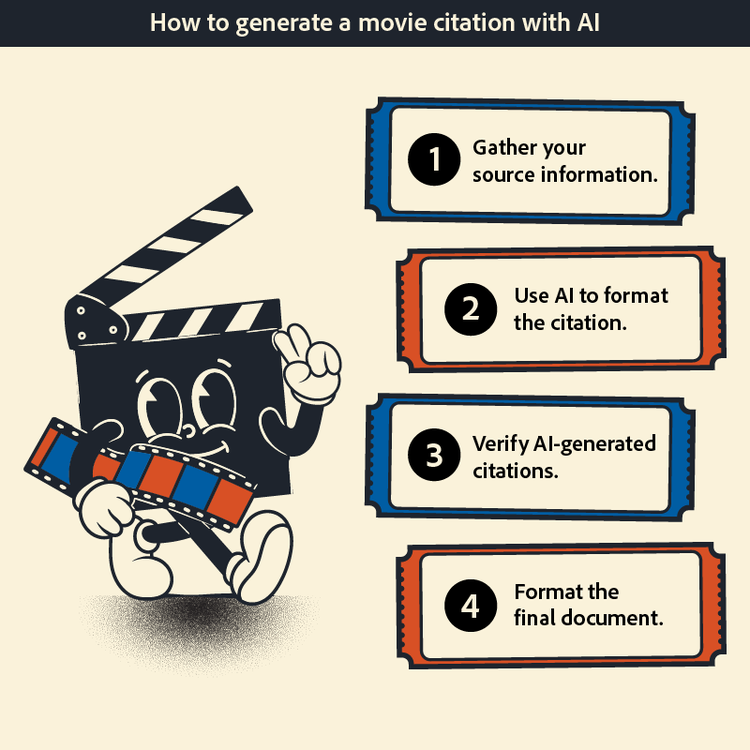
1. Gather your source information first. Before asking an AI tool for help, collect the film's director, title, production company, release year, and viewing format. Having accurate source details ensures the AI generates a correct citation rather than fabricating information.
2. Use AI to format your citation. Upload your research document and chat with your PDF to request properly formatted citations. Specify your required style (APA, MLA, or Chicago) and provide the film details you gathered.
3. Verify AI-generated citations. Always double-check AI output against the official style guide rules. AI tools occasionally make formatting errors, hallucinate, or use outdated style editions, so verification protects your academic integrity.
Frequently asked questions
How do you cite a movie in writing?
How do I quote dialogue from a movie?
Do I need to include the film's runtime in my citation?
Should I italicize movie titles in my citations?
How do I cite a movie with multiple directors?
Can I cite a movie that was released in theaters and later on streaming?
You may also like