How to paraphrase a quote
Learn how to paraphrase a quote, understanding its meaning and rewriting in your own words.

How to paraphrase a quote.
Paraphrasing a quote requires more than just rewording, it’s about capturing the original speaker’s intent while expressing it in your own voice. Whether you're writing an article, academic paper, or marketing content, knowing how to paraphrase quotes correctly helps you maintain credibility, avoid plagiarism, and adapt language for clarity or tone. Unlike quoting, which uses the author's exact words, paraphrasing involves a complete and nuanced rewrite of those specific words.
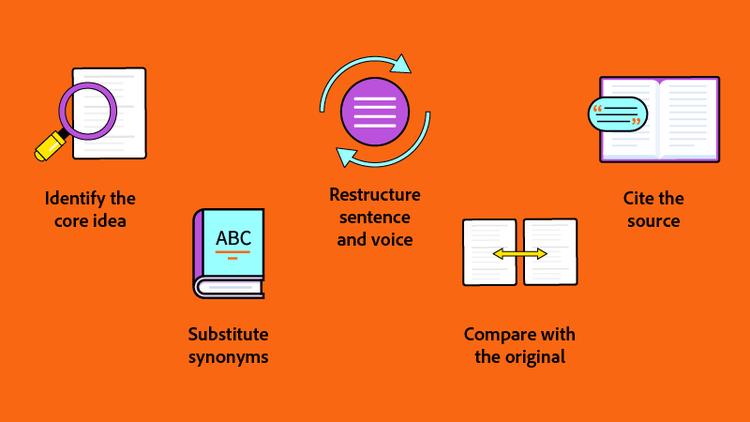
To paraphrase effectively and ethically, you need a systematic approach. Following these steps ensures your paraphrase is both accurate and original, allowing you to integrate the source's ideas seamlessly into your own writing. Let's walk through the process with an example.
Original Quote: "The rapid advancement of artificial intelligence in the last decade has fundamentally transformed the digital marketing landscape, forcing businesses to adapt to algorithm-driven strategies."
- Identify the core idea of the original quote. Read the quote several times until you fully grasp its central message. You cannot rephrase something accurately if you don't understand what it's trying to say. Pinpoint the main subject, the action, and any important supporting details. In our example, the core idea is that rapid AI growth has changed digital marketing, requiring businesses to adopt new strategies.
- Substitute synonyms. Once you understand the idea, start replacing keywords with synonyms that fit the context. Be careful not to change the core meaning; the goal is to restate, not reinterpret.
- Rapid advancement could become swift development or quick progress.
- Fundamentally transformed could be drastically altered or completely reshaped.
- Forcing businesses to adapt could be making it necessary for companies to change.
- Restructure sentence and voice. This is the most important step for avoiding patchwriting, where you only swap out a few words. Change the sentence structure entirely. The original sentence starts with the cause (AI advancement). You could start with the effect (digital marketing).
First draft attempt: "The swift development of AI has drastically altered digital marketing, making it necessary for companies to change to algorithm-driven strategies." This is a good start, but the structure is still too similar to the original. - Compare with the original quote. Place your paraphrase next to the original quote. Your version should convey the same information but sound completely different. Let's refine our attempt by changing the structure more significantly.
Revised paraphrased quote: "Digital marketing has been completely reshaped over the past ten years due to the quick progress of artificial intelligence, which has compelled companies to adopt strategies centered on algorithms." This version changes the subject of the sentence and uses different phrasing, making it more original. - Cite the source. Even though you are using your own words, the idea still belongs to the original author. Always include a proper citation according to the style guide you are following, such as Harvard, APA, or MLA. This typically includes the author's last name and the year of publication. For example: (Smith, 2023).
How to quote.
While paraphrasing is a versatile skill, there are times when using a direct quote is more effective or even necessary. A direct quote uses the author's exact words, enclosed in quotation marks. Knowing when to quote instead of paraphrase is key to producing strong, credible writing.
When you should quote instead of paraphrase.
Certain situations call for the precision of a direct quote. You should quote when the author's wording is so powerful, memorable, or succinct that paraphrasing would diminish its impact. This is often true for famous speeches or beautifully crafted literary passages. Direct quotes are also essential when you plan to analyze an author's specific word choice or rhetorical strategy.
You should also quote when dealing with authoritative wording that cannot be altered without changing its meaning, such as legal statutes, technical definitions, or scientific principles. Statistical data is another instance where a direct quote ensures you represent the information with complete accuracy. Using an AI summary generator tool can help you quickly locate and extract these exact phrases from your source documents, ensuring precision.
Formatting and citation basics.
Proper formatting is crucial when you quote. For short, inline quotes (typically fewer than 40 words or four lines of prose), you simply enclose the author's words in quotation marks and integrate them into your sentence. For longer passages, you should use a block quotation, which is indented from the main text and does not use quotation marks.
Punctuation placement with quotation marks can be confusing, but the general rule in American English is that periods and commas go inside the closing quotation mark. An in-text citation should immediately follow the quote, providing the reader with the source information, including a page number or other locator.
If you need to omit a part of a quote for brevity, use an ellipsis (...). If you need to add a word for clarification, place it within square brackets []. These conventions allow you to tailor quotes to fit your grammatical structure while maintaining academic honesty.
Tools for accurate quoting.
To ensure your quotes are perfectly accurate, you need to copy the text from your source document cleanly. If you're working with a scanned document or a restrictive PDF, this can sometimes be a challenge. Using a reliable PDF to Word converter can help you extract text without introducing formatting errors, making the process of quoting much more efficient and precise.
Differences between paraphrasing, summarizing and quoting.
Understanding the distinct roles of paraphrasing, summarizing, and quoting allows you to use sources more effectively. While all three are methods for incorporating external information into your work, they serve different purposes and are used in different contexts. A paraphrase tool can also help to diversify your writing.

- Quoting — Use the exact words of a source for impact or precision; same length as original; requires quotation marks plus citation (author, year, page).
- Paraphrasing — Restate a specific passage in your own words; roughly same length; citation (author, year).
- Summarizing — Condense the main ideas of a longer work; significantly shorter; citation (author, year).
The best approach depends on your goal and the context of your writing. Understanding when and why to choose each technique is a hallmark of a skilled writer.
In academic writing, your choice will depend heavily on your purpose. When writing a literature review, you will primarily paraphrase and summarize to synthesize the findings of multiple researchers. When conducting a close reading or textual analysis of a literary work or a historical document, you will use direct quotes to support your argument with concrete evidence from the text.
In business communications, clarity and conciseness are key. Summarizing a lengthy report is essential for an executive overview that busy stakeholders can digest quickly. You might paraphrase a competitor's mission statement or a market analysis report to integrate key information into a strategic plan without getting bogged down in external jargon. Direct quotes are used more sparingly, perhaps to highlight a powerful customer testimonial or a key legal point in a contract.
Even in creative writing, these techniques have their place. A historical fiction writer might paraphrase a historical account to build a realistic scene, while a non-fiction author might quote a primary source to lend a sense of immediacy and authenticity to their narrative. Having the flexibility to move between different source formats is key. A good online PDF converter ensures you can work with any document, no matter its original format.
Frequently asked questions.
Keep exploring.
https://main--dc--adobecom.hlx.live/dc-shared/fragments/seo-articles/seo-caas-collection
https://main--dc--adobecom.aem.live/dc-shared/fragments/seo-articles/acrobat-color-blade