What is paraphrasing?
Paraphrasing is a crucial skill for students, writers, and professionals who need to present information in their own words.

In a world where information is abundant, the ability to express ideas in your own voice is more valuable than ever. According to a study on academic integrity, a significant percentage of students struggle with properly citing and integrating sources, often leading to unintentional plagiarism. This highlights a critical need for understanding not just what paraphrasing is, but how to do it correctly. Knowing how to paraphrase effectively or how to use a paraphrase tool is essential for academic success, professional communication, and creating original content that respects intellectual property.
This article will provide a comprehensive overview of paraphrasing. We will define what paraphrasing means, explore its benefits, and differentiate it from quoting and summarizing. You will also find a step-by-step guide on how to paraphrase correctly, complete with practical examples to illustrate the process.
What is paraphrasing?
At its core, paraphrasing is the art of restating someone else's ideas or information in your own words without changing the original meaning. Understanding the paraphrasing meaning involves more than just swapping out a few words; it requires a deep understanding of the source material to accurately convey its message using a different sentence structure and vocabulary. The goal of paraphrasing is to integrate a source's information seamlessly into your own work, demonstrating that you have understood and processed the information.
People paraphrase for several reasons. The most common reason is to avoid plagiarism, which is the act of using someone else's work without proper attribution. By paraphrasing, you can use information from other sources while still presenting it in your own unique voice. Paraphrasing also helps improve the clarity and flow of your writing. Instead of inserting a direct quote that might disrupt the narrative, a well-paraphrased sentence can fit more naturally into your text. Furthermore, paraphrasing allows you to adapt the tone of the original material to better suit your audience. For instance, you might simplify complex technical jargon for a general audience or adopt a more formal tone for an academic paper. A paraphrasing tool can assist in this process, but it's crucial to understand the fundamentals to ensure accuracy and originality.
Benefits of effective paraphrasing
Mastering the skill of paraphrasing offers numerous benefits beyond simply avoiding plagiarism. Effective paraphrasing demonstrates a thorough understanding of the source material. To paraphrase correctly, you must first comprehend the original author's message, which deepens your own knowledge of the topic. This process of active engagement with the text helps you to think critically about the information and how it fits into your own argument.
Additionally, paraphrasing enhances your writing style. By translating complex ideas into your own words, you develop a more versatile vocabulary and a stronger command of sentence structure. This practice allows you to maintain a consistent tone and voice throughout your work, making it more readable and engaging for your audience. It also allows for smoother transitions between your own ideas and the information you are citing, creating a more cohesive and persuasive piece of writing.

How to paraphrase correctly
Paraphrasing is a skill that requires practice and attention to detail. Following a structured process can help ensure you learn how to paraphrase correctly and ethically. Here are seven steps to guide you through the process:
- Read the original passage carefully. Before you can paraphrase, you must fully understand the source material. This means more than just skimming the words. Read the passage several times to grasp its main idea, supporting points, and any nuances in its meaning or tone. It can be helpful to read it aloud to slow yourself down and process the information more deeply. Look up any unfamiliar words or concepts to ensure you have a complete and accurate understanding before you proceed.
- Take notes and identify key concepts. As you read, actively engage with the text by jotting down the main points and key terms. This is not about copying sentences, but about extracting the essence of the author's message. Think about what the author is trying to achieve with the passage. Is it to inform, persuade, or explain? Identifying the core argument and the supporting evidence is a crucial step. This will become the foundation of your paraphrasing.
- Set the original text aside. This is a critical step to ensure your paraphrase is truly in your own words. Once you feel confident in your understanding of the passage, put the source material completely out of sight. This action creates a mental separation and prevents you from being overly influenced by the author's specific language and sentence construction. This forces you to rely on your comprehension and your notes, which is the key to generating original phrasing.
- Write your own version of the passage. Using only your notes, write out the idea in your own words. Don't worry about getting it perfect on the first try. The goal is to articulate the concept from your perspective. Focus on conveying the meaning accurately, but experiment with different ways to structure the sentences. Try explaining the concept as if you were talking to a friend or colleague who is unfamiliar with the topic. This can help you find a more natural and authentic voice.
- Compare your paraphrase with the original. After you have your draft, it's time to bring back the original text for a side-by-side comparison. This is your quality control step. First, check for accuracy: have you maintained the original meaning without adding your own opinions or distorting the author's intent? Second, check for originality: look for any phrases, sentences, or even unique words that are too similar to the original. If you find sections where your wording is too close to the source, you'll need to revise them.
- Use synonyms and change sentence structure. While paraphrasing is more than just swapping out words, using synonyms thoughtfully is part of the process. A thesaurus can be a useful tool, but always consider the context. A word might have a similar dictionary definition but a different connotation. In addition to changing words, you must also alter the sentence structure. If the original uses a long, complex sentence, try breaking it into two shorter ones. If it uses a simple sentence, try combining it with another idea to create a more complex one.
- Cite your source. Every time you paraphrase or summarize information from another source, you must include a citation. This is a fundamental rule of academic and professional integrity. A citation gives credit to the original author for their work and provides a path for your readers to find the source material themselves. The specific format of the citation will depend on the style guide you are following, such as APA (American Psychological Association), MLA (Modern Language Association), or Chicago. You should learn how to cite an article, as failure to cite your source is considered plagiarism, even if you have paraphrased the content perfectly.
Tips for paraphrasing
For complex documents, you can chat with your PDF to quickly verify your comprehension of the source material before paraphrasing. After drafting, you can use an editor to edit your PDF online and make any necessary adjustments to ensure your final document is polished. These tools are available across various platforms, including Windows, Mac, and mobile devices, making them accessible wherever you work.
Common paraphrasing mistakes to avoid
Even with the best intentions, it's easy to make mistakes when paraphrasing. One common error is the "thesaurus game," where you simply substitute a few words with synonyms without changing the sentence structure. This is often considered a form of plagiarism. Another mistake is failing to understand the original text fully, which can lead to an inaccurate or distorted paraphrase.
It's also crucial to avoid mixing your own ideas with the author's. A paraphrase should only reflect the source's message. Your analysis or commentary should be separate. Finally, forgetting to cite the source is a major academic and ethical violation. Always double-check that every paraphrased section is properly attributed.
Paraphrasing for different audiences and tones
The way you paraphrase can change depending on who you're writing for. If you're paraphrasing a dense academic article for a general audience, you'll need to simplify complex terminology and break down intricate ideas into more digestible concepts. Your goal is to make the information accessible without sacrificing accuracy.
Conversely, if you're writing for an expert audience, you can use more technical language. The tone can also be adapted. You might take a formal, objective passage and paraphrase it with a more persuasive or narrative tone to fit the context of your own work. The key is to remain faithful to the original meaning while shaping the language to meet the needs of your audience and your writing style.
Examples of paraphrasing
Seeing paraphrasing in action can help clarify the concept. Here are a few examples that demonstrate how to restate a passage in different ways while preserving its original meaning.
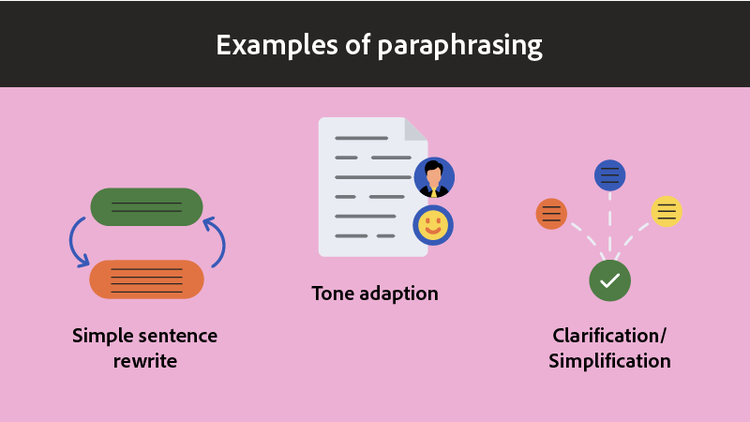
Simple sentence rewrite
Original: "The rapid advancement of artificial intelligence has led to significant disruptions across numerous industries, forcing companies to adapt to new technological paradigms."
Paraphrased: Companies in many sectors have been compelled to adjust to new technological models due to the substantial impact of fast-developing artificial intelligence.
In this example, the sentence structure has been altered, and synonyms like "fast-developing" for "rapid advancement" and "compelled to adjust" for "forcing companies to adapt" have been used. The core message remains the same.
Tone adaptation example
Original: "The study's findings indicate a statistically significant correlation between regular exercise and improved cognitive function in elderly participants."
Paraphrased for a blog post: Want to keep your mind sharp as you age? A recent study found a strong link between working out regularly and better brain health in older adults.
Here, the formal and technical tone of the original has been transformed into a more conversational and engaging one suitable for a general audience, using phrases like "keep your mind sharp" and "working out."
Clarification / simplification example
Original: "The pedagogical approach of constructivism posits that learners actively construct their own knowledge and meaning from their experiences, rather than passively receiving information."
Paraphrased for students: The theory of constructivism suggests that you learn best by doing. Instead of just listening to a teacher, you build your own understanding of a topic through hands-on experiences.
This paraphrase simplifies the academic jargon ("pedagogical approach," "posits") into more accessible language ("theory suggests," "learn best by doing") to clarify the concept for a non-expert audience. To practice these techniques, you can convert your PDF to Word to work with an easily editable file.
Frequently asked questions.
You may also like
https://main--dc--adobecom.aem.live/dc-shared/fragments/seo-articles/seo-caas-collection
https://main--dc--adobecom.aem.live/dc-shared/fragments/seo-articles/acrobat-color-blade