REFERENCE MANAGEMENT
How to cite an article in the right way.
Simplify citations and avoid accidental plagiarism with foolproof techniques and intuitive digital tools.
How to cite an article in an essay
Writing an essay means weaving outside research into your own analysis. That involves two distinct types of citations.
1. In-text citation vs. works-cited entry.
An in-text citation sits inside the body of your essay and acts like a signpost — usually author last name and page number or publication year — pointing the reader to a full reference later on. A works-cited entry appears at the end of your paper and includes every detail a reader needs to find the original source. For citing a PDF, consult Adobe’s cite a PDF guide.
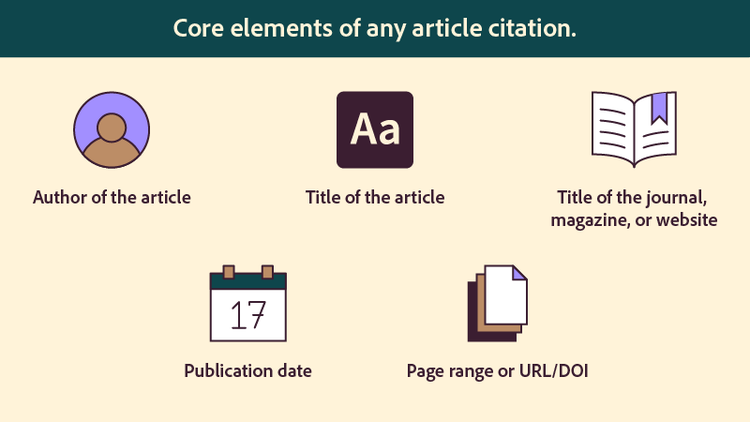
2. Core elements of any article citation.
Regardless of style guide, most article references share the same building blocks:
- Author (individual or corporate)
- Title of the article
- Title of the journal, magazine, or website
- Publication date (year, month, day as required)
- Page range (for print) or uniform resource locator (URL)/DOI (for digital)
Keeping those elements handy makes it easier to slot information into any citation template.
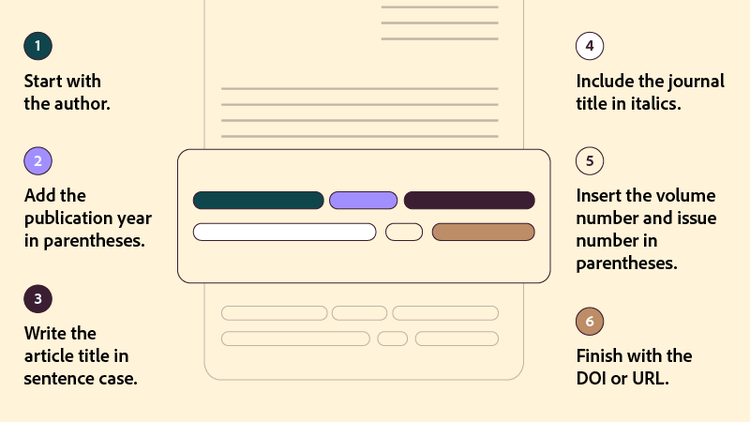
Follow these steps to assemble a complete reference list entry.
- Start with the author. List the last name first, followed by a comma and initials (e.g., "Smith, J.")
- Add the publication year in parentheses. Place a period after it.
- Write the article title in sentence case. Only capitalize the first word and any proper nouns.
- Include the journal title in italics. Capitalize all major words.
- Insert the volume number and issue number in parentheses, then a comma and the page range.
- Finish with the DOI or URL. Remove live hyperlinks if your style guide requires plain text — then polish the final reference using an online PDF editor.
How to cite an article APA style
The American Psychological Association (APA) 7th Edition style is common in social sciences. It uses an author-date in-text system and a reference list with hanging indents.
APA basics.
- Author-date in-text citations:
(Smith, 2023) - Title in sentence case: "Understanding social networks"
- Journal title and volume in italics: Journal of Media Studies, 14
- Hanging indent of 0.5 inches on reference list entries
For formatting help, try Adobe's AI flashcard maker.
Print journal article example.
Smith, J. (2023). Understanding social networks. Journal of Media Studies, 14(2), 112-130.
Online journal article example.
Lee, K. (2022). Digital literacy in remote classrooms. Education Technology Today, 9(1), 45-59. https://doi.org/10.1234/ett.2022.789
Articles with no author.
When no author is listed, move the article title to the author position: Digital privacy concerns rise. (2022)…
How to cite an article MLA style
Modern Language Association (MLA) 9th Edition rules dominate humanities papers. The style uses author-page in-text citations and a "Works Cited" list.
MLA basics.
- Author-page in-text citations:
(Smith 112) - Title capitalisation: Title Case for both article and journal
- Container system: Journal title, volume, number, year, pages
- Access date required for online sources
Need practice? Generate drills with the AI quiz generator.
Print article example.
Smith, John. "Understanding Social Networks." Journal of Media Studies, vol. 14, no. 2, 2023, pp. 112-130.
Online article example.
Lee, Karin. "Digital Literacy in Remote Classrooms." Education Technology Today, vol. 9, no. 1, 2022, pp. 45-59. Education Technology Today, https://doi.org/10.1234/ett.2022.789. Accessed 10 Jan. 2024.
How to cite an online article.
Digital publishing introduces extra variables: web-exclusive content, version updates, and missing page numbers. Here is how to stay accurate.
Distinguishing online-only articles vs. scanned PDFs.
Online-only content appears as HTML pages without stable page numbers, while scanned PDFs replicate a print layout. Identify the format early to determine whether you need a uniform resource locator (URL), a DOI, or page numbers.
Including URLs, DOIs, and access dates.
Most style guides now prefer a digital object identifier (DOI) because it does not change over time. If no DOI exists, paste the full, stable URL. For MLA citations, add an Accessed date after the URL.
When author information is missing.
If an article lists no author, both APA and MLA move the title to the author position. In-text citations shorten the title to the first few words.
Quoting article titles in text.
Use quotation marks around the title and follow your style's capitalisation rules. Example: In "Understanding Social Networks," Smith argues…
When you need to know how to cite a quote from an article, follow the same author-date or author-page conventions outlined above.
Frequently asked questions.
You may also like
https://main--dc--adobecom.hlx.live/dc-shared/fragments/seo-articles/seo-caas-collection
https://main--dc--adobecom.aem.live/dc-shared/fragments/seo-articles/acrobat-color-blade