PSAT study guide: How to study for the PSAT with AI tools
A strong PSAT study guide combines structured preparation with AI-powered tools.

What is the PSAT?
The Preliminary SAT/National Merit Scholarship Qualifying Test (PSAT/NMSQT) serves as both a practice run for the SAT and a gateway to significant scholarship opportunities. Administered by the College Board, this standardized test measures your readiness for college-level work while giving you valuable experience with the SAT format.
The PSAT is now delivered in a digital format and consists of two main sections. The Reading and Writing section tests your ability to comprehend passages, analyze arguments, and apply grammar and usage rules. The Math section covers algebra, problem-solving, data analysis, and advanced mathematical concepts. The entire test takes approximately two hours and fourteen minutes to complete.
Scores on the PSAT range from 320 to 1520, with each section scored on a scale of 160 to 760. Your score report provides detailed insights into your performance, breaking down results by specific skill areas so you can identify exactly where to focus your future study efforts.
Students typically take the PSAT in the fall of their sophomore or junior year. While sophomores can use the test primarily for practice, juniors have the additional opportunity to qualify for the National Merit Scholarship Program. According to the National Merit Scholarship Corporation, approximately 50,000 students earn recognition through this program each year, with about 7,500 receiving scholarships. Beyond scholarship opportunities, the PSAT offers several compelling benefits. It provides authentic practice with the same question types and format you'll encounter on the SAT. The detailed score report helps you identify academic strengths and weaknesses, allowing you to learn how to study for a test efficiently, with strategies tailored to your specific needs. Additionally, taking the PSAT connects you with colleges through the Student Search Service, which can lead to information about programs and scholarships you might not otherwise discover.
Understanding the structure and purpose of the PSAT is essential for creating an effective study plan. When you know what the test measures and why it matters, you can approach your preparation with clear goals and focused intentions. This foundational knowledge sets the stage for the specific study techniques that will help you maximize your score.
How to study for the PSAT
Effective PSAT preparation requires more than just reading through a prep book once. The most successful students combine multiple study methods, creating a comprehensive approach that addresses content knowledge, test-taking strategies, and time management skills. By understanding how to make a study guide for the PSAT using a variety of techniques, you can maximize your score improvement while making efficient use of your study time.
Learning how to study for PSAT success means recognizing that different approaches work better for different aspects of the test. Content review requires different strategies than building test-taking stamina, and both require different approaches than developing time management skills. A well-rounded PSAT study plan incorporates methods that address each of these areas.
The following four approaches work together to create a well-rounded preparation plan. Each method reinforces the others, helping you build both the knowledge and confidence you need for test day.
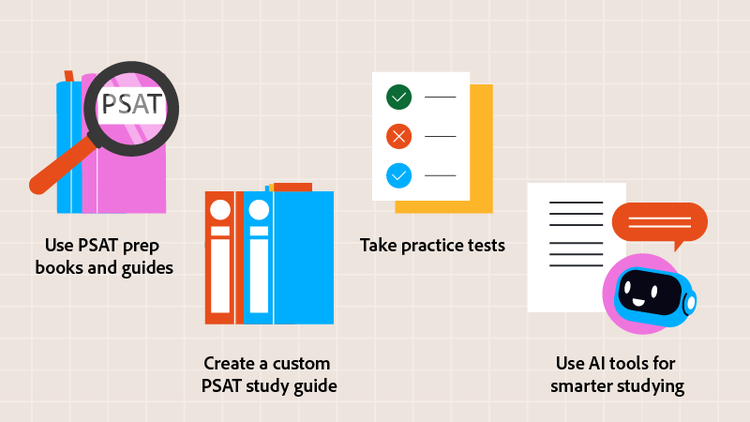
1. Use PSAT prep books and guides
Official College Board materials should form the foundation of your PSAT study guide. These resources contain authentic practice questions written by the same people who create the actual test, ensuring you're practicing with the most accurate representations of what you'll encounter.
When selecting additional prep books, look for publishers with strong reputations in test preparation. Quality guides include detailed explanations for every answer choice, not just the correct ones. Understanding why wrong answers are wrong helps you recognize similar traps on the actual test.
Work through prep materials systematically rather than jumping around randomly. Start with a diagnostic test to identify your baseline, then focus your efforts on the sections where you have the most room for improvement. Apply proven study methods like spaced repetition and active recall to reinforce what you learn from these materials.
Consider organizing your prep books by section and difficulty level. Begin with foundational concepts before moving to more challenging material. Mark questions you find difficult so you can return to similar problem types during review sessions. This systematic approach ensures you build skills progressively rather than overwhelming yourself with advanced content before mastering the basics.
2. Create a custom PSAT study guide
While commercial prep books provide valuable content, creating your own personalized study materials can significantly enhance retention. A custom study guide allows you to focus specifically on the concepts and question types that challenge you most. Here are a few tips for creating your study guide:
- Organize your notes by test section, dedicating separate areas to Reading, Writing, and Math content. Within each section, create subsections for specific skills. For example, your Writing section might include notes on subject-verb agreement, pronoun clarity, and punctuation rules.
- Use a consistent format that makes information easy to review quickly. Include example questions alongside the concepts they test and write brief explanations in your own words. When you create a study guide that reflects your personal learning style, you're more likely to engage with the material actively.
- Convert Word to PDF documents to keep your materials organized and accessible across devices. This ensures your study guides maintain their formatting whether you're reviewing on your laptop, tablet, or phone.
- Update your materials. Your custom study guide should evolve as you progress through your preparation. Add new information as you encounter it, update sections when you discover better explanations, and remove content you've thoroughly mastered. This living document becomes increasingly valuable as test day approaches.
3. Take practice tests
Nothing prepares you for test day quite like simulating the actual experience. Taking full-length practice tests under realistic conditions builds stamina, improves time management, and reduces anxiety by making the format familiar.
Set up your practice environment to mirror test conditions as closely as possible. Use the same time limits, take the same breaks, and work in a quiet space free from distractions. Avoid the temptation to check your phone or look up answers while testing.
After completing each practice test, spend significant time analyzing your results. Look for patterns in your mistakes. Are you consistently missing certain question types? Running out of time on specific sections? Making careless errors toward the end when fatigue sets in? These insights guide your subsequent study sessions.
Aim to take a full practice test every one to two weeks during your preparation period. Between tests, focus your study sessions on addressing the weaknesses your practice tests reveal. This cycle of testing and targeted practice creates continuous improvement throughout your preparation period.
Track your practice test scores over time to monitor your progress. Seeing improvement can boost motivation, while identifying plateaus helps you recognize when you need to adjust your study approach. Many students find that their scores improve most dramatically in the first few weeks, then more gradually as they approach their target score.
4. Use AI tools for smarter studying
Artificial intelligence has revolutionized how students prepare for standardized tests. AI tools for students can accelerate learning, personalize practice, and provide instant feedback that would otherwise require a tutor.
Modern AI study tools offer capabilities that enhance every aspect of PSAT preparation. These technologies can transform your study sessions from passive review into active, engaging learning experiences. Here are a few examples:
- Quiz generation features create unlimited practice questions tailored to specific sections and difficulty levels. When you need extra work on quadratic equations or evidence-based reading questions, an AI quiz generator can produce targeted practice in seconds. Unlike static prep books, AI-generated quizzes provide fresh questions each time, preventing you from simply memorizing answers rather than understanding concepts.
- Weakness analysis capabilities help you understand patterns in your performance. By analyzing your practice test results and quiz responses, AI can pinpoint specific weaknesses and recommend focused study sessions. This data-driven approach ensures you spend time on the areas that will most improve your score rather than reviewing material you've already mastered.
- Summarizing prep materials becomes effortless with AI assistance. For efficient review of lengthy prep materials, generative AI for studying can summarize key concepts and extract the most important information. Instead of rereading entire chapters, you can quickly review AI-generated summaries that highlight essential content. When working with complex passages or detailed explanations, you can chat with PDF documents to get instant clarification and deeper analysis.
- Flashcard creation transforms vocabulary building from tedious memorization into efficient learning. An AI flashcard maker automatically creates cards from your study materials, complete with context sentences and usage examples. These flashcards help you understand words in the ways they appear on the test, not just as isolated definitions.
The combination of these AI capabilities creates a personalized learning experience that adapts to your specific needs. As you progress through your PSAT study plan, AI tools continuously adjust to focus on your evolving weak points, ensuring your study time remains maximally efficient.
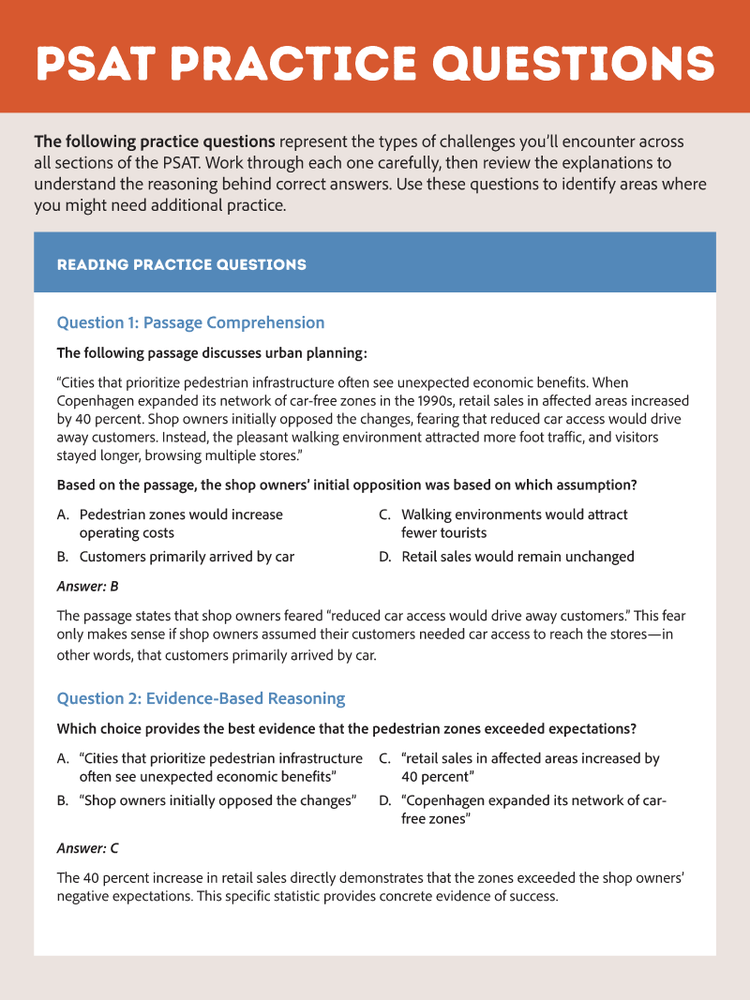
PSAT study guide practice questions
The following practice questions represent the types of challenges you'll encounter across all sections of the PSAT. Work through each one carefully, then review the explanations to understand the reasoning behind correct answers. Use these questions to identify areas where you might need additional practice.
Reading practice questions
Question 1: Passage Comprehension
The following passage discusses urban planning:
"Cities that prioritize pedestrian infrastructure often see unexpected economic benefits. When Copenhagen expanded its network of car-free zones in the 1990s, retail sales in affected areas increased by 40 percent. Shop owners initially opposed the changes, fearing that reduced car access would drive away customers. Instead, the pleasant walking environment attracted more foot traffic, and visitors stayed longer, browsing multiple stores."
Based on the passage, the shop owners' initial opposition was based on which assumption?
A) Pedestrian zones would increase operating costs B) Customers primarily arrived by car C) Walking environments would attract fewer tourists D) Retail sales would remain unchanged
Answer: B
The passage states that shop owners feared "reduced car access would drive away customers." This fear only makes sense if shop owners assumed their customers needed car access to reach the stores—in other words, that customers primarily arrived by car.
Question 2: Evidence-Based Reasoning
Which choice provides the best evidence that the pedestrian zones exceeded expectations?
A) "Cities that prioritize pedestrian infrastructure often see unexpected economic benefits" B) "Shop owners initially opposed the changes" C) "Retail sales in affected areas increased by 40 percent" D) "Copenhagen expanded its network of car-free zones"
Answer: C
The 40 percent increase in retail sales directly demonstrates that the zones exceeded the shop owners' negative expectations. This specific statistic provides concrete evidence of success.
Question 3: Vocabulary in Context
As used in the passage, "drive away" most nearly means:
A) Transport elsewhere B) Discourage from coming C) Force to leave quickly D) Operate a vehicle
Answer: B
In this context, "drive away customers" is an idiomatic expression meaning to discourage customers from visiting. The shop owners worried that limiting car access would discourage people from coming to their stores.
Question 4: Central Idea
The following passage discusses renewable energy:
"Solar panel efficiency has improved dramatically over the past decade. Early commercial panels converted only about 6 percent of sunlight into electricity. Today's standard panels achieve 20 percent efficiency, while laboratory prototypes have exceeded 47 percent. These improvements, combined with falling manufacturing costs, have made solar energy cost-competitive with fossil fuels in many regions."
Which choice best states the central idea of the passage?
A) Solar panels are now more efficient than fossil fuels B) Laboratory prototypes represent the future of energy C) Technological advances have made solar energy increasingly viable D) Manufacturing costs determine energy market success
Answer: C
The passage traces the improvement in solar panel efficiency and notes that these advances, along with cost reductions, have made solar energy competitive. This supports the central idea that technological progress has increased solar energy's viability.
Writing practice questions
Question 5: Grammar and Usage
Select the option that correctly completes the sentence:
Neither the principal nor the teachers _____ aware of the schedule change until Monday morning.
A) was B) were C) is D) has been
Answer: B
When "neither...nor" connects two subjects, the verb agrees with the subject closer to it. Since "teachers" is plural and closer to the verb, the plural "were" is correct.
Question 6: Sentence Structure
Which revision most effectively combines these sentences?
"The museum opened in 1985. It has since welcomed over ten million visitors. The visitors come from more than fifty countries."
A) The museum opened in 1985, it has since welcomed over ten million visitors from more than fifty countries. B) Opening in 1985, the museum has since welcomed over ten million visitors, and they come from more than fifty countries. C) Since opening in 1985, the museum has welcomed over ten million visitors from more than fifty countries. D) The museum opened in 1985, and since then, over ten million visitors from more than fifty countries have been welcomed.
Answer: C
This option combines all three pieces of information concisely and clearly, using "since opening" to establish the time frame and integrating the visitor origin information smoothly.
Question 7: Expression of Ideas
The writer wants to emphasize the collaborative nature of the research project. Which choice best accomplishes this goal?
A) The research project required specialized equipment. B) Scientists from twelve universities contributed to the research project. C) The research project took three years to complete. D) The research project received federal funding.
Answer: B
Mentioning scientists from twelve universities directly emphasizes collaboration by highlighting the number of institutions working together on the project.
Question 8: Punctuation
Select the correctly punctuated version of the sentence:
A) The experiment yielded surprising results, however, additional testing is needed. B) The experiment yielded surprising results, however additional testing is needed. C) The experiment yielded surprising results; however, additional testing is needed. D) The experiment yielded surprising results however, additional testing is needed.
Answer: C
When "however" is used as a conjunctive adverb connecting two independent clauses, it should be preceded by a semicolon and followed by a comma.
Math practice questions
Question 9: Algebra and Problem-Solving
If 3x + 7 = 22, what is the value of 6x + 14?
A) 30 B) 44 C) 15 D) 37
Answer: B
First, solve for x: 3x + 7 = 22, so 3x = 15, and x = 5. However, notice that 6x + 14 = 2(3x + 7). Since 3x + 7 = 22, then 6x + 14 = 2(22) = 44.
Question 10: Data Analysis
A survey of 200 students found that 45% prefer studying in the morning, 35% prefer afternoon, and the rest prefer evening. How many students prefer studying in the evening?
A) 20 B) 40 C) 70 D) 90
Answer: B
Morning (45%) plus afternoon (35%) equals 80%. Therefore, evening preference is 100% - 80% = 20%. Calculate: 20% of 200 = 0.20 × 200 = 40 students.
Question 11: Advanced Math
If f(x) = x² - 4x + 3, what are the x-intercepts of the function?
A) x = 1 and x = 3 B) x = -1 and x = -3 C) x = 2 and x = 6 D) x = -4 and x = 3
Answer: A
To find x-intercepts, set f(x) = 0 and solve: x² - 4x + 3 = 0. Factor: (x - 1)(x - 3) = 0. Therefore, x = 1 or x = 3.
Question 12: Linear Equations
A phone plan charges a monthly fee of $25 plus $0.10 per text message. If a customer's bill was $43 last month, how many text messages did they send?
A) 180 B) 430 C) 18 D) 68
Answer: A
Set up the equation: 25 + 0.10t = 43, where t represents text messages. Solve: 0.10t = 18, so t = 180 text messages.
When working through additional practice questions in books or digital resources, you can chat with PDF documents to get instant clarification, step-by-step explanations, or alternative solution methods for problems you find challenging.
Best practices for PSAT success
Preparing for the PSAT isn’t just about memorizing facts, it’s about strategy. The right approach can boost your confidence, improve your score, and set the stage for future exams. Below are practical tips to help you make the most of your preparation. Keep these actionable tips in mind as you work through your preparation:
- Start your preparation two to three months before the test date to allow adequate time for improvement without cramming.
- Study in focused sessions lasting 25 to 45 minutes, taking short breaks between sessions to maintain concentration.
- Review your mistakes immediately after completing practice tests while your thinking process is still fresh.
- Dedicate extra study time to your weakest sections, but don't completely neglect areas where you're already strong.
- Use digital tools to create portable study materials you can review during spare moments throughout the day.
- Practice with strict timing to build the stamina and pacing skills needed for test day.
- Prioritize sleep in the week leading up to the exam, as rest significantly impacts cognitive performance.
- Prepare your test day materials the night before, including approved calculators, identification, and admission ticket.
- Join study groups or find a study partner to discuss challenging concepts and maintain accountability.
- Celebrate small victories along the way to maintain motivation throughout your preparation journey.
Frequently asked questions
You may also like