Adobe Acrobat
10 best study methods and how to use them
Studying is an essential part of learning, but the approach you take can make all the difference in your productivity, focus, and overall success.

Study methods are structured techniques designed to optimize learning outcomes, catering to various learning styles such as visual, auditory, and kinesthetic. Finding the right strategy can transform the way you retain information and apply it effectively.
With so many study techniques available, students often face the challenge of selecting the one that works best for them. From mnemonic devices to retrieval practices, the sheer diversity can feel overwhelming.
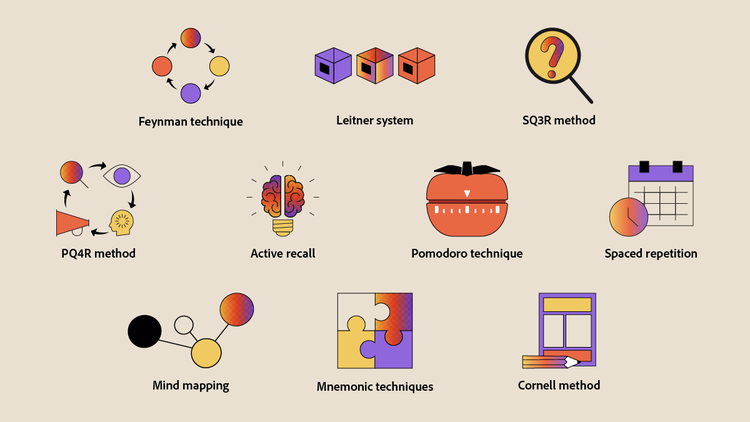
For example, while one learner may thrive using mind maps, another may find success with active recall. Here’s a brief overview of study method types or categories:
- Summarizing techniques: These methods involve distilling information into concise summaries, such as the Cornell Method, which uses structured notes to highlight key points.
- Mnemonic techniques: These include tools like acronyms, rhymes, and visualization to improve memory recall.
- Retrieval practices: Techniques like Active Recall focus on retrieving information from memory, strengthening neural connections.
- Spaced repetition: By revisiting material at intervals, spaced repetition ensures long-term retention.
- Time management techniques: Methods like the Pomodoro Technique divide study sessions into manageable intervals to maintain focus.

1. The Feynman technique
The Feynman technique is a powerful strategy that involves simplifying complex concepts by teaching them to others. Named after physicist Richard Feynman, this method requires breaking down topics into simple language, identifying gaps in understanding, and refining your explanations.
This approach promotes deeper understanding and retention by forcing you to articulate ideas clearly. It’s particularly useful for mastering complex subjects, as it highlights areas where further study is needed.
2. The Leitner system
The Leitner system is a flashcard-based method that employs spaced repetition to optimize learning. Flashcards are organized into boxes based on how well you know the material, with frequent reviews of cards in lower-confidence boxes. This study method is very commonly used for efficient memorization.
This system excels at improving long-term retention and is ideal for subjects requiring heavy memorization, such as vocabulary or historical dates. Learn how to turn notes into flashcards for even greater efficiency.
3. The SQ3R method
The SQ3R method—Survey, Question, Read, Recite, Review—is designed for comprehensive reading and understanding. It encourages active engagement with the material by breaking it down into manageable steps:
- Survey: Skim the material to get an overview of the content, focusing on headings, subheadings, and key points.
- Question: Formulate questions based on the survey stage. For example, "What is this section about?" or "How does this concept work?"
- Read: Read the material thoroughly while seeking answers to your questions.
- Recite: Summarize the information in your own words to reinforce understanding.
- Review: Go back over the material periodically to solidify retention.
By dissecting complex topics into smaller parts, SQ3R improves comprehension and recall. It’s particularly helpful for studying dense texts. Find additional tips on how to study for a test using this method.
4. The PQ4R method
The PQ4R method—Preview, Question, Read, Reflect, Recite, Review—focuses on critical thinking and retention. This systematic approach ensures that learners engage deeply with material rather than passively skimming:
- Preview: Scan the material briefly to identify key ideas and concepts.
- Question: Develop questions around the content to direct your focus during reading.
- Read: Carefully read the material with the goal of answering your questions.
- Reflect: Think critically about what you’ve read, connecting it to prior knowledge or experiences.
- Recite: Summarize the content aloud or in writing to reinforce learning.
- Review: Periodically revisit the material to strengthen retention.
By encouraging reflection and active engagement, PQ4R fosters critical thinking skills and helps with long-term memory retention. This technique, similar to the SQ3R study method, is commonly used to effectively study for tests.
5. Active recall or Retrieval practice
Active recall is a retrieval-based learning method that involves testing yourself on material rather than passively reviewing it. This technique strengthens memory pathways and enhances understanding. The main steps involved in active recall study method are:
- Learning the material: Start by reading or listening to the content you want to master.
- Removing the source: Put away notes or textbooks so you’re not looking at the answers.
- Testing yourself: Ask questions about the material or write down everything you remember without checking the source.
- Checking and correcting: Compare your answers with the original material to identify gaps or mistakes.
- Repeating: Revisit the process at spaced intervals to strengthen long-term retention.
By actively engaging your brain to retrieve information, this method boosts retention and helps build connections between concepts. It’s ideal for mastering complex networks of ideas.
6. The Pomodoro technique
The Pomodoro study method divides work into 25-minute intervals, separated by short breaks. This time management strategy is perfect for maintaining focus and productivity during study sessions.
It prevents burnout and helps manage study time effectively, ensuring consistent progress. This method works well for students juggling multiple tasks, because the technique supports focus and productivity in several ways:
- Improves concentration: Short, timed intervals help you stay fully engaged without mental fatigue.
- Reduces procrastination: Breaking sessions into manageable chunks makes starting tasks less overwhelming.
- Enhances time awareness: The timer creates a sense of urgency, encouraging efficient work.
- Supports work-life balance: Regular breaks prevent burnout and maintain energy throughout the day.
- Boosts accountability: Tracking Pomodoros gives a clear picture of progress and time spent.
7. Spaced repetition
Spaced repetition involves revisiting material at strategically timed intervals to maximize retention. This technique is backed by cognitive science and is particularly effective for memorizing large volumes of information.
By spacing out study sessions, this method prevents forgetting and strengthens memory over time. It’s ideal for subjects requiring cumulative knowledge.
8. Mind mapping
Mind mapping is a visual technique that organizes information into diagrams, connecting ideas and concepts in a structured format. It helps connect concepts effectively and it’s based on 5 main steps:
- Start with a central idea: Write the main topic in the center of a blank page.
- Add key branches: Draw lines outward for major subtopics or themes related to the central idea.
- Expand with details: Add smaller branches for supporting points, examples, or keywords under each subtopic.
- Use visual elements: Incorporate colors, symbols, and images to make connections clearer and aid memory.
- Review and refine: Check the map for completeness and reorganize if needed to improve clarity.
Perfect for visual learners, mind mapping promotes creativity and helps clarify relationships between topics.
9. Mnemonic techniques
Mnemonic techniques use memory aids like acronyms, rhymes, and associations to simplify complex information. The basic steps involved in these techniques are:
- Identifying key information: Select the facts, terms, or concepts you need to remember.
- Creating associations: Link the information to something familiar, such as a word, phrase, or image.
- Using patterns: Form acronyms, rhymes, or sentences where each element represents a piece of the information.
- Visualizing: Add mental images or stories to strengthen the connection and make it more memorable.
- Using recall: Revisit and apply the mnemonic regularly to reinforce memory.
This approach makes information more memorable and is particularly useful for languages, formulas, or lists.
10. Cornell method (writing summaries)
The Cornell method involves dividing your notes into sections for key points, summaries, and questions. This structured approach enhances understanding and retention.
By summarizing content, you engage actively with the material, making it easier to recall later.
Choosing the best study method
Selecting the right study methods depends on your individual learning style, goals, and the type of material you’re studying. Here are some tips to help you choose the method or methods that are most effective for you:
- Identify your learning style: Visual learners may prefer mind mapping, while auditory learners might benefit from teaching concepts aloud.
- Match methods to material: Use mnemonic techniques for memorization-heavy subjects and retrieval practices for conceptual understanding.
- Leverage AI tools: Tools like Acrobat’s AI flashcard maker and AI summary generator can automate note-taking and study preparation.
Understanding and applying the right study techniques can transform your learning experience, helping you achieve better results with less stress. Whether you choose Active recall, the Cornell method, or the Pomodoro technique, tailoring your approach to your needs is key.
Frequently asked questions.
What is the best method for studying?
What is the 2 3 5 7 study method?
What are the four types of study methods?
What is the 3 3 3 method of studying?
What is the Harvard study method?
Keep exploring