Adobe Acrobat
What is active recall and how it can help you study
Choosing the right study method is crucial for academic success.


Adobe Acrobat
Choosing the right study method is crucial for academic success.

One standout technique that has gained popularity among educators and learners is active recall, a powerful method proven to boost learning outcomes significantly.
In this article, we'll explore what active recall is, discuss five actionable methods to incorporate it into your study routine, explain its cognitive benefits, and answer common questions about its application.
Whether you're preparing for exams or striving to master complex subjects, active recall can transform the way you learn. For additional inspiration, check out these effective study methods to refine your approach.

Active recall is a learning technique that involves actively retrieving information from memory rather than passively reviewing material. Unlike methods like rereading or highlighting, active recall challenges the brain to engage deeply with the content, strengthening neural connections and improving memory retention.
The process of active recall is rooted in cognitive science. When you actively retrieve information, your brain works harder to access stored knowledge, reinforcing pathways that make the memory more resilient. This repetitive cycle of effortful recall helps transfer information from short-term memory to long-term memory, enhancing both comprehension and retention.
Active recall can be applied in various ways:
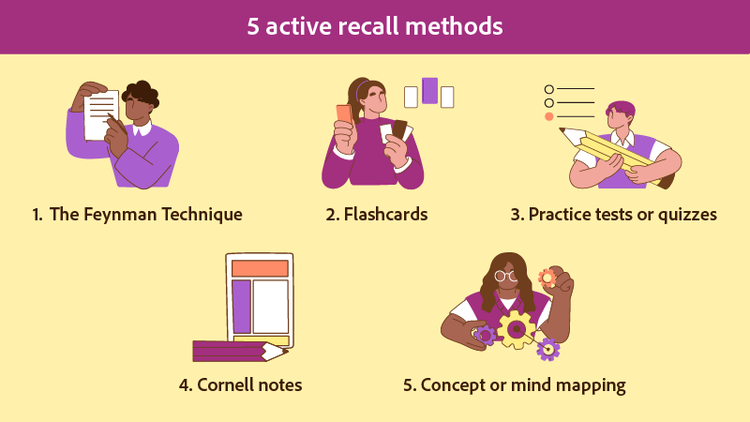
Finding the right learning method, whether it is active recall studying or not, can make a significant difference in your learning outcomes. Below are five actionable techniques to help you incorporate active recall into your study routine.
The Feynman Technique is one of the most effective ways to apply active recall. It involves simplifying a concept by teaching it to yourself or someone else, emphasizing understanding over memorization. It’s based on four steps:
By breaking down complex ideas, you not only strengthen recall but also deepen your comprehension of the subject.
Flashcards are a classic tool for active recall. They allow you to test yourself repeatedly, reinforcing memory through spaced repetition. When you turn notes into flashcards, use these tips to create effective ones:
This method is particularly effective for vocabulary, formulas, and definitions.
Simulating exam conditions through practice tests is an excellent way to apply active recall. By answering questions from memory, you simulate the real-world application of knowledge. Here are a few tips to find or create practice tests:
This method is ideal for preparing for exams or mastering problem-solving skills.
The Cornell notes method is a structured system for note-taking that enhances active recall through organization and review. By breaking down notes into summaries, main ideas, and questions, you create a framework for active engagement with the material.
To use Cornell notes for active recall, follow these steps:
This method encourages you to revisit and actively engage with your notes, improving comprehension and retention.
Concept or mind mapping is a visual strategy for organizing and recalling information. By creating diagrams that connect related ideas, you actively engage with the material and reinforce memory.
Here’s how to use concept or mind mapping for active recall:
Active recall isn’t just another study technique, it’s a powerful way to engage your mind and strengthen memory. By shifting from passive review to active retrieval, this approach changes how learning truly sticks. Active recall offers numerous cognitive advantages:
Passive recall methods, like rereading or highlighting, often result in surface-level learning. In contrast, active recall engages the brain, making learning more effective. While passive methods may feel easier, they lack the rigor necessary for deep understanding.
To maximize the benefits of active recall, consider these tips:
For additional advice on organizing your study materials, check out these tips to organize study notes.
For more guidance, learn how to make a study guide.