



Spaced repetition is a time-tested memorization method that schedules review sessions at gradually increasing intervals. By revisiting information just as you're about to forget it, this technique strengthens memory retention and transforms short-term learning into lasting knowledge. Whether you're preparing for exams or mastering new skills, spaced repetition offers a systematic approach to more efficient studying.
From flashcards to mind maps, students today have access to dozens of effective study methods designed to help them learn and retain information. Yet despite this abundance of options, many learners still struggle with a fundamental challenge: remembering what they've studied when it matters most.
The reality is that not every study technique works equally well for every person or every type of material. Some methods excel at building conceptual understanding, while others focus on memorization and recall. Visual learners may thrive with diagrams and color-coded notes, while auditory learners prefer recorded lectures and verbal repetition. Kinesthetic learners often need hands-on practice to truly absorb new concepts.
Finding the right approach requires experimentation and an understanding of how your own memory works. Your ideal study strategy might combine multiple techniques, adapting based on the subject matter, the depth of understanding required, and the timeframe you have available. Factors like your attention span, learning environment, and even the time of day can influence which methods prove most effective for you.
What is spaced repetition and why it works?
Spaced repetition is a learning technique that involves reviewing information at systematically increasing intervals over time. Rather than studying material once and hoping it sticks, you revisit it multiple times, with each review session occurring further apart than the last. This strategic approach to learning leverages the brain's natural memory consolidation processes to create stronger, more durable memories.
The concept dates back to the late 19th century when German psychologist Hermann Ebbinghaus conducted groundbreaking research on memory. His experiments revealed what's now known as the forgetting curve, a predictable pattern showing how quickly newly learned information fades from memory without reinforcement. Ebbinghaus discovered that we forget approximately 70% of new information within 24 hours if we don't actively work to retain it.
Spaced repetition directly combats this natural forgetting process. By timing your review sessions to occur just before you're likely to forget the material, you strengthen the neural pathways associated with that information. Each successful recall makes the memory more durable and extends the time before you need to review it again. This phenomenon, known as the spacing effect, has been confirmed by hundreds of studies across various learning contexts.
So how do you practice spaced repetition effectively? The core principle involves scheduling review sessions at expanding intervals. Instead of reviewing material on consecutive days, you might review on day 1, then day 3, then day 7, then day 14, and so on. Each successful recall pushes the next review further into the future, while forgotten items return to shorter intervals for reinforcement.
Consider this practical example of spaced repetition in action: You're learning vocabulary for a foreign language exam. On day one, you study 20 new words. Without spaced repetition, you might review them once and move on. With spaced repetition, you'd review those same words the next day, then three days later, then a week later, and finally a month later. Each review session reinforces the memory while requiring less total study time than cramming would. By exam time, you can recall all 20 words effortlessly because they've been encoded into long-term memory through strategic repetition.
Here's why spaced repetition works so effectively:
- It combats the forgetting curve by strategically timing reviews at optimal moments
- It strengthens neural pathways through repeated retrieval practice
- It optimizes study time by focusing attention on weaker material
- It builds long-term memory rather than temporary short-term recall
- It creates durable knowledge that remains accessible months or years later
- It reduces cognitive load by spreading learning over time
- It improves confidence by demonstrating mastery through successful recalls
This method proves particularly valuable for students preparing for cumulative exams, language learners building vocabulary, medical students memorizing terminology, and professionals studying for certifications. Anyone who wants to learn how to memorize something fast and retain it long-term can benefit from this approach.
How often should you do spaced repetition? The optimal frequency varies based on the complexity of the material and your familiarity with it. Generally, newer or more difficult information requires shorter intervals between reviews, while well-established knowledge can be reviewed less frequently. Most spaced repetition systems adapt automatically based on your performance during each review session. For new material, daily review for the first week is common, gradually extending to weekly and then monthly reviews as mastery develops.
How to use the spaced repetition method
Implementing spaced repetition doesn't require special equipment or extensive preparation. With a clear system and consistent practice, you can incorporate this technique into your existing study routine. Here's a step-by-step approach to getting started.
1. Gather and organize your study materials
Collect all relevant notes, textbooks, PDFs, and lecture recordings in one accessible location. Having your materials organized makes it easier to create study items and reference source content when needed. Consider using cloud storage or a dedicated study folder to ensure you can access materials from any device. You might want to start by summarizing study documents to extract the most important points before creating your review materials.
2. Break content into discrete, testable chunks
Divide your material into small, specific pieces of information that can be tested individually. Instead of trying to memorize an entire chapter, create separate items for each key concept, definition, or fact. Each chunk should be atomic, meaning it tests one and only one piece of knowledge. For example, instead of creating a flashcard asking “Explain photosynthesis,” create separate cards for each step of the process.
3. Create your initial study materials
Transform your content chunks into review-ready formats. Popular options include:
- Question-and-answer flashcards
- Fill-in-the-blank sentences
- Diagram labeling exercises
- Definition matching pairs
- Concept explanation prompts
4. Complete your first review session
Study your material actively during the initial learning phase. Read through the content, take notes, and make sure you understand the concepts before beginning the repetition cycle. This first exposure should focus on comprehension, not just memorization. Ask yourself questions about the material and try to connect new information to things you already know.
5. Schedule increasing intervals
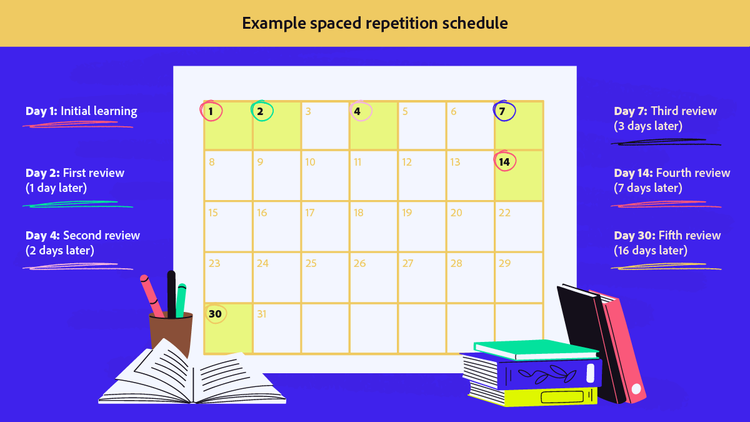
Plan your review sessions with expanding gaps between them. A common schedule follows this pattern:
- Day 1: Initial learning
- Day 2: First review (1 day later)
- Day 4: Second review (2 days later)
- Day 7: Third review (3 days later)
- Day 14: Fourth review (7 days later)
- Day 30: Fifth review (16 days later)
6. Use active recall during each session
Test yourself rather than passively re-reading your notes. Cover the answers and try to retrieve the information from memory. This approach using active recall techniques strengthens memory far more effectively than simple review. When you struggle to recall something, the effort of trying to remember actually enhances the subsequent learning when you check the answer.
7. Track your progress and adjust
Keep records of which items you recall easily and which ones challenge you. Focus more attention on difficult material by reviewing it more frequently, while extending intervals for well-mastered content. Many learners use a simple rating system: items recalled instantly can move to longer intervals, while forgotten items return to the beginning of the cycle.
8. Leverage AI tools to streamline the process
Modern technology can significantly reduce the time needed to create study materials. An AI summary generator can condense lengthy readings into reviewable content, saving you hours of manual work while ensuring you capture the essential information.
The 2 3 5 7 method
What is 2 3 5 7 spaced repetition? This method is a simplified spaced repetition schedule that's easy to remember and implement without specialized software. The numbers represent the days between review sessions: you review material after 2 days, then 3 days later, then 5 days after that, and finally 7 days later.
Here's how this method works in practice. Imagine you're learning 20 new terms for an upcoming biology exam scheduled for day 20:
- Day 1: Initial learning of all 20 terms
- Day 3: First review (2 days after initial learning)
- Day 6: Second review (3 days after first review)
- Day 11: Third review (5 days after second review)
- Day 18: Final review (7 days after third review)
- Day 20: Exam day with strong retention
Some learners prefer variations like the 1-3-7-14-30 schedule for longer-term retention needs. The key is consistency rather than following any specific formula exactly. Choose a schedule that fits your timeline and stick with it.
Spaced repetition for ADHD learners
For students with attention deficit hyperactivity disorder (ADHD), spaced repetition can be particularly effective when adapted appropriately. The method's structured approach provides external scaffolding that helps compensate for challenges with executive function and working memory. Consider these modifications:
- Use shorter review sessions of 10-15 minutes to maintain focus
- Incorporate more frequent breaks between study blocks
- Add visual elements like color-coded flashcards, diagrams, and images to maintain engagement
- Set specific alarms or calendar reminders for each review session
- Use gamified spaced repetition apps that provide immediate feedback and rewards
- Break study sessions into even smaller chunks if needed
- Study in a distraction-free environment with phone notifications disabled
The structure of spaced repetition can actually be beneficial for ADHD learners because it removes the need to decide when and what to study. The schedule provides clear guidance, reducing decision fatigue and making it easier to maintain consistent study habits.
You can even use AI to help plan your schedule. Try a prompt like: “Create a 2-3-5-7 review schedule for my chemistry chapter on molecular bonds starting Monday, March 3rd, with specific dates and suggested review activities for each session.”
Tools for the spaced repetition method
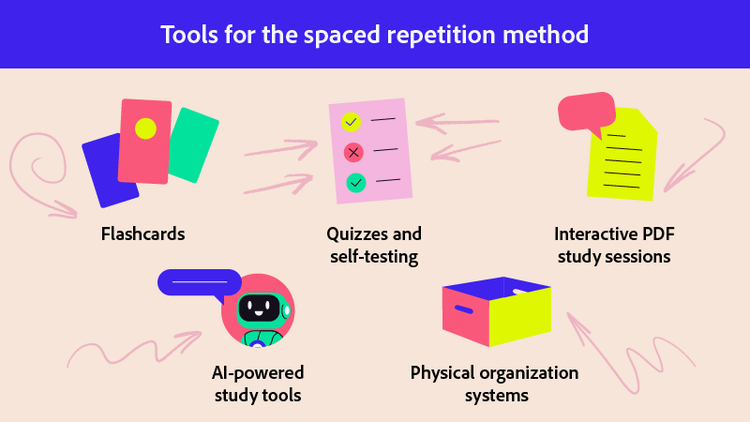
Several tools can help you implement spaced repetition effectively, from traditional analog methods to sophisticated digital solutions. The best choice depends on your learning style, the type of material you're studying, and your access to technology.
1. Flashcards
Flashcards remain one of the most popular tools for spaced repetition because they naturally support the question-and-answer format that promotes active recall. They're simple to create, easy to use, and highly portable.
- Traditional paper flashcards offer tactile engagement and work without batteries or internet access
- Digital flashcard apps can automatically schedule reviews based on your performance
- AI-powered flashcard creation can generate cards directly from your study materials, saving hours of manual work
- Color-coding systems help organize cards by topic, difficulty, or mastery level
An AI flashcard maker can transform your lecture notes or textbook chapters into ready-to-use flashcards. Try a prompt like: “Generate 15 flashcards covering the key concepts of photosynthesis, including the light-dependent and light-independent reactions, with the question on one side and a concise answer on the other.”
2. Quizzes and self-testing
Regular self-testing reinforces learning and helps identify areas that need more attention. The testing effect, a well-documented phenomenon in cognitive psychology, shows that the act of retrieving information strengthens memory more than passive review.
- Practice tests simulate exam conditions while providing retrieval practice
- AI-generated quizzes can create fresh questions from your study materials
- Varying difficulty levels helps build confidence while challenging your understanding
- Immediate feedback helps correct misconceptions before they become ingrained
An AI quiz generator can create customized assessments based on your specific study content. Example prompt: “Create a 10-question quiz on the causes and effects of the French Revolution with three easy questions, four medium questions, and three challenging questions. Include answer explanations for each.”
3. Interactive PDF study sessions
Modern AI tools allow you to have conversations with your study materials, making review sessions more dynamic and personalized. This interactive approach keeps engagement high while providing tailored explanations.
- Chat with PDF documents to ask questions and receive instant explanations
- Request clarifications on confusing concepts without searching through entire documents
- Generate summaries of specific sections for quick review
- Ask for examples that illustrate complex concepts
- Request practice questions based on specific sections
Example prompt: “Explain the main arguments in chapter 4 in simple terms, then give me three questions I should be able to answer after understanding this material. Finally, suggest memory tricks for the key vocabulary terms.”
4. Additional AI-powered study tools
Beyond individual tools, comprehensive AI solutions can support your entire study workflow from initial reading through final review. Various AI tools for students continue to evolve, offering increasingly sophisticated ways to generate study guides, create practice problems, and organize learning materials. These tools can analyze your study patterns and suggest optimizations to your learning approach.
An AI study assistant can help you prepare materials for spaced repetition, track your progress, and adapt your study schedule based on your performance patterns. These assistants can also answer questions about your materials, explain difficult concepts in multiple ways, and generate additional practice problems when you need extra reinforcement.
5. Physical organization systems
For learners who prefer analog methods or want to supplement digital tools:
- The Leitner box system uses physical compartments to organize flashcards by mastery level
- Calendar blocking dedicates specific time slots for review sessions
- Bullet journals can track review schedules and progress
- Wall calendars provide visual reminders of upcoming review sessions
- Index card systems with tabbed dividers organize cards by interval
Most successful learners use a combination of tools rather than relying on a single approach. You might use an AI tool to generate initial study materials, a digital flashcard app for daily review, and a physical calendar to track your overall progress. The key is finding a system that you'll actually use consistently.
Frequently asked questions
To practice spaced repetition effectively, start by breaking your study material into small, testable chunks. Create flashcards or practice questions for each chunk, then review them at increasing intervals. Begin with short gaps of one to two days, then gradually extend to weekly and monthly reviews as you master the material. The key is testing yourself rather than passively reviewing, and adjusting intervals based on how easily you recall each item. Items you struggle with should return to shorter intervals, while well-mastered items can be reviewed less frequently.
Yes, spaced repetition applies effectively across virtually all subjects and disciplines. It works particularly well for material that requires memorization, such as vocabulary, historical dates, scientific terminology, mathematical formulas, and professional certifications. Even conceptual subjects benefit when key principles and frameworks need to be retained long-term. The technique is less suited for skills that require physical practice, like playing an instrument, though the theoretical knowledge behind such skills can certainly be learned through spaced repetition.
Most experts recommend keeping individual review sessions between 15 and 30 minutes for optimal focus and retention. Shorter sessions of 10-15 minutes may work better for those who struggle with sustained attention or have ADHD. The key is consistency rather than duration. Brief daily sessions outperform occasional marathon study periods. If you have a lot of material to review, consider breaking it into multiple shorter sessions throughout the day rather than one long session.
Cramming involves intensive study immediately before an exam, creating temporary short-term memories that fade quickly. Spaced repetition distributes learning over time, building stronger neural pathways that support long-term retention. Research consistently shows that spaced learning produces better results on delayed tests, even when total study time is equal. While cramming might help you pass tomorrow's test, spaced repetition ensures you'll still remember the material months or years later.
Absolutely. Spaced repetition pairs exceptionally well with active recall, mind mapping, the Pomodoro technique, and elaborative interrogation. Many students use mind maps during initial learning, then convert key concepts into flashcards for spaced repetition review. The Pomodoro technique can structure individual review sessions effectively by providing focused 25-minute work blocks. Elaborative interrogation, which involves asking “why” and “how” questions about the material, deepens understanding before the repetition phase begins.
Material is considered mastered when you can consistently recall it correctly across multiple extended intervals, typically when the gap between reviews reaches 30 days or more without errors. Most digital spaced repetition systems track this automatically and will eventually retire cards you've demonstrated strong retention of. Signs of mastery include instant recall without hesitation, the ability to explain concepts in your own words, and successfully applying knowledge in new contexts or problems.
Yes, visual learners can adapt spaced repetition to their preferences by incorporating diagrams, charts, images, and color-coded materials into their flashcards and review sessions. Drawing concepts from memory, using visual mnemonics, and creating picture-based associations all enhance the effectiveness of spaced repetition for those who learn best through visual means. Consider creating flashcards that require you to sketch diagrams or label images rather than simply recalling text-based information.
You may also like
title
Spaced repetition: what it is and how it works
cardImageAltText
A student uses spaced repetition to study
cardImage
Tags
caas:content-type/article,caas:products/acrobat,caas:topic/students,caas:topic/edit-pdf,caas:topic/chat-pdf

