


A simple sentence is defined by its structure: a single independent clause that conveys a complete thought. It must contain, but is not necessarily limited to, one subject and one verb. Understanding how simple sentences work helps writers craft clearer documents, emails, and professional content that readers can quickly understand and act upon.
What is a simple sentence
A simple sentence contains one independent clause that expresses a complete thought. It must include at least one subject and one verb, though it may contain additional elements like objects or modifiers. The defining characteristic is that it stands alone as a single, complete idea without relying on other clauses for meaning.
Consider these examples: "The dog barks." "Sarah completed the project." Each sentence contains one subject performing one action, creating a clear and direct statement that requires no additional context to understand.
Simple sentences serve several essential functions in writing. They provide clarity by presenting one idea at a time, making them ideal for instructions, headlines, and important announcements. When you need readers to absorb information quickly, simple sentences deliver that directness without confusion or ambiguity.
Professional writers rely on simple sentences in numerous contexts. Technical documentation often uses them for step-by-step instructions. Business emails benefit from simple sentences when conveying key decisions or requests. Headlines in newspapers and marketing materials use simple sentences to grab attention immediately. Legal documents employ them when precision matters most.
The power of a simple sentence lies in its straightforward structure. Every simple sentence ends with appropriate period punctuation, signaling the completion of a thought. This clear boundary helps readers process information efficiently and move to the next idea without confusion.
AI writing tools like Acrobat AI Assistant can help writers communicate more effectively. By recognizing what makes a sentence simple, you can better evaluate AI suggestions and maintain control over your writing style.
Elements of a simple sentence
Every simple sentence contains essential components that work together to convey meaning. Understanding these elements helps writers construct grammatically correct sentences and identify opportunities to add clarity or detail without overcomplicating their message.
The core elements of a simple sentence include:
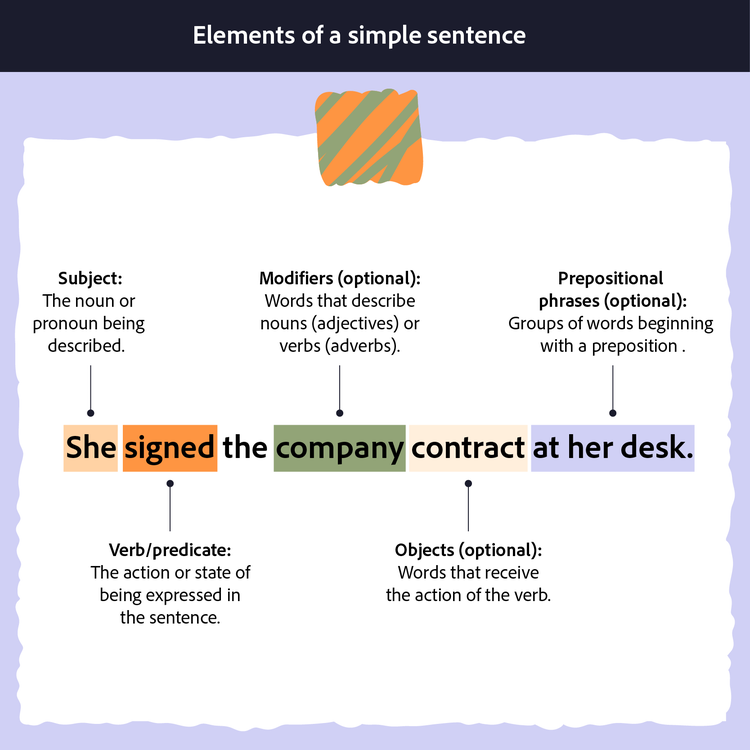
- Subject (simple or compound): The noun or pronoun performing the action or being described. A simple subject contains one noun, while a compound subject joins two or more nouns with a conjunction like "and" or "or."
- Verb/predicate (simple or compound): The action or state of being expressed in the sentence. A simple verb contains one action, while a compound verb joins two or more actions performed by the same subject.
- Optional components: objects (direct/indirect): Words that receive the action of the verb. A direct object answers "what" or "whom," while an indirect object indicates to whom or for whom the action is performed.
- Optional components: modifiers (adjectives, adverbs): Words that describe or provide additional information about nouns (adjectives) or verbs (adverbs).
- Optional components: prepositional phrases: Groups of words beginning with a preposition that add context about time, location, or manner.
Simple sentences can take several structural forms while maintaining their essential nature as single independent clauses:
- Single subject + single verb: "Birds fly." This represents the most basic sentence structure.
- Single subject + single verb + object: "She reads books." Adding an object provides more information about the action.
- Compound subject + single verb: "Tom and Jerry run." Multiple subjects share the same action.
- Single subject + compound verb: "He eats and drinks." One subject performs multiple actions.
- Compound subject + compound verb: "Dogs and cats eat and sleep." Multiple subjects perform multiple actions.
Despite these variations in structure and optional elements, all examples above remain simple sentences because they contain only one independent clause. The presence of compound subjects or compound verbs does not create additional clauses—it simply expands the existing clause's components while maintaining the sentence's essential simplicity.
Acrobat AI Assistant can help you analyze your sentence structures and identify whether you're using simple or more complex constructions. This feature proves especially useful when editing documents for clarity and readability.
How to write a simple sentence
Despite being the most basic sentence type, crafting an effective simple sentence requires attention to structure and clarity. A well-written simple sentence communicates its message instantly, leaving no room for misinterpretation. Follow these steps to construct clear, purposeful simple sentences.
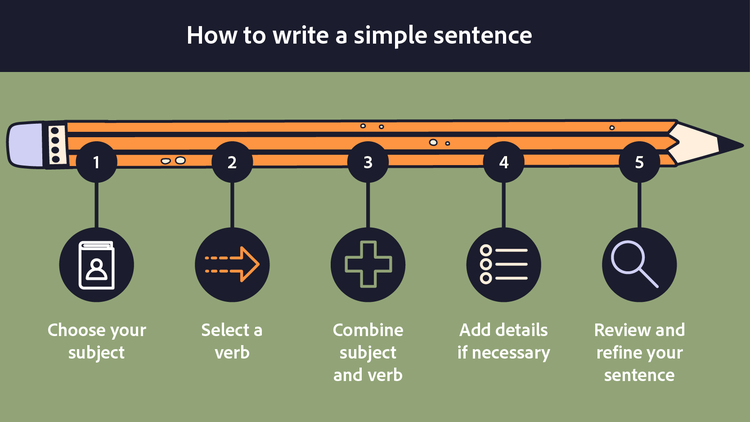
1. Choose your subject
The subject identifies who or what the sentence is about. It answers the question "Who or what is performing the action?" Begin by determining the main focus of your sentence.
A simple subject contains one noun or pronoun: "The manager approved the request." Here, "manager" is the subject performing the action.
A compound subject joins two or more nouns with a conjunction: "The manager and director approved the request." Both individuals share responsibility for the action, yet the sentence remains simple because it contains only one independent clause.
Consider your audience when selecting subjects. Use specific nouns rather than vague pronouns when clarity matters. "The quarterly report shows growth" communicates more precisely than "It shows growth."
2. Select a verb
Verbs express action or state of being. They tell readers what the subject does or what condition exists. Choose verbs that accurately convey your intended meaning.
Action verbs describe physical or mental activities: "The team completed the analysis." "She considered the options." State-of-being verbs describe conditions: "The results are positive." "The deadline remains unchanged."
Compound verbs join multiple actions performed by the same subject: "The assistant filed and organized the documents." Both actions belong to one subject within one clause, maintaining the simple sentence structure.
Strong, specific verbs create more impactful sentences. "The sales figures increased" communicates more effectively than "The sales figures went up."
3. Combine subject and verb
Join your subject and verb to form the core clause. This combination creates the foundation of your simple sentence.
Ensure subject-verb agreement in number. Singular subjects require singular verbs: "The report shows improvement." Plural subjects require plural verbs: "The reports show improvement."
Test your combination by asking whether it expresses a complete thought. "The team finished" works as a complete sentence. "The team finishing" does not, because it lacks a proper verb form.
4. Add details if necessary
Once you have established your subject-verb foundation, consider whether additional elements would enhance clarity or meaning. Objects, modifiers, and prepositional phrases can enrich your sentence without changing its fundamental structure.
Start basic: "The analyst reviewed."
Add a direct object: "The analyst reviewed the data."
Include modifiers: "The senior analyst carefully reviewed the quarterly data."
Incorporate prepositional phrases: "The senior analyst carefully reviewed the quarterly data before the meeting."
Exercise caution when adding details. Too many additions can obscure your main point even while technically maintaining a simple sentence structure. If your sentence becomes difficult to follow, consider splitting information across multiple sentences.
5. Review and refine your sentence
After constructing your simple sentence, review it for clarity and impact. Read the sentence aloud to check its flow and ensure it conveys your intended meaning without ambiguity.
Using Acrobat AI Assistant can help you identify sentences that have grown unwieldy and suggest clearer alternatives. The tool analyzes your writing patterns and recommends improvements while preserving your intended meaning. You can ask the assistant to review your document and highlight opportunities where simpler sentence structures might improve readability.
When working with generative AI for documents, you gain access to powerful rewriting features that can transform complex passages into clearer, more direct language. This capability proves especially valuable when editing lengthy reports or technical documentation where clarity matters most.
Simple sentences vs. complex sentences
Understanding the difference between simple and complex sentences helps writers choose the right structure for each situation. While simple sentences contain one independent clause, complex sentences combine one independent clause with one or more dependent clauses, creating relationships between ideas.
A dependent clause contains a subject and verb but cannot stand alone as a complete thought. It begins with a subordinating conjunction such as "because," "although," "when," "if," "before," "after," or "while." These conjunctions signal that the clause depends on another clause for its meaning.
Choosing between simple and complex sentences depends on your communication goals. Simple sentences work best when you need clarity, directness, or emphasis. Complex sentences excel when you need to show relationships, explain causes, or provide context.
Consider these comparisons with guidance on when to use each structure:
- Simple: "The report is complete." | Complex: "The report is complete because the team worked overtime." Use the simple version when stating facts directly. Choose the complex version when explaining the reason matters.
- Simple: "Click the button." | Complex: "Click the button after you enter your password." Use the simple version for basic, standalone instructions. Choose the complex version when sequence or timing affects the outcome.
- Simple: "Sales increased." | Complex: "Sales increased although the economy struggled." Use the simple version for headlines or quick status updates. Choose the complex version for nuanced analysis that acknowledges contrasting factors.
- Simple: "She signed the contract." | Complex: "She signed the contract before the deadline expired." Use the simple version for direct statements of fact. Choose the complex version when timing provides important context.
- Simple: "The file is ready." | Complex: "The file is ready whenever you need to access it." Use the simple version for immediate status updates. Choose the complex version when availability conditions matter.
Both sentence types have value in effective writing. Skilled writers alternate between simple and complex sentences to create rhythm, maintain reader interest, and match sentence structure to content needs. Too many simple sentences can make writing feel choppy. Too many complex sentences can overwhelm readers.
When you want to analyze your own writing or content for sentence structure, Acrobat AI Assistant can help. The AI chat for documents feature allows you to ask questions about your content and receive recommendations for enhancing clarity. When you finish editing, you can convert Word documents to PDF to preserve your formatting and share your polished content with others.
Understanding when to use simple versus complex sentences also helps when you're reviewing documents created by others. You can use Acrobat AI Assistant to summarize lengthy passages and identify areas where sentence structure could be simplified for better comprehension.
Frequently asked questions
Yes, a simple sentence can have a compound subject. When two or more subjects share the same verb and are joined by a conjunction like "and" or "or," the sentence remains simple. For example, "Marketing and sales collaborated on the campaign" contains two subjects but only one independent clause. The key factor is that all subjects perform the same action within a single clause structure.
Yes, a simple sentence can contain a compound verb or compound predicate. When one subject performs multiple actions joined by a conjunction, the sentence remains simple. "The assistant answered calls and scheduled appointments" shows one subject performing two actions within a single independent clause. This differs from a compound sentence, which would contain two independent clauses with separate subjects and verbs.
A sentence becomes complex when it includes a dependent clause alongside the independent clause. Adding words like "because," "although," "when," or "if" to introduce a dependent clause changes the structure. A sentence becomes compound when it joins two independent clauses with a coordinating conjunction like "and," "but," or "so." For example, "The project succeeded, and the client was satisfied" is compound because it contains two complete, independent thoughts.
Length does not determine whether a sentence is simple—structure does. A simple sentence can be quite long if it contains only one independent clause with multiple modifiers, objects, or prepositional phrases. "The experienced marketing director carefully reviewed the comprehensive quarterly sales report from all regional offices before the scheduled board meeting" is still a simple sentence despite its length because it contains only one subject-verb combination expressing one complete thought.
Yes, as long as it still conveys a complete thought. Writers sometimes use ellipsis punctuation when sentences trail off or when omitting words that readers can infer from context. However, even with these variations, the fundamental structure of a simple sentence remains unchanged.
AI writing tools like Acrobat AI Assistant can analyze your documents and identify opportunities to simplify complex constructions. These tools can suggest breaking long, complicated sentences into shorter, clearer ones. They can also help you identify passive voice constructions that might benefit from active, direct phrasing. By using an AI writing assistant, you can quickly review and refine your work to ensure your sentences communicate effectively while maintaining your unique voice and style.
You may also like
title
Simple sentence: definition and examples
cardImageAltText
Visual example showing the structure of a simple sentence with subject and verb labeled
cardImage
primaryTag
caas:content-type/article
Tags
caas:content-type/article,caas:products/acrobat,caas:topic/ai-chat-pdf,caas:topic/students,caas:topic/grammar

