From approval to accountability: why directors now lead AI adoption in business documents.
AI for business leaders and senior executives is reshaping executive workflows. Discover how Adobe Acrobat is helping directors and VPs approve contracts, policies, and financial documents with confidence and accountability.
AI adoption in business documents has typically followed a familiar pattern: operational teams use it to speed up routine work, while senior leaders remain largely hands-off. That model is now shifting.
Recent Adobe Acrobat data shows that directors and vice presidents are now the most likely group to use AI daily, at 36%. They also lead in the number of AI tools used per role. This points to a clear shift in where AI is sitting within organisations and how to use AI in business decision-making and document governance.
Rather than remaining a background productivity aid, AI is becoming embedded in formal approval and governance workflows. Contracts, policies, financial records, and other high-stakes documents that carry legal, regulatory, and reputational implications are increasingly being reviewed and approved with AI directly at the executive level.
What does this mean for businesses in Australia, where regulatory scrutiny and personal accountability for leaders continue to intensify?
style
two up
layout
1 | 2
Why are directors and VPs using AI more today?
The growing use of AI among business leaders reflects how essential it has become in everyday document work. Senior executives are now managing unprecedented volumes of documents that require their review and sign off, often within tighter timeframes and under increased regulatory scrutiny. From contract variations and policy updates to compliance attestations, leaders are expected to approve more information, more quickly, and with greater accuracy than ever before.
Unlike operational staff, executives are also accountable for the downstream consequences of those approvals. This explains why they are not only using AI more frequently but also using a wider range of AI tools for legal document reviews, financial audits, compliance checks, and more. They are relying on AI to surface inconsistencies, highlight changes between document versions through AI document comparison, and reduce the risk of overlooking material details.
Daily AI use at this level signals that AI has become part of how leaders exercise oversight. It reflects a shift from delegation to direct engagement with AI-supported review and approval.
AI amid regulatory pressure and executive accountability in Australia.
Executive level AI adoption is happening against a backdrop of tightening regulatory expectations in Australia. Regulators increasingly expect organisations to demonstrate not just compliance, but how decisions were made, who approved them, and what controls were in place at the time. Directors and officers are personally accountable for failures in governance, record keeping, and oversight.
AI supports this environment by enabling traceability and defensibility. When approvals are supported by audit trails, version histories, and documented review processes, leaders are better positioned to respond to regulatory inquiries or audits. This is where an AI governance framework in Australia becomes critical. It keeps everything aligned with legal obligations, privacy requirements, and public sector standards. The growing daily use of AI by executives reflects an understanding that accountability now requires better AI tools, not just better intentions.
Enabling accountable AI-driven document workflows with Adobe Acrobat.
As AI becomes embedded in executive approval workflows, organisations need document infrastructure that supports scrutiny, traceability, and regulatory confidence. Adobe Acrobat enables leaders to move from informal, email based approvals to structured, defensible processes to make sure AI-assisted document review and approval workflows still result in clear human accountability. Each capability plays a distinct role in strengthening governance at the approval layer and supporting AI for contract management and document oversight.
Rather than informal signoffs scattered across emails or messaging tools, executives can approve contracts, policies, and financial documents with legally binding digital signatures. When a document is sent for signing using Adobe Acrobat Sign, the audit trail is built directly into the process. This audit log can be downloaded alongside the signed document and is securely stored in the cloud, allowing organisations to retrieve it at any time.
For directors and senior leaders, this creates a clear record of approval that supports accountability, audit readiness, and regulatory compliance while maintaining speed and consistency across distributed teams.
Document comparison for contract and policy changes
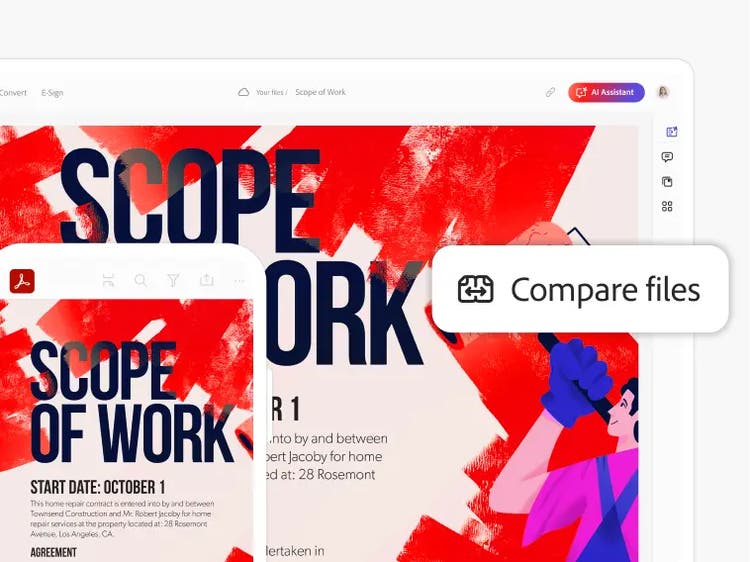
Adobe Acrobat's AI document comparison functionality allows leaders to quickly identify differences between document versions and highlight additions, deletions, and modifications. This is especially valuable for executives approving updated contracts or revised policies, where small changes can carry significant legal or financial implications.
This capability also supports AI contract review and AI contract analysis, enabling leaders to quickly understand how agreements have changed before approval. By clearly surfacing what has changed, Acrobat supports faster, more confident approvals and reduces the risk of unintended commitments.
Redaction for sensitive government and enterprise data
In government, legal, and enterprise environments, documents often contain personal data, commercially sensitive information, or classified content. With Adobe Acrobat's redaction tool, teams can permanently remove personal data, confidential details, or classified information before documents are shared internally or externally for approval or regulatory review. This capability supports privacy obligations and data protection requirements while ensuring that AI-supported workflows remain compliant with Australian regulations and public sector standards without limiting access to essential information.
Secure external sharing for regulators and partners
Adobe Acrobat enables organisations to share sensitive documents with regulators, auditors, and external partners through secure, controlled access. In addition to permission based sharing, PDFs can be protected with password security and encryption to prevent unauthorised access and reduce the risk of data exposure once documents leave the organisation. Security settings can also be applied to restrict editing, copying, printing, or modifying content, ensuring documents remain intact and authoritative.
For leaders approving high stakes documents, these protections provide confidence that externally shared files reflect the correct, approved versions and cannot be altered or misused. This offers a balance between transparency with control and supports regulatory engagement, audit readiness, and collaboration without compromising enterprise or government security standards.
Benefits of adopting AI in executive document workflows.
As AI becomes embedded in document workflows, executives, VPs, and directors gain more than efficiency. AI strengthens oversight, reduces risk, and supports defensible decision-making in high-accountability environments.
Improved visibility into approvals: AI helps leaders quickly identify key changes, risks, and inconsistencies across contracts, policies, and financial documents, reducing the risk of approving documents without full context.
Stronger governance and audit readiness: AI-supported review, combined with version history and audit trails, creates clear evidence that approvals were informed and controlled, supporting regulatory scrutiny and governance requirements.
Reduced personal and organisational risk: By flagging discrepancies and unintended changes before approval, AI acts as an additional safeguard while keeping accountability with the decision maker.
Faster decisions without loss of control: AI streamlines review and comparison, enabling quicker approvals without compromising compliance or oversight.
Greater consistency across leadership approvals: Executive-level AI adoption standardises how documents are reviewed and approved, improving alignment across teams and reinforcing governance standards.
Frequently asked questions.
It means AI is being used directly by directors and senior leaders to review, compare, approve, and govern documents not just by operational teams preparing them.
No. AI supports review and risk detection, but final accountability and approval remain with the executive decision maker.
Rising document volumes, tighter regulatory expectations, and greater personal accountability are pushing leaders to adopt tools that improve visibility and control.
AI provides clearer audit trails, version tracking, and document history, helping leaders demonstrate how decisions were made if questioned later.
Yes, when used within a clear governance framework that ensures privacy, security, and human oversight remain in place.
Key risks include data privacy, over reliance on automation, and inconsistent usage without governance controls, all of which can be mitigated with the right framework.
No. Most AI document tools are designed for business users and focus on clarity, comparison, and approval rather than technical configuration.
AI creates a shared, structured review process, reducing back-and-forth and improving alignment between legal advisors and decision makers.
Productivity tools focus on speed, while governance tools focus on traceability, accountability, and defensibility. The latter is mostly critical at the executive level.
Yes. As regulatory scrutiny increases, AI is likely to become a standard component of executive document approval and governance processes.