#F5F5F5

How generative AI works at a glance.

In the past year, generative artificial intelligence has captured the world’s imagination. This powerful type of AI can create new content — like images, music, writing, or code — based on patterns it learns from existing data. Generative AI works by using your inputs, such as a text prompt or a reference image, and then applying advanced models to produce entirely new outputs that match your request. That’s why it can make fantastical images, write poetry, generate software code, or even produce a song that sounds genuine.

Soon, generative AI may be as central to our lives as the smartphone. Yet to many, it remains a mystery. This guide looks at what generative AI is, what it’s not, and how it may change the way we work and create.

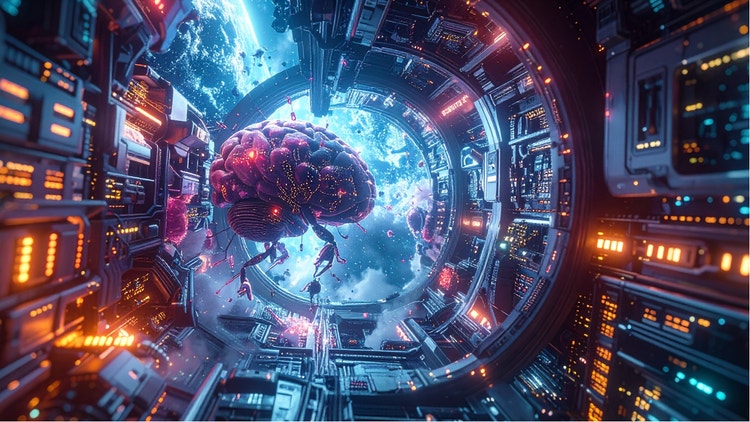
A sci-fi inspired image of a robotic brain working inside a spaceship made with generative AI.

How does generative AI work behind the scenes?

While generative AI might seem like magic, it’s powered by complex technology that learns from data and applies patterns to create something new. By breaking it down piece by piece, the “magic” becomes easier to understand.

Generative AI is artificial intelligence that doesn’t just analyze existing information — it generates brand-new content. Models are trained on massive datasets of text, images, audio, or video, where they learn patterns, relationships, and styles. When you give the model an input like a text prompt or reference image, it applies what it has learned to produce an original output that matches your request.

That’s why you can ask a chatbot to suggest a slogan and get a fresh idea in seconds, or use Firefly to transform a description into an image that looks hand-drawn or photorealistic. Beyond creative tasks, generative AI is being used in science and healthcare to design new proteins, improve cancer treatments, and accelerate research. Its potential goes far beyond wordplay — it’s already reshaping industries.

Why generative intelligence is so intelligent.

In the past, computer applications couldn’t perform a task unless humans first provided explicit instructions on how to accomplish the task. Those instructions are called “programming.” Although sophisticated programming can yield impressive results, a traditional computer application can’t do something humans didn’t include in its programming.

Generative AI systems are more flexible because they rely on machine learning, which doesn’t require explicit programming. Instead, humans give computers access to large amounts of data. The machines train themselves to recognize patterns in that data and, most importantly, to draw conclusions from what they’ve learned. (That’s where the learning part of “machine learning” comes in.) The size and quality of the dataset is important. AI is only as good as the data on which it’s trained.

Answering the question “How does generative AI work?” is complex, and gaining a deep understanding of it requires effort. The beauty of generative AI, however, is that you don’t need to understand everything about it to benefit from it. You can simply find an app, such as Firefly, type in what you want to see — “three labradoodle puppies run on the grass” — and presto, you’re now a generative AI user. No programming degree required.

An AI generated image of three yellow lab puppies running on a lawn with modern buildings in the background.

How generative AI is powered.

Behind the scenes, generative AI depends on powerful hardware and large-scale computing to function. Graphics processing units (GPUs) and tensor processing units (TPUs) handle the massive calculations needed to train and run these models.

The process has two main phases:

Training.

During training, models learn from huge datasets of text, images, audio, or video. This stage is energy-intensive because it requires distributed computing, parallel processing, and long runtimes to recognize patterns and relationships.

Inference.

Once trained, a model can generate outputs on demand like writing text, producing an image, or translating audio using much less energy. Inference can also be optimized through techniques like batching and deployment in the cloud.

Generative AI can use a lot of energy, and companies developing these tools are increasingly aware of the environmental cost. Efforts to improve efficiency and reduce the carbon footprint are under way, but there’s still progress to be made.
Generative AI image of energy traveling through a spaceship.

How generative AI is trained.

To understand how generative AI works, it helps to look at what happens before you ever type a prompt. The AI training process includes careful data cleaning and curation to improve quality, pretraining on large datasets to establish a base of knowledge, and fine-tuning for specific tasks or domains.

Human feedback and safety tuning are also important, helping refine outputs and reduce unwanted bias. At Adobe, training incorporates licensed and rights-cleared data, including content from Adobe Stock, so professional creatives can use generative tools with confidence.

How different types of generative AI models work.

There are several kinds of generative AI models, and each works in slightly different ways. Understanding generative AI versus other AI can help you understand which model type is best suited for your specific project.

  • Large Language Models (LLMs).
    Trained on massive text datasets, LLMs, like ChatGPT or Claude, generate natural-sounding language by predicting the next word in a sequence. This makes them powerful for writing, answering questions, and creating human-sounding dialogue.
  • Diffusion Models.
    Commonly used for images and video, diffusion models start with random noise and gradually refine it into a clear result that matches a prompt. This is the method that powers the Firefly AI image generator.
  • Generative Adversarial Networks (GANs).
    GANs use two networks: a generator that creates outputs and a discriminator that evaluates them. By competing, they improve until the generated images look realistic. GANs were an early driver of AI art and deepfake creation.
  • Variational Autoencoders (VAEs).
    VAEs compress data into a simpler representation and then reconstruct it, allowing them to generate variations that capture the “essence” of the original. They’re especially useful for blending styles or producing multiple versions.
  • Transformer-based Models.
    Transformers are the underlying architecture behind many generative systems, including both LLMs and diffusion models. They use an “attention” mechanism to understand relationships across data, like words in a sentence or pixels in an image, so outputs stay accurate and contextually relevant.
Together, these model types make it possible for generative AI to handle everything from text to video, and to keep evolving into more capable, creative systems.
An image of a defiant woman in armor with robots and mechs fighting in the background created with generative AI prompts.
A colorful surreal illustration of a man standing on a cliff looking at an eye in the sky made with generative AI text-to-image prompts.

Quality, bias and safety challenges with generative AI.

The capabilities of generative AI are astonishing, but it’s important to understand its limitations. These challenges, like accuracy, bias, intellectual property, and evolving rules around AI ethics, all stem from how generative AI works behind the scenes.

  • The AI isn’t always right. Generative AI can produce results that sound convincing but aren’t factually accurate. Because generative AI works by predicting patterns in data rather than verifying facts, it may present information that looks polished but is incorrect. The best safeguard is still human oversight and validation using trusted sources.
  • Bias can be anywhere. Understanding how generative AI works — learning from large datasets that reflect real-world inputs — explains how societal biases such as those around gender or race can appear in results. While developers work to identify and reduce bias through design and ongoing oversight, users can also play a role by recognizing blind spots, refining prompts, and sharing feedback.
  • Intellectual property rights are an issue. Generative AI is sometimes trained on vast collections of creative work, which can lead to copyright concerns. Professional creators are rightfully cautious about how their content is used, and courts are still addressing the legal boundaries. Adobe trains Firefly on licensed and rights-cleared data and supports initiatives like the Content Authenticity Initiative (CAI) and the proposed “Do Not Train” tag, so creators can control how their work is used.

Keeping up with changes in how generative AI works.

The rules, policies, and regulations around generative AI are still evolving. Businesses and individuals need to stay informed, review privacy policies carefully, and avoid uploading confidential information they want to keep private. For companies, this means reviewing outputs for accuracy, bias, and copyright concerns. For individuals, it means treating generative AI as a creative partner, not a replacement for human judgment.

A futuristic building with sweeping curves generated with Firefly AI.

How does generative AI work from prompt to output?

Here’s how generative AI works behind the scenes when you provide a prompt using Adobe Firefly or another generative tool. Each step combines advanced machine learning with user-friendly controls to create new content from your inputs.

1. Input and conditioning.

Start by entering a text prompt or uploading a reference image. The system conditions on these inputs, meaning it interprets what you’ve asked for and prepares to generate a result.

2. Encoding.

The input is converted into a numerical representation that the model can understand. For example, words are broken down into tokens, while images are transformed into data points describing shapes, colors, and features.

3. Context understanding and alignment.

The generative AI model evaluates your input against what it has learned from training data, paying attention to relationships and context. This alignment helps ensure the output matches your intent and stays relevant to your request.

4. Generation.

Using its training, the model generates new content, like predicting the next word in a sentence, refining random noise into an image, or producing audio that fits the description.

5. Guidance and controls.

User settings, like style, aspect ratio, or brand palettes, guide the process. These controls help steer the output toward a specific look, tone, or use case.

6. Post-processing and export.

The system polishes the output, improving quality and applying final adjustments. You can then download, export, or refine the result further with your favorite Firefly tools or Adobe apps.