
1. Actualiza a la última versión dePhotoshop para usar estas funciones.
2. Abremake-new-background.psd , un archivo PSD con 2 capas (New Background [Nuevo fondo] y Model [Modelo]). También puedes utilizar una imagen tuya.
Selecciona el sujeto
3. En el panel Capas, haz clic en la capa Model (Modelo).
4. Selecciona Herramienta Selección rápida.
5. Haz clic en Seleccionarsujeto y, a continuación, en Seleccionar y aplicar máscara.
Afina la selección
6. Mueve el regulador de Desplazamiento de borde hacia la izquierda (-100 %). Haz clic en OK.

7. En el panel Capas, haz clic en Añadir máscara de capa.
Nota: Al salir del modo Seleccionar y aplicar máscara, el fondo vuelve a mostrarse. Debería desaparecer cuando apliques la máscara.
Unifica el color
8. En el panel Capas
, pulsa la tecla Alt y arrastra la capa New Background (Nuevo fondo) sobre la modelo para duplicarla.
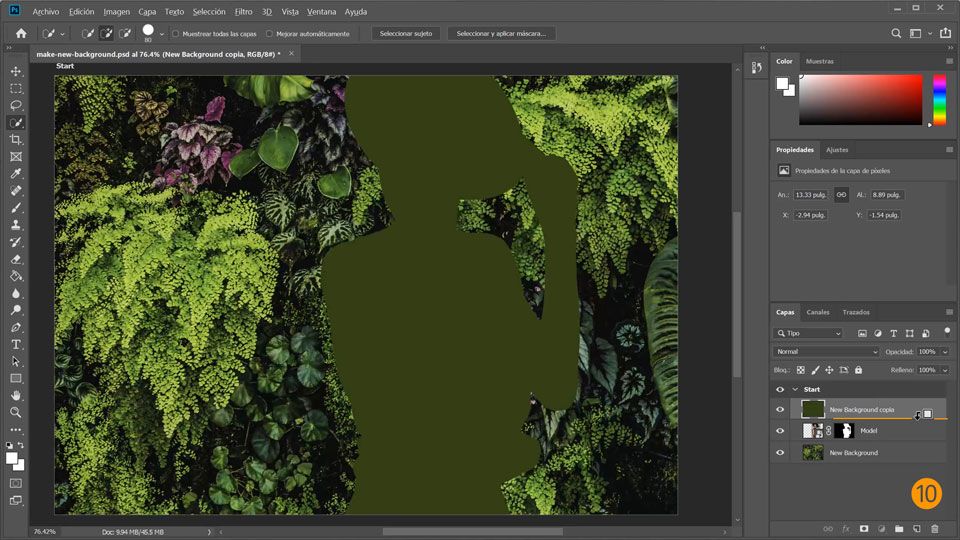
9. Haz clic en la capa New Background (Nuevo fondo) duplicada. Selecciona Filtro > Desenfocar > Media. Todo se vuelve de color verde.
10. Pulsa la tecla Alt y haz clic entre la capa verde y la capa de la modelo para crear una máscara de recorte. El verde rellena el espacio de la modelo.
11. Asegúrate de que esté seleccionada la capa verde y establece el Modo de fusión en Luz suave. Reduce el valor de Opacidad al 45 %.
Añade un efecto de color
12. En el panel Capas, selecciona Nueva capa de ajuste y, a continuación, Color sólido.
13. Elige un azul oscuro en el selector (por ejemplo, #080c56). Haz clic en OK.
14. En el panel Capas, establece el Modo de fusión en Luz suave. Reduce el valor de Opacidad al 50 %.
¡Ya está! Ahora es tu turno: sustituye un fondo en 60 segundos con Photoshop. Descarga los recursos o utiliza los tuyos propios y comparte tu imagen en Facebook, Twitter e Instagram con #MadewithPhotoshop para recibir comentarios y conectar con otras mentes creativas.
Behance:https://www.behance.net/live Únete a nuestros livestreams en directo y encuentra inspiración con profesionales trabajando en proyectos reales en en tiempo real.

You can control how Adobe websites use cookies and similar technologies by making choices below. But note that if you disable cookies and similar technologies entirely, Adobe websites may not function properly.
Cookies are small text files stored by your web browser when you use websites. There are also other technologies that can be used for similar purposes like HTML5 Local Storage and local shared objects, web beacons, and embedded scripts. These technologies help us do things like remembering you and your preferences when you return to our sites, measure how you use the website, conduct market research, and gather information about the ads you see and interact with.
You can make choices in the menu below about what cookies and other technologies you want us to use on Adobe sites when you visit them from this browser. You can always change those choices later by clicking on the Cookie Preferences link at the bottom of the page.
If enabled:
We can improve your experience by tailoring the site and the content to things we think might be of interest
We can better keep track of your preferences — like what language you prefer to use
We will better understand your likely interests so we can provide you more relevant Adobe ads and content on non-Adobe websites and in non-Adobe apps
It will help us improve the performance of our website and those of our partners who use the Adobe Experience Cloud
If disabled:
We won’t be able to remember you from session to session so the experience may not be tailored to your interests
You’ll still have access to the content of the site but certain features that depend on cookies may not function
You’ll still see ads, they just may not be as relevant to you
General information
You can control how Adobe websites use cookies and similar technologies by making choices below. But note that if you disable cookies and similar technologies entirely, Adobe websites may not function properly.
Cookies are small text files stored by your web browser when you use websites. There are also other technologies that can be used for similar purposes like HTML5 Local Storage, web beacons, and embedded scripts. These technologies help us do things like remembering you and your preferences when you return to our sites, measure how you use the website, conduct market research, and gather information about the ads you see and interact with.
You can make choices in the menu below about what cookies and other technologies you want us to use on Adobe sites when you visit them from this browser. You can always change those choices later by clicking on the Cookie Preferences link at the bottom of the page.
If enabled:
We can improve your experience by tailoring the site and the content to things we think might be of interest
We can better keep track of your preferences — like what language you prefer to use
We will better understand your likely interests so we can provide you more relevant Adobe ads and content on non-Adobe websites and in non-Adobe apps
It will help us improve the performance of our website and those of our partners who use the Adobe Experience Cloud
If disabled:
We won’t be able to remember you from session to session so the experience may not be tailored to your interests
We’ll still count your use of our site and services
You’ll still have access to the content of the site but certain features that depend on cookies may not function
You’ll still see ads, they just may not be as relevant to you
Operate the site and core servicesOperate site and measure engagement
Always active
These cookies are required, and they are used to enable the site and related services core functionality. Without them the site could not operate, so they cannot be disabled.
These cookies enable the site and related services’ core functionality and collect statistics about user engagement, such as counting active use to help us understand trends. These cookies cannot be disabled.
Measure performance
These cookies are used to analyze site usage to measure and improve performance. Without them Adobe cannot know what content is most valued and how often unique visitors return to the site, making it hard to improve information we offer to you.
These cookies are used to analyze site usage to measure and improve performance. Without them Adobe cannot know what content is most valued, making it hard to improve information we offer to you.
Extend functionality
These cookies are used to enhance the functionality of Adobe sites such as remembering your settings and preferences to deliver a personalized experience; for example, your username, your repeated visits, preferred language, your country, or any other saved preference.
Personalize advertising
These cookies are used to enable Adobe and our partners to serve ads more relevant to your interests. Without them you will still see ads, but they might not be as relevant to you.
Personalize advertising
These cookies are used to enable Adobe and our partners to serve ads more relevant to your interests. Without them you will still see ads, but they might not be as relevant to you.