Top cities searching for the best times to post on LinkedIn
content-3-short
content-4
Post with purpose
content-4-short
Summary
If you're using LinkedIn to grow your brand, you've probably wondered: When is the best time to post? We surveyed business owners and marketers and analyzed search trends across the 100 most populous US cities to find out the days and times people are most likely to post and engage on LinkedIn. What we found can help you schedule smarter, reach wider, and maximize your content's performance.
Key takeaways
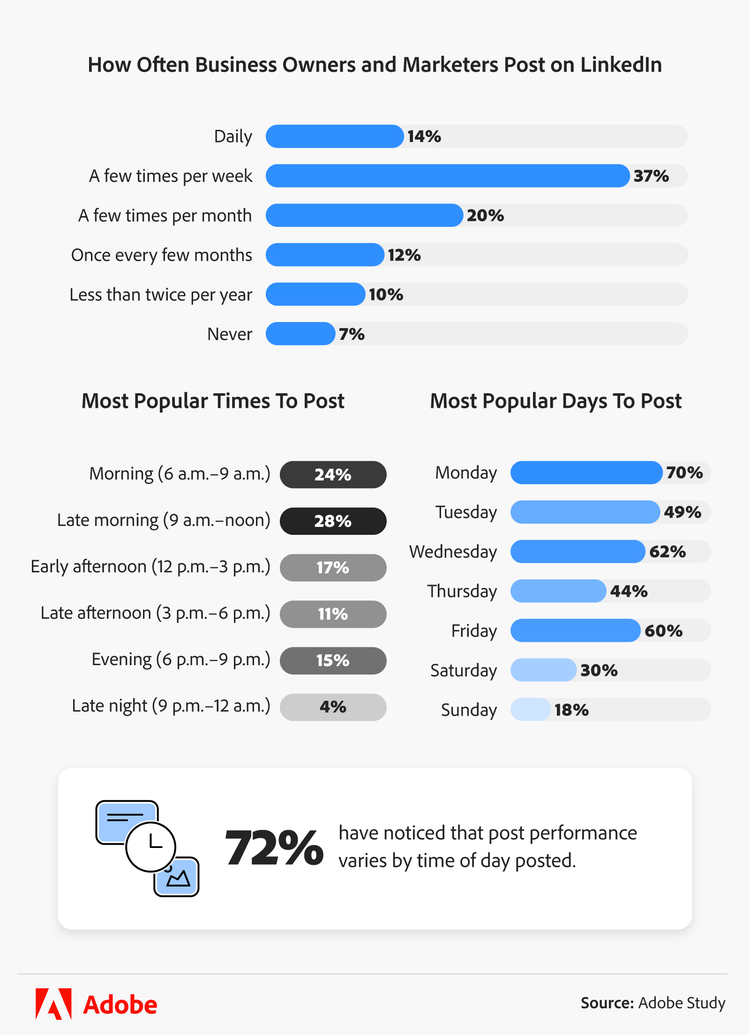
Late morning (between 9 a.m. and 12 p.m.) is the most popular time for business owners and marketers to post on LinkedIn.
Monday is their most popular day to post (70%), followed by Wednesday (62%) and Friday (60%).
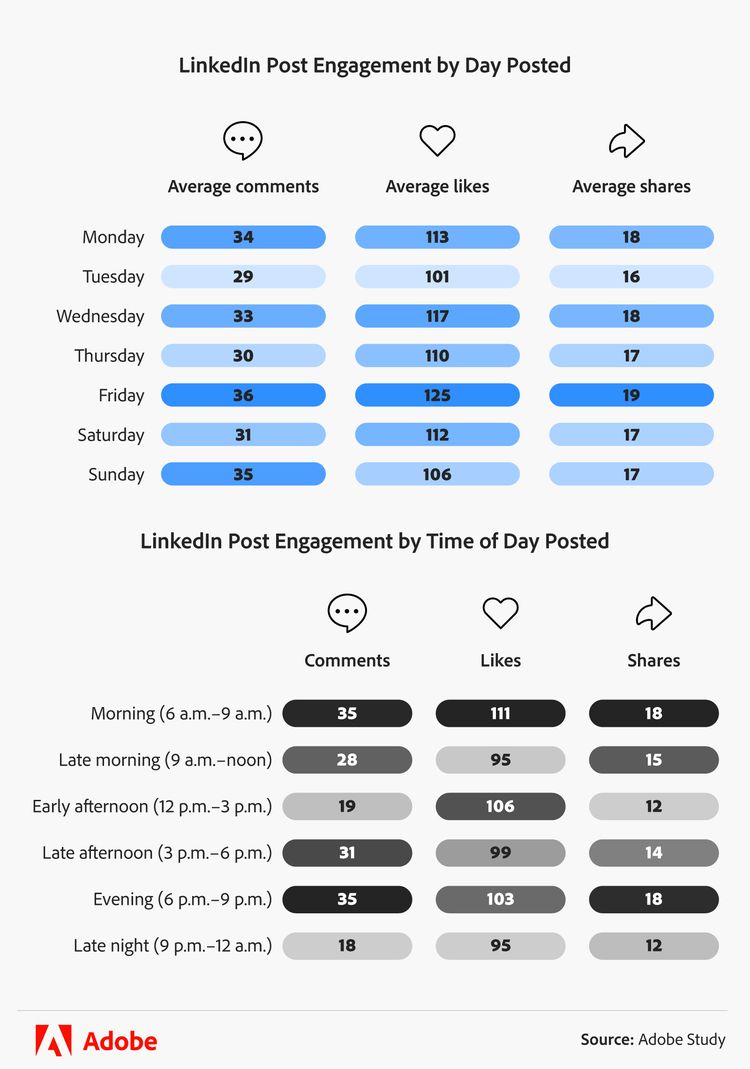
Friday posts get the highest average likes (125), comments (36), and shares (19) for business owners and marketers.
style
long-form, long-form-blog, xxl-spacing-top
When professionals post on LinkedIn
Knowing when others post can help you time your own content. But it’s important to be realistic about how much volume you can create and manage.
Nearly three-quarters of business owners and marketers (72%) said the time of day they post on LinkedIn directly impacts their posts' performance.
The most popular window for sharing social media posts on LinkedIn was late morning. Between 9 a.m. and 12 p.m. Monday stood out as the top day of the week to post, with 70% of respondents posting on this day. Wednesday followed with 62%, and Friday rounded out the top three with 60%.
This could make for a manageable every-other-weekday social media calendar posting strategy with just a two-day weekend gap.
style
long-form, long-form-blog, l-spacing
How post timing affects LinkedIn post engagement
When you post can influence visibility and change how (and if) your target audience interacts with your content. Although business owners and marketers preferred to post in the later morning hours, the engagement metrics painted a different picture.
Posts published early in the morning, between 6 a.m. and 9 a.m., saw the most likes on average (111). And posts shared during the late morning or late night hours received the fewest average likes each (95). However, these less-”liked" time slots (early morning and evening posts) racked up the most shares, averaging 18 shares per post. Friday posts delivered the highest overall engagement, receiving averages of 125 likes, 36 comments, and 19 shares each.
style
long-form, long-form-blog, l-spacing
Top cities searching for the best times to post on LinkedIn
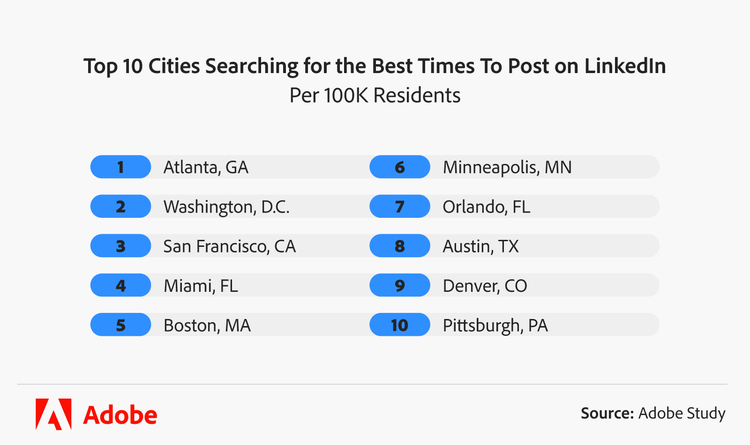
People in certain cities paid more attention to timing than others. Search data reveals which US cities are most interested in strategically timing their LinkedIn posts.
Of the cities we analyzed, people in Atlanta, Washington D.C., and San Francisco searched the most per 100K residents for "best time to post on LinkedIn." This indicates that professionals in these areas are more actively seeking ways to boost their content's reach on the platform.
style
long-form, long-form-blog, l-spacing
Post with purpose
Timing your LinkedIn posts for maximum engagement potential can give you an edge. Most professionals favor late morning and early in the workweek, but the highest engagement often comes from early morning or end-of-week posts. Experiment with timing, track what works, and let your content do the talking — ideally right when people are there to see it and ready to engage with it.
Methodology
Adobe Express surveyed 607 business owners and marketers on June 12, 2025, using SurveyMonkey, to understand how they leverage LinkedIn for content sharing and engagement. Additionally, Google search volume data was analyzed for "best time to post on LinkedIn" per 100,000 residents across the 100 most populous US cities from the past two years.
Limitations: This study reflects self-reported behavior and intent, not exact platform performance. Search data captures interest but not actual LinkedIn posting habits or results.
Fair use statement
If you'd like to share insights from this article, you're welcome to do so for noncommercial purposes. Please include a link back to this page and credit Adobe Express as the source.
You can control how Adobe websites use cookies and similar technologies by making choices below. But note that if you disable cookies and similar technologies entirely, Adobe websites may not function properly.
Cookies are small text files stored by your web browser when you use websites. There are also other technologies that can be used for similar purposes like HTML5 Local Storage and local shared objects, web beacons, and embedded scripts. These technologies help us do things like remembering you and your preferences when you return to our sites, measure how you use the website, conduct market research, and gather information about the ads you see and interact with.
You can make choices in the menu below about what cookies and other technologies you want us to use on Adobe sites when you visit them from this browser. You can always change those choices later by clicking on the Cookie Preferences link at the bottom of the page.
If enabled:
We can improve your experience by tailoring the site and the content to things we think might be of interest
We can better keep track of your preferences — like what language you prefer to use
We will better understand your likely interests so we can provide you more relevant Adobe ads and content on non-Adobe websites and in non-Adobe apps
It will help us improve the performance of our website and those of our partners who use the Adobe Experience Cloud
If disabled:
We won’t be able to remember you from session to session so the experience may not be tailored to your interests
You’ll still have access to the content of the site but certain features that depend on cookies may not function
You’ll still see ads, they just may not be as relevant to you
General information
You can control how Adobe websites use cookies and similar technologies by making choices below. But note that if you disable cookies and similar technologies entirely, Adobe websites may not function properly.
Cookies are small text files stored by your web browser when you use websites. There are also other technologies that can be used for similar purposes like HTML5 Local Storage, web beacons, and embedded scripts. These technologies help us do things like remembering you and your preferences when you return to our sites, measure how you use the website, conduct market research, and gather information about the ads you see and interact with.
You can make choices in the menu below about what cookies and other technologies you want us to use on Adobe sites when you visit them from this browser. You can always change those choices later by clicking on the Cookie Preferences link at the bottom of the page.
If enabled:
We can improve your experience by tailoring the site and the content to things we think might be of interest
We can better keep track of your preferences — like what language you prefer to use
We will better understand your likely interests so we can provide you more relevant Adobe ads and content on non-Adobe websites and in non-Adobe apps
It will help us improve the performance of our website and those of our partners who use the Adobe Experience Cloud
If disabled:
We won’t be able to remember you from session to session so the experience may not be tailored to your interests
We’ll still count your use of our site and services
You’ll still have access to the content of the site but certain features that depend on cookies may not function
You’ll still see ads, they just may not be as relevant to you
Operate the site and core servicesOperate site and measure engagement
Always active
These cookies are required, and they are used to enable the site and related services core functionality. Without them the site could not operate, so they cannot be disabled.
These cookies enable the site and related services’ core functionality and collect statistics about user engagement, such as counting active use to help us understand trends. These cookies cannot be disabled.
Measure performance
These cookies are used to analyze site usage to measure and improve performance. Without them Adobe cannot know what content is most valued and how often unique visitors return to the site, making it hard to improve information we offer to you.
These cookies are used to analyze site usage to measure and improve performance. Without them Adobe cannot know what content is most valued, making it hard to improve information we offer to you.
Extend functionality
These cookies are used to enhance the functionality of Adobe sites such as remembering your settings and preferences to deliver a personalized experience; for example, your username, your repeated visits, preferred language, your country, or any other saved preference.
Personalize advertising
These cookies are used to enable Adobe and our partners to serve ads more relevant to your interests. Without them you will still see ads, but they might not be as relevant to you.