Image file conversion just got faster.
Adobe Express makes it easy to get the file type you need SVG, JPG, PNG or even Transparent Files in just a few clicks.


PHOTOGRAPHY
At some point, you may need to choose between JPEG and PNG formats for saving your digital images. These are two of the most popular raster (that is, pixel-based) image file types used online. Learn about the similarities and differences between JPEGs and PNGs and find out when to use — and not to use — each file type based on quality, compression, transparency, and usage in web or print contexts.
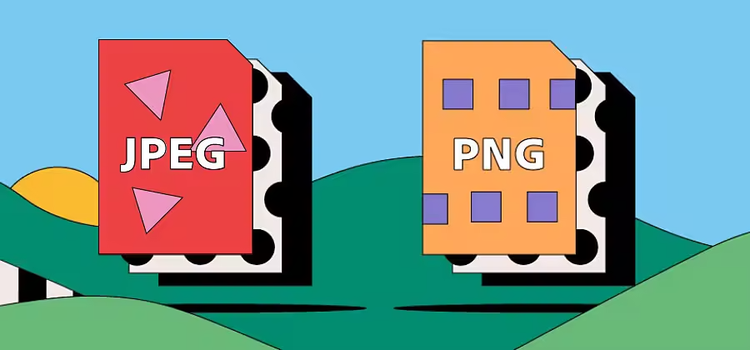

Joint Photographic Experts Group (JPEG) files are one of the most common ways to store digital photos. Many modern cameras use them to shoot and store images. JPEGs go through a compression process to significantly reduce the image file size — making them easier to store and load on webpages. JPEG images use lossy compression and can contain up to 16 million colours, making them suitable for rich, detailed photographs.
Portable Network Graphics files (PNGs) are compressible and like JPEGS, can handle 16 million colours. They are a type of raster image format known for their lossless compression. They’re mostly used for web graphics, logos, charts and illustrations, rather than high-quality photographs, because they take up more storage space than JPEGs. One thing PNGs offer that JPEGs don’t is the ability to handle graphics with transparent backgrounds.
Despite their similarities and widespread use, there are many differences between JPEG and PNG files. Because of their different compression processes, JPEGs contain less data than PNGs — and therefore, are usually smaller in size. Unlike JPEGs, PNGs support transparent backgrounds, making them preferred for graphic design.
Key differences include:
Understanding these differences between JPEG and PNG helps users choose the best format based on quality, file size, and design needs.
Find out more differences below:
It’s important to understand the different compression processes each file type uses when considering whether to use JPEG or PNG as your file type.
JPEGs are designed to efficiently store high-quality digital photos packed with detail and colour. They compress large images into much smaller file sizes, making them easier to share and upload online. But this comes at a price.
JPEGs use a lossy compression process — meaning some data from the image is permanently deleted when it’s made smaller. This could compromise the quality of your file in the long term because each time you edit and save it, you lose more data. Because of this, some professional photographers prefer using uncompressed raw files.
In contrast, PNG files benefit from lossless compression. This means no data is lost when the image is compressed — the quality stays the same no matter how many times you edit and save the file. The image won’t become blurry or distorted, making PNGs ideal for sharp logos and graphs containing lots of figures.
In summary:
- JPEG = lossy compression → smaller size, reduced quality
- PNG = lossless compression → larger size, preserved quality
This core difference between JPG and PNG affects performance, editing, and image integrity across different use cases.
They may compromise on quality with their lossy compression, but JPEGs can crunch large images down into more manageable file sizes. This is helpful if you don’t have a huge amount of disc space to play with — and can speed up page loading times, too.
The trade-off with PNGs is that their lossless compression creates bigger files, since they retain much more information. They’re generally larger than JPEGs and GIFs, use up additional storage space and potentially slow down the responsiveness of web pages.
When choosing between PNG vs JPG, consider whether smaller size or higher image fidelity is more important for your project.
One of the major differences between JPEG and PNG files is their ability to handle transparency in images.
JPEGs don’t support transparent backgrounds. Non-rectangular logos and graphics featuring lots of text are unlikely to work well in this format as a result. JPEG images will also struggle to blend seamlessly with web pages that feature different background colours.
PNG files, on the other hand, do support transparency. Web designers can apply transparent backgrounds to their images - and even different degrees of transparency. It means PNG images integrate better with different background colours on a page and text is easier to read.
This transparency support is a key difference between PNG and JPG files — especially for design-heavy formats like logos, icons, and overlays.
JPEGs are hugely popular with photographers and businesses that manage large image libraries. Their smaller file size allows multiple digital photos to be shared and downloaded simultaneously. By making efficient use of storage space, JPEGs can keep an image library relatively streamlined, with no long wait times for files to open.
Given their widespread usage, JPEG files are viewable and editable across a vast array of operating systems and programs — so you’re unlikely to need specialised software to work on them.
In comparison, PNGs aren’t really built to store high-quality photos. They specialise in handling detailed, high-contrast web graphics. They’re often the default format for screenshot images since they can provide a highly accurate representation of your desktop and don’t compress pixels together. A huge colour palette and lossless compression ensure that they retain plenty of detail — making them a popular choice for illustrations and charts.
The ability of PNGs to handle transparent images also gives them an edge over JPEGs when designing logos. For example, you can create a company logo with a transparent background, then seamlessly layer it on top of other images or webpages.
As with JPEGs, you can open PNGs in many programmes and web browsers. PNGs were specifically designed to be an upgrade on the older GIF format — meaning they’re patent-free and offer a much broader choice of colours.
To summarise:
- Use JPEG for digital photos, photo storage, and web sharing
- Use PNG for transparency, illustrations, and screenshots
The choice between JPEG vs PNG depends on whether image quality, compression, or design flexibility is your top priority.
Choosing between JPEG and PNG isn’t just about quality, it depends on what you're creating, how it will be used, and what matters most: file size, clarity, or flexibility. Here are some common scenarios where one format is better suited than the other:
In short, JPEG is ideal for full-colour photos where reduced file size is key, while PNG is best for graphics that require sharpness, transparency, or repeated editing. Both formats have their strengths, and choosing the right one depends on the visual content and how it will be used.

Adobe Express makes it easy to get the file type you need SVG, JPG, PNG or even Transparent Files in just a few clicks.
₹733.96/moincl. GST
Get Photoshop on desktop and iPad as part of Creative Cloud.
₹2,714.00/moincl. GST
Get 20+ Creative Cloud apps, including Photoshop on desktop and iPad.
See what's included | Learn more
Save over 70% on Creative Cloud Pro.
See terms | Learn more

Based on your location, we think you may prefer the United States website, where you'll get regional content, offerings, and pricing.