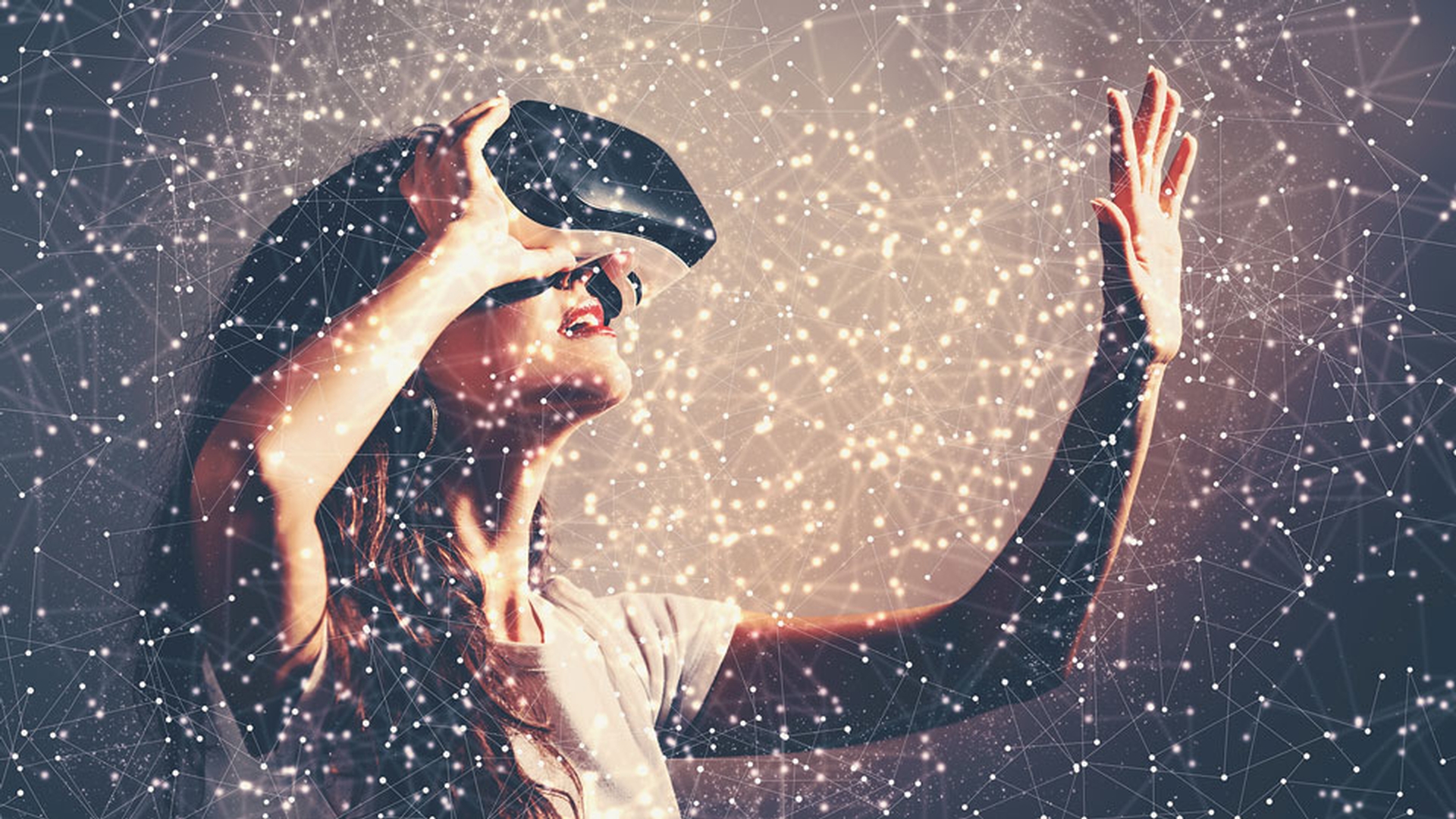
Adobe Premiere Pro CC includes tools that make it easy to edit 360 and VR footage.
In this tutorial I will show you how easy it is to view 360 and VR footage in Premiere Pro CC.
I will also show you how to add logos and text to your 360 video so that it looks correct in the scene and how to apply VR transitions to your 360 footage.
If you want to follow along you can download the assets that accompany this tutorial.
In Premiere Pro CC I've got some 360 footage here in my Sequence, as we can see it's in the equirectangular format and that's a format of what 360 footage will likely be in after it's been stitched together.
And that's the format we needed to be in when we are working with it here in Premiere Pro CC.
Very quickly I want to show you how you can add the Toggle VR Display button to the Program Monitor toolbar.
Just come over here to a little Plus icon, click that and you're going to see the Toggle VR Display button.
I'm just going to click it and drag it to my Monitor toolbar and click OK.
And now we can go ahead and select the Toggle VR Display and this will show us kind of a POV perspective of our 360 video that we can click and drag around to look at our 360 footage.
Whenever you want to turn this on and off it's very easy, just click on that little icon and it will toggle it on and off.
Now it's important to note that equirectangular footage requires specific effects designed to work on 360 and VR video in order for them to look correct.
Just to demonstrate I'm going to apply a traditional Gaussian Blur effect to my 360 video.
Let’s select the Blur and apply it to my footage and under the Effect Controls, I'm going to increase the Blurriness here and I'm also going to turn on Repeat Edge Pixels.
Now I've actually pan around here on the 360 video.
If we look at the back of the video we're going to see we get this seam line right here and that's an artifact you're going to get whenever you use effects that aren't created specifically for VR footage.
We will also get some distortion up here at the top and bottom area, you can see how it's kind of pinching all the blur together at the top up there and the same thing will result down here at the bottom and we definitely don't want that on our 360 video.
So, I'm going to go ahead and select that Blur effect and delete it.
Premiere Pro CC features specific effects that are designed to work on 360 footage and we can toggle those VR Effects by coming over to the Effects panel and just typing in VR.
And you're going to see the Immersive Video effects which has all of our 360 VR effects inside of it and those are signaled by the VR in the name.
So very quickly I'm just going to apply the VR Blur effect to my 360 footage and I'm going to come here to the Effect Controls and increase the Blurriness.
And now if we look around our 360 shot we're going to see we don't get any seam lines on the back and also at the top and bottom areas of our video, at the pole areas it looks correct for our 360 video.
That's the key difference that a specific VR effect is going to have on your 360 footage.
I'm going to go ahead and delete that Blur effect and show you some of the other powerful 360 VR effects in Premiere Pro CC.
To demonstrate this, I am going to turn back off the Toggle VR Display.
Let's take a look at the VR Rotate Sphere effect.
I'm just going to drag that on to my 360 footage.
And what this allows us to do is actually pan and tilt around our 360 footage seamlessly.
So, you can see I have the Pan axis here.
If I just click and drag you can see I can infinitely rotate around my 360 footage and so with equirectangular video what is ever directly in the center that's going to be the forward-facing area.
So, if you're looking this in a POV perspective if I just toggle back on the display here you can see right now we're facing the front of our 360 video.
I can go ahead and toggle that back off.
However, if I want this not to be the front of my video I could easily just pan it around to another area.
If I go ahead and toggle this we could have this be the front of our video if we needed to.
And so typically with 360 footage you're going to want to do some adjusting with the Panning.
I will go ahead and turn this back off.
You're also going to want to do some adjustments usually on the Tilt axis because typically your 360 footage isn't going to come in just being straight on the horizon line.
You're going to need to fine-tune it and using the VR Rotate Sphere effect is a nice easy way to do that right inside of Premiere Pro CC.
Now I'm going to go ahead and delete the VR Rotate Sphere effect.
Let's take a look at how we can add in a logo or some text and make it look correct in our 360 video.
So, I'm just going to drag in this Adobe_Logo.png that I have and place it on top of my 360 footage.
Let's go ahead and toggle back in the VR Display mode.
And now as we look at the logo we're going to notice something, the logo is kind of getting wrapped around and it's getting bent at the edges and if you think about it this kind of makes sense.
So, if we go out of this VR Display mode, our logo looks correct from this perspective but our footage obviously looks distorted because it's basically been unfolded from a sphere.
So, when we go back and look at this from our POV view the logo is actually getting bent because this footage is essentially getting wrapped around in a spherical shape.
And that's why we're getting this distorted result.
So, if we want this to look correct we can apply what's called the VR Plane to Sphere effect.
That takes a plane image something that's flat and conforms it so it looks correct in the spherical view.
So, I'm going to select that effect and apply it to my logo and immediately you're going to see now the logo looks flat and looks correct for this perspective.
If we go ahead and toggle out of the VR Display mode, in this view you're going to see it's kind of conforming it now to a normal 360 video, the way it's kind of bending around there, if I go ahead and toggle this on and off we can see that.
We also have quite a few other controls here such as the Scale, we can change the size of the logo if we need to, you can see we can get it really close to the 360 camera and we have other options as Rotate Source or Rotate Projection which is much like Rotate Sphere because you can see you can pan it around the footage and place it wherever you need to.
It's definitely the fastest way of adding elements in your 360 video and ensuring that they look correct to the viewer.
Finally, let's take a look at transitions with 360 video.
So, I'm going to drag in another piece of footage here, place it in my Timeline, let's go ahead and toggle back on the VR Display.
If I just track along here in the Sequence you're going to see a hard cut in 360 video can be quite jarring because it's like we're immediately teleported out of that location.
So, a lot of times you're going to want to use a Subtle Wipe transition which can also help guide the viewer’s attention to specific areas and it's a lot more subtle and not going to be as jarring.
However, once again we need to use transitions that are formatted specifically for 360 VR video.
Just to demonstrate let's apply a traditional transition effect to our 360 footage and see what happens.
So, I'm going to go under Video Transitions and I'm going to select an VR Iris transition here and I'm going to select VR Iris Round, just place it between the two clips and I'll zoom in here so we can see this a little closer.
Now let's move the Play head and just kind of see frame by frame what's happening.
So, we can see the Round Iris transition is appearing, we can see our secondary footage.
However, when it gets over about halfway or so we're going to note something kind of weird happening around the edges of that circle.
It's not quite looking correct.
And you can see at the very top of the video we're getting kind of a pinch up here where it's looking distorted and then it really starts to fall apart near the end here where it's really just more like a slice instead of a Circle Iris that we wanted.
So, you can see how the distortion really falls apart.
And again, this is on a transition, it's not formatted specifically for 360 VR video.
So, I'm going to go ahead and delete that transition.
Again, Premiere Pro CC has specific transitions that are created for 360 VR video, so I am going to come back over here to Effects and type in vr.
And if we scroll down we're going to see Video Transitions, Immersive Video and we have all these VR Transitions and I want to select the VR Iris Wipe transition and just apply it in between my two clips.
So, let's jump back up to the front of this again.
If we go ahead and scroll through this we're going to see the Iris comes on, you're going to see this is looking much more natural for a 360 video.
It's coming across in an even circle, we are not getting any distortion at the top and it just sweeps across there.
What's great about these VR transitions, so we have a lot of control.
If I click on the transition here I can obviously control the length of the transition but I have other Controls here such as the Feathering, if I want to dial this all the way down we get kind of a portal look, how it just sweeps across with a hard edge.
We are going to also change the Point of Interest, so I can actually move this around from where I want this to start and in from.
And I can even move it all the way up to the top of the video if I go ahead and set this at 0.0.
We're going to see this is going to look like it kind of collapses down across the entire video and so that can be a very cool unique effect there.
And again, you can change the Feathering, make it blend a lot smoother, it's just a much more natural transition for 360 VR videos.
And that's an overview of editing a 360 and VR footage in Adobe Premiere Pro CC.