Easily create titles directly on your video using the Type tool in the Essential Graphics panel in Adobe Premiere Pro. Add shapes, text, images, and video to layers that you can rearrange and adjust with tools you’re familiar with from other Adobe Creative Cloud apps. Add motion or effects and export your titles as Motion Graphics templates that you can share via Creative Cloud Libraries.
With your sequence already open in the Timeline panel, click Graphics in the workspace bar at the top of the screen or choose Window > Workspaces > Graphics from the main menu.
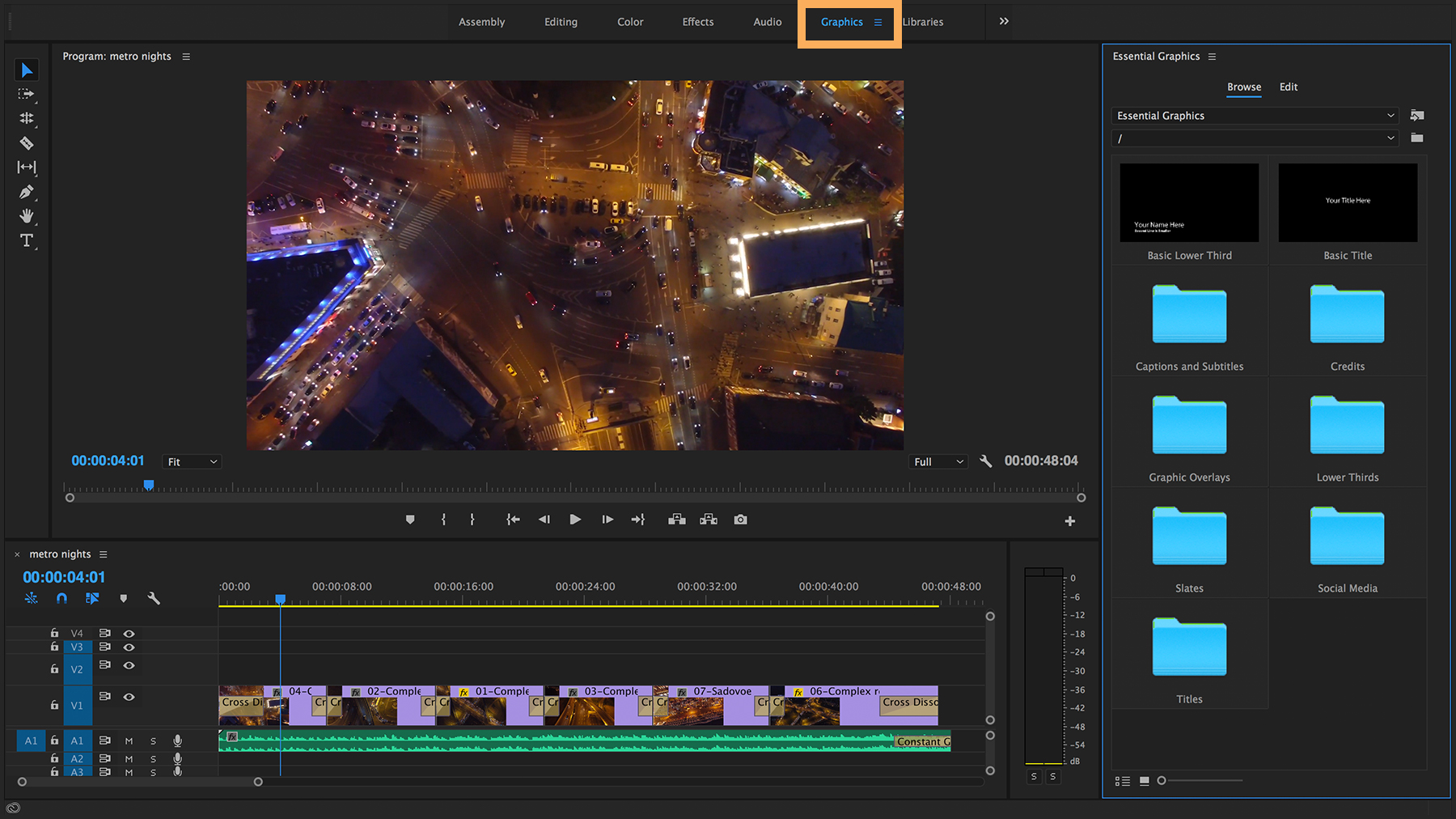
Select a Motion Graphics template
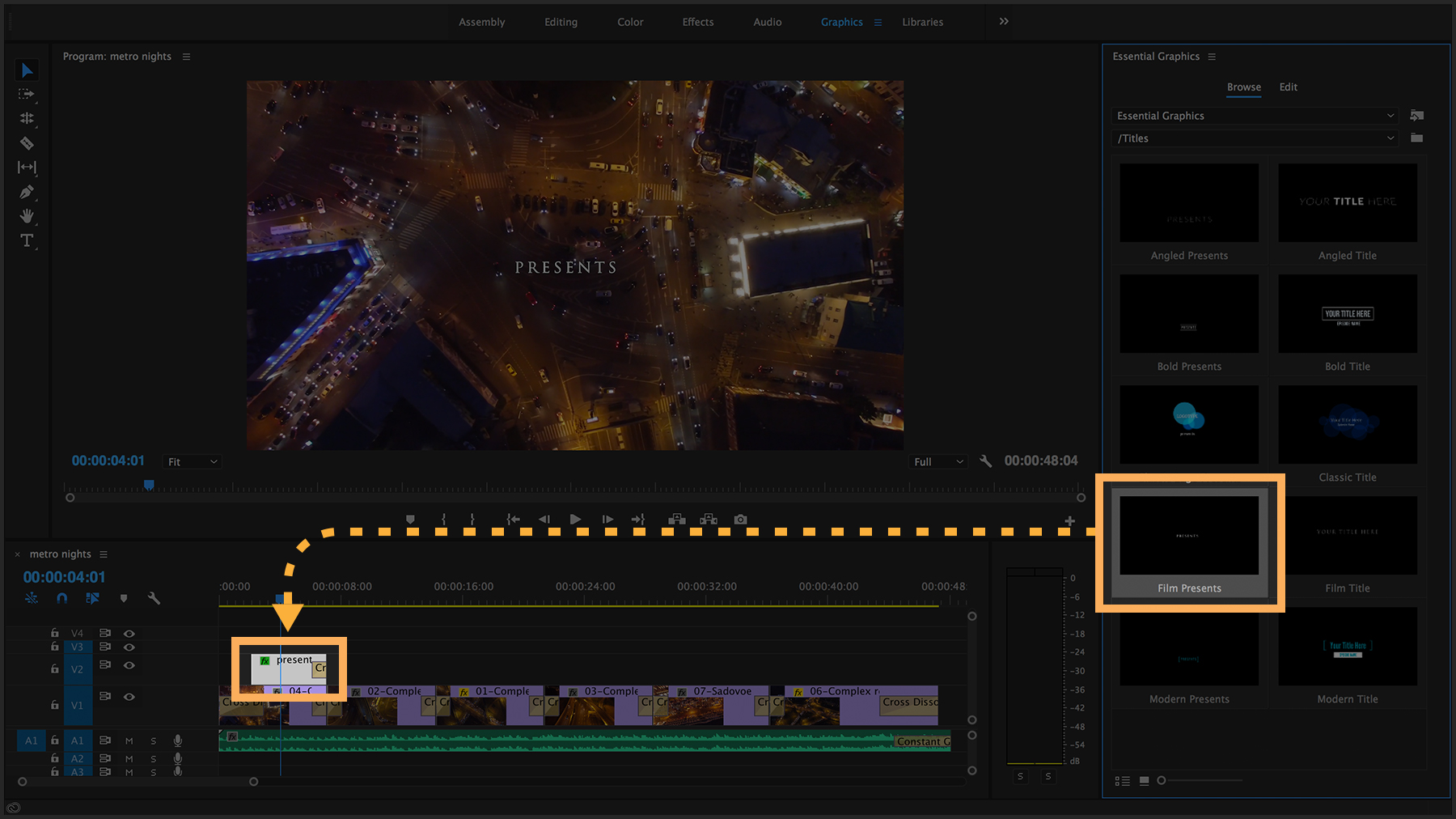
Browse in the Essential Graphics panel to the Titles folder and double-click to open the folder. Drag the Film Presents Motion Graphics template onto a video track in the Timeline, where it becomes a clip with the default duration. Adjust the clip’s timing and duration to suit your footage. You may wish to add a transition to improve the way the title appears in your sequence.
Note: Some templates use Adobe Typekit fonts that you may not have installed. Check the appropriate font in the Resolve Fonts dialog box to sync it with your system.
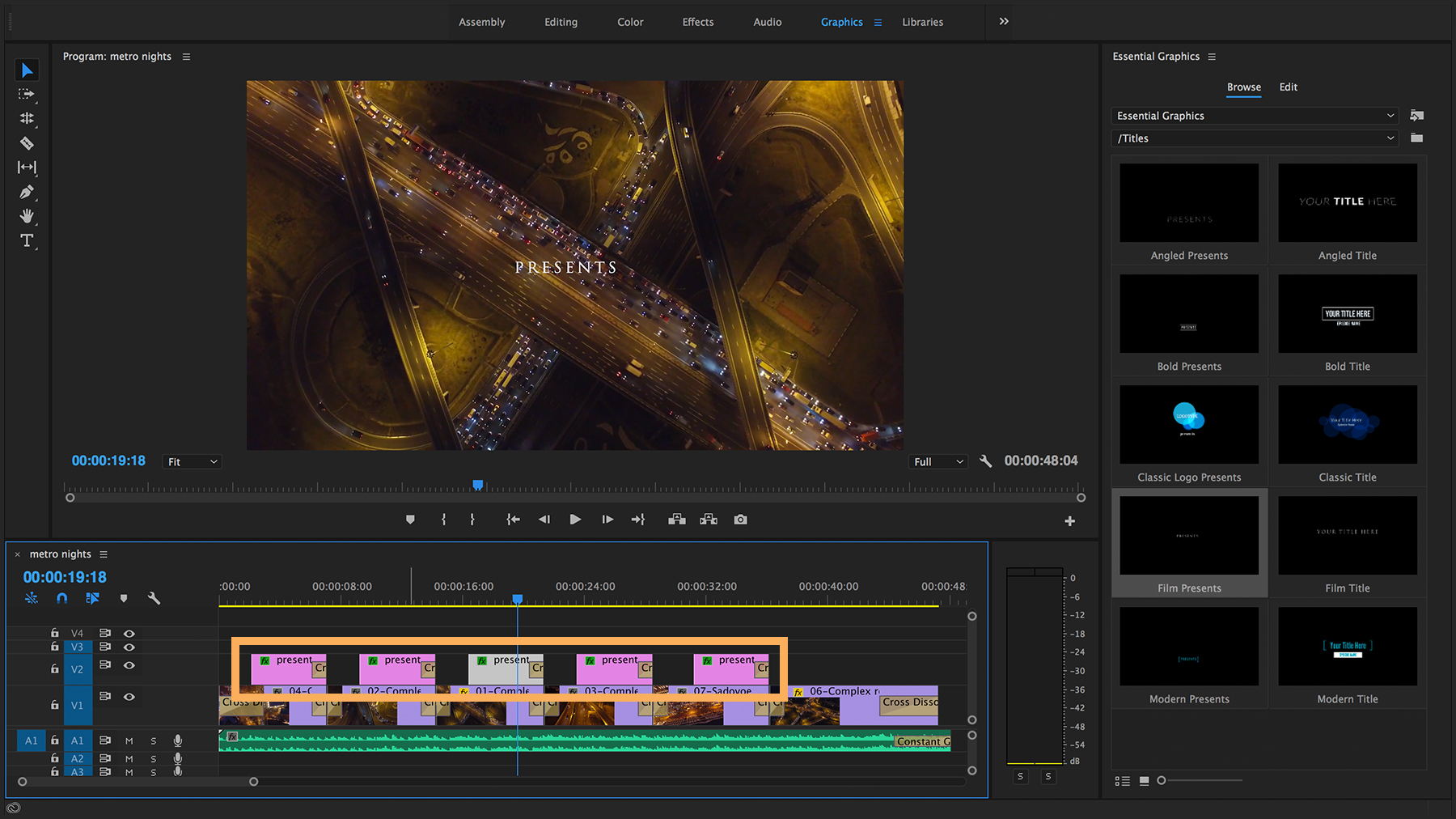
Copy the motion graphic throughout your project
To add credits in the same style throughout your project, Alt-drag (Windows) or Option-drag (macOS) the clip to duplicate it elsewhere in your sequence.
Edit the template text
Select a title clip in your sequence. It will appear in the Program Monitor. Select the Type tool and click once on the sample text so that you see a red bounding box. Now you can edit the displayed text. Do this for all your titles.
Edit the template style
With a title clip already selected in your sequence and the Selection tool active, click once on the text in the Program Monitor so that you see a blue bounding box. Select the Edit tab in the Essential Graphics panel and then, in the Text section, change the typeface to a different font or font style. Adjust the font size slider to increase or decrease the size. Change other text properties as you wish.
Create or apply a master style
When you’re satisfied with your text styling, open the Master Styles submenu and choose Create Master Text Style. Give the new master style a name and click OK.
Now you can open other title clips in the Program Monitor and apply the master style you just created by choosing it in the Essential Graphics panel. You need to make the text active in the Program Monitor first in order to see its properties displayed in the Essential Graphics panel.
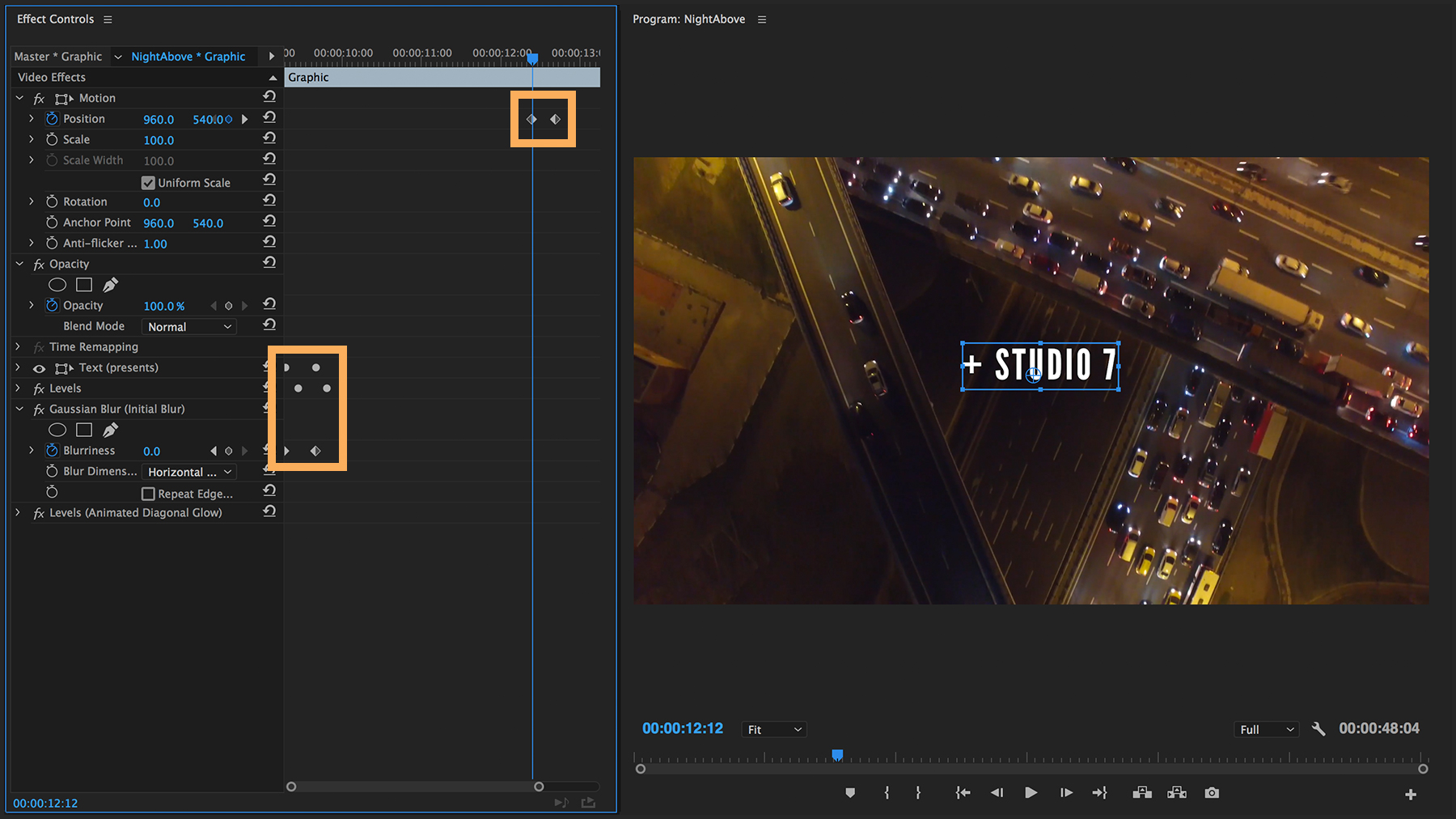
Add motion with keyframes
To enhance your title visually, feel free to animate the parameters of effects you apply to a title clip — for example, animate the position and size using keyframes — or add a Cross Dissolve effect at the beginning or end of a clip. The templates that ship with Premiere Pro employ creative uses of these effects: Convolution Kernel, Fast Color Corrector (Blue Lens), Gaussian Blur, or Levels (Animated Diagonal Glow).
Export a Motion Graphics template
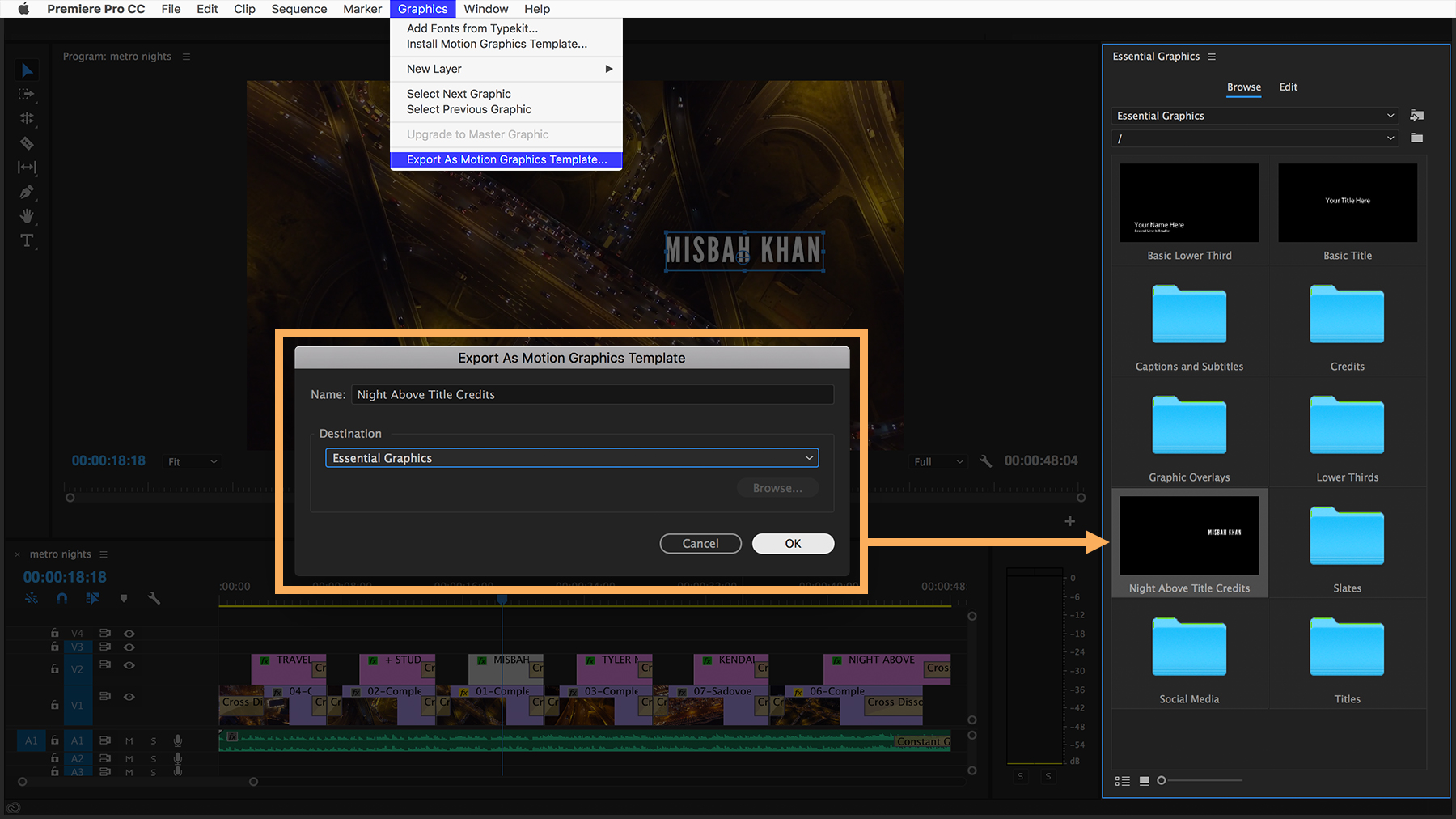
Select a title clip in your sequence. Select Graphics > Export As Motion Graphics Template from the main menu. Rename the template if you wish and choose a destination, whether within the Essential Graphics panel, on your local drive, or in your Creative Cloud Library. Click OK. The template you export is now available for use in future projects and sharable with others via Creative Cloud Libraries. Access them later through the Essential Graphics panel or in your Library (under Motion Graphics Templates).
To learn about creating Motion Graphics templates in Adobe After Effects for use by editors in Premiere Pro, seeCreate Motion Graphics templates .

You can control how Adobe websites use cookies and similar technologies by making choices below. But note that if you disable cookies and similar technologies entirely, Adobe websites may not function properly.
Cookies are small text files stored by your web browser when you use websites. There are also other technologies that can be used for similar purposes like HTML5 Local Storage and local shared objects, web beacons, and embedded scripts. These technologies help us do things like remembering you and your preferences when you return to our sites, measure how you use the website, conduct market research, and gather information about the ads you see and interact with.
You can make choices in the menu below about what cookies and other technologies you want us to use on Adobe sites when you visit them from this browser. You can always change those choices later by clicking on the Cookie Preferences link at the bottom of the page.
If enabled:
We can improve your experience by tailoring the site and the content to things we think might be of interest
We can better keep track of your preferences — like what language you prefer to use
We will better understand your likely interests so we can provide you more relevant Adobe ads and content on non-Adobe websites and in non-Adobe apps
It will help us improve the performance of our website and those of our partners who use the Adobe Experience Cloud
If disabled:
We won’t be able to remember you from session to session so the experience may not be tailored to your interests
You’ll still have access to the content of the site but certain features that depend on cookies may not function
You’ll still see ads, they just may not be as relevant to you
General information
You can control how Adobe websites use cookies and similar technologies by making choices below. But note that if you disable cookies and similar technologies entirely, Adobe websites may not function properly.
Cookies are small text files stored by your web browser when you use websites. There are also other technologies that can be used for similar purposes like HTML5 Local Storage, web beacons, and embedded scripts. These technologies help us do things like remembering you and your preferences when you return to our sites, measure how you use the website, conduct market research, and gather information about the ads you see and interact with.
You can make choices in the menu below about what cookies and other technologies you want us to use on Adobe sites when you visit them from this browser. You can always change those choices later by clicking on the Cookie Preferences link at the bottom of the page.
If enabled:
We can improve your experience by tailoring the site and the content to things we think might be of interest
We can better keep track of your preferences — like what language you prefer to use
We will better understand your likely interests so we can provide you more relevant Adobe ads and content on non-Adobe websites and in non-Adobe apps
It will help us improve the performance of our website and those of our partners who use the Adobe Experience Cloud
If disabled:
We won’t be able to remember you from session to session so the experience may not be tailored to your interests
We’ll still count your use of our site and services
You’ll still have access to the content of the site but certain features that depend on cookies may not function
You’ll still see ads, they just may not be as relevant to you
Operate the site and core servicesOperate site and measure engagement
Always active
These cookies are required, and they are used to enable the site and related services core functionality. Without them the site could not operate, so they cannot be disabled.
These cookies enable the site and related services’ core functionality and collect statistics about user engagement, such as counting active use to help us understand trends. These cookies cannot be disabled.
Measure performance
These cookies are used to analyze site usage to measure and improve performance. Without them Adobe cannot know what content is most valued and how often unique visitors return to the site, making it hard to improve information we offer to you.
These cookies are used to analyze site usage to measure and improve performance. Without them Adobe cannot know what content is most valued, making it hard to improve information we offer to you.
Extend functionality
These cookies are used to enhance the functionality of Adobe sites such as remembering your settings and preferences to deliver a personalized experience; for example, your username, your repeated visits, preferred language, your country, or any other saved preference.
Personalize advertising
These cookies are used to enable Adobe and our partners to serve ads more relevant to your interests. Without them you will still see ads, but they might not be as relevant to you.
Personalize advertising
These cookies are used to enable Adobe and our partners to serve ads more relevant to your interests. Without them you will still see ads, but they might not be as relevant to you.