ACROBAT | 10-MINUTE READ
How to write a memo in 5 steps (with a free template).
Learn how to write an effective memo for eye-catching communication.
What is a memo?
Short for memorandum, a memo is a concise internal message primarily written in professional environments. Unlike sending an email — a more casual form of communication to one or several recipients — memos are considered official company correspondence. However, they are less formal than letters, which are typically addressed to an external audience.
Memos can also be used to share timely information across non-profit institutions, community organisations or government agencies.They are a helpful tool for business operations in maintaining clear, efficient communication throughout an organisation.
The purpose of a memo is to convey a message in a concise format. It needs to explain what is happening and why, along with any required action items.
Reasons to write a memo.
Memos are written for a variety of topics, which is why businesses typically use a memo template that's easy to adjust and customise.. Memos provide information or address a problem. They can also be used to solicit feedback on company services, programmes or projects.
Other types of communication for memos include:
- Personnel changes
- Upcoming events and meetings
- Policy or process changes
- Product or marketing announcements
- Financial updates
- General business news
No matter the reason let us show you how to write a memo and ensure it’s a success.
How to write a memo in 5 steps
Memos should maintain a tone of professionalism and courtesy, regardless of the subject matter being addressed. Focus on presenting factual information and outlining actionable steps. Avoid using emojis, as they are not appropriate for formal business communication. Keep your memo concise, straightforward and easy to understand, ensuring that it includes only the most relevant details.
- Write an insightful heading.
The heading conveys the type of memo you’re writing. Even if you are distributing your memo content through email, you should still include the heading at the top since it clearly defines who the memo is for and who sent it.
The heading should include the following format:
To — the audience for the memo, such as All Employees or a department name
From — your name and job title
Date — the memo distribution date
Subject — the topic of the memo
The subject line should be as specific as possible. For instance, instead of “Personnel Update,” change the subject line to “Promotion of Steve Davis, VP of Marketing.” - Explain your purpose in the introduction.
As an introduction to the memo, highlight a summary of the situation, issue or problem. This paragraph is the purpose of the memo and conveys the most important information. - Provide relevant background details.
Provide the background and additional details about why the memo is being sent. Each memo type has a suggested context structure.
The context section of the memo may vary slightly depending on the purpose of the memorandum, from general announcements and business problems to process updates, project statuses or events. However, generally, it will include the following:
Background or feedback about the situation
Supporting details about the problem (how the problem was discovered, additional evidence, etc)
Proposed solutions or actions
Dates and timelines
Summary of previous behaviour or situation
Summary of new behaviour or situation
Decisions made and why the decisions were made
Other key points - Define a call to action.
When learning how to write a memo, one of the most crucial steps is the task statement or call to action. Depending on the memo type, create an appropriate call to action for your recipients and invite them to:
Contact you with questions
Keep in touch to their manager with any concerns
Review attachments or visit a website
Complete an assigned task by a deadline
Participate in or volunteer for an event
Stand by for additional information
If no direct action is required by the recipients, incorporate a supportive follow-up invitation within your conclusion. - Close with a courteous conclusion.
Consider how your memo will affect your audience and use this paragraph to create a courteous conclusion. If you search for a memo example, you'll find that conclusions typically:
Offer congratulations
Thank recipients for their support or patience (depending on the situation)
Reinforce recipient feedback or contact options from the Call to Action section
Invite recipients to watch for more information
A memo does not require a signature since the sender’s information is provided in the heading.
Free memo template + 6 memo examples
If you find it challenging to know how to write a memo without an example, here is a general memo template, as well as 6 memo examples to get you started. Below, you can find a memo example within each type — from a business memo template to a specific event template. You can use the template as a guide and adjust as needed for varying projects.
General Memo.
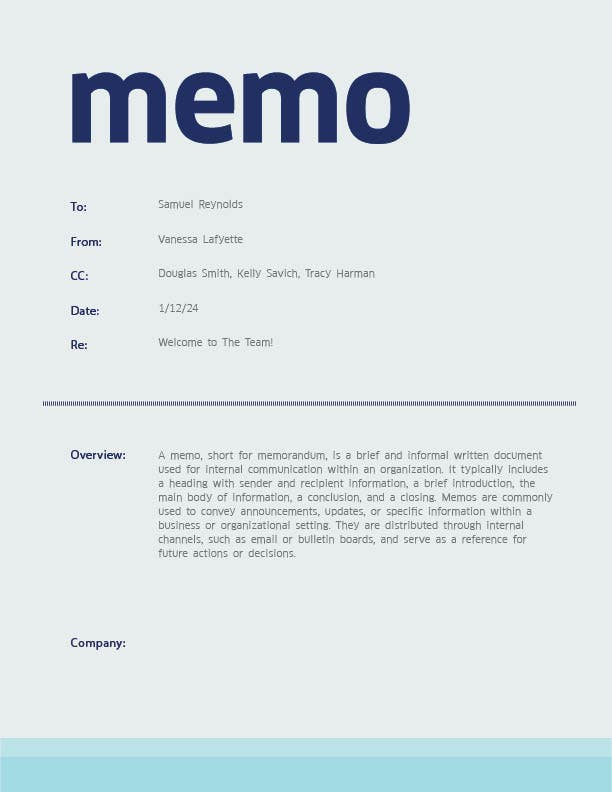
Sample general memo — change to performance review date
To: All Team Members
From: Jeffrey Jensen, CEO
Date: 15 December 2023
Subject: Changes to 2024 performance review date
Effective 1 January 2024, performance reviews will be conducted in February instead of March.
This date change has been made to align all aspects of our personnel budget within the first quarter of business. However, no additional changes have been made to the performance review process.
Department managers will distribute the standard performance review preparation materials and the performance review timeline during the first week of January. All personnel salary increases will be implemented by 29 March 2024.
Thank you for your continued commitment and I wish you a rejuvenating holiday season. We look forward to celebrating your career achievements and learning about your goals for the upcoming year.
Sample general memo — notice of software breach
To: Finance department
From: Jeffrey Jensen, CEO
Date: 4 October 2023
Subject: Recent security breach and changes to software permissions
Because of a recent security breach, we have adjusted permission access to our financial systems.
The security breach occurred as part of a change to our firewall system. We uncovered this situation yesterday and have diligently worked with our IT department to discover the cause. Until the situation has been resolved, we have adjusted all permissions to financial systems. Only senior directors and the executive management team currently have access to these systems.
If you need immediate access to these systems, please contact James Smith. He will provide any requested reports as quickly as possible.
We apologise for the temporary inconvenience as we continue our investigation. I will provide more information as made available by our staff.
Project Memo.
Sample project memo — delay of product launch
To: All Team Members
From: Henry Bittenger, Product Manager
Date: 12 September 2023
Subject: Delay of Product ABC Launch to early 2024
Because of consumer testing and outstanding engineering concerns, the launch of Product ABC has been delayed from our original 20 October launch date to early 2024.
Consumer testing is a significant part of our go-to-market strategy. If testing proves beneficial, we delay our product launch for the general public. Additionally, our engineering team is still reviewing outstanding behaviours that also need to be resolved.
Be assured that we will announce a launch date as soon as additional testing and feedback prove beneficial.
Thank you for your patience.
Feedback Memo.
Sample feedback memo — company benefits programme
To: All Employees
From: Jennifer Benson, HR Manager
Date: 16 August 2023
Subject: Feedback for 2024 Company Benefits Programme
As company leadership, we request your feedback regarding our current benefits programme.
Our current benefits programme is up for renewal at the end of the year. We will be defining our 2024 programme according to the following timeline:
- 16-30 August — collect employee feedback
- 5-15 September — evaluate employee feedback
- 18-29 September — evaluate programme gaps and research needs
- 2-27 October — conduct employee focus groups
- 1-22 November — finalise plan offerings
- 27 November — introduce new programme along with open enrolment options
Please complete the included 2023 benefits survey by Friday, 1 September.
Additionally, if you are interested in participating in a focus group, please indicate appropriately within the benefits survey.
Thank you for your participation in improving our benefits programme!
Attachment: 2023 benefits survey
Event Memo.
Sample event memo — community day of service
To: All volunteers
From: Julia Jensen, Community Coordinator
Date: 28 August 2023
Subject: 9 September Day of Service Activity
Our annual community day of service activity will be held on Saturday, 9 September, at Jordanville City Park.
We have co-ordinated this event with Jordanville City’s community centre over the last several months and have committed to completing several maintenance projects.
Please help us support our community by attending this event:
- Meet at the Jordanville City Park pavilion at 9 am.
- All community members of all ages are welcome.
- All tools and supplies will be provided.
- Wear clothes that you don’t mind getting dirty.
Thank you for your interest and participation!
Sample event memo — annual summit
To: All employees
From: Andrea Anderson, Business Manager
Date: 6 February 2024
Subject: 2024 Annual Summit Date and Agenda
Our annual summit will be hosted at the Springdale Convention Centre on 17 May, 2024.
This summit brings together the brightest minds in marketing and is an opportunity to workshop with like-minded individuals and colleagues.
The overall schedule is outlined as follows:
- 8.00 am — registration
- 9.00 am — keynote address
- 10.30 am — workshops
- Noon — lunch
- 1.30 pm — workshops
- 3.00 pm — workshops
- 5.00 pm — dinner
- 7.00 pm — happy hour & networking
Additional workshop details and our keynote speaker will be available in the next few weeks.
As posted on our website, early-bird registration will open on Monday, 12 February and close on Friday, 1 March.
Pro tips for writing memos
Writing an effective memo is an essential skill for clear and professional communication within an organisation. A well-crafted memo ensures your message is understood and actionable. However, crafting a memo that is concise, professional and impactful can be challenging. Pro tips on writing a memo can help you streamline your communication, avoid common mistakes and deliver your message with clarity and confidence.
State your purpose.
Define why the memo needs to be written. Understanding the purpose will help you to compose the memo context. The memo’s purpose should be brief and straightforward
However, any topic can be written for a memo if it is important to the organisation and is intended to be referenced as an official company document.
Determine the audience.
Define who will receive the memo. When writing the memo, use clear and concise language everyone understands — do not use complicated terminology, acronyms or abbreviations. Additionally, use proper grammar and don’t include emojis or slang.
Outline the memo.
Whether you're using a memo template or starting from scratch, outlining a memo is a crucial step to ensure its structure is clear and logical. A typical outline includes key sections such as the heading, introduction, statement of facts, discussion and conclusion, which help organise the content and guide the reader through the message effectively.Starting with a solid outline allows you to focus on the memo’s purpose and maintain clarity and flow throughout.
Finalise design and formatting.
If your content is longer than one page, reevaluate your message and remove nonessential content. If you need to attach a flyer, document or other item to help clarify your message, you can reference the attachment in the content details section of your memo.
Memo formatting and design.
Memos should be one-page documents written in only a few paragraphs. There is a certain structure to a business memo format (and link here to the memo format article coming out), a common rule being that they are single-spaced and left-justified
Depending on the length of your additional context section, use bullets to separate ideas and break up content for easier reading.
Traditionally printed as a physical handout and attached to office notice boards, memos are still in use, even with the decline of printed distribution. In today’s world, where more employees are working from home, memo content can be included easily in the body of an email — it should never be sent as an attachment.
Memos also don’t have to be boring in design. Incorporate branding for your company or organisation as part of the memo. You can also style the memo to fit the memo type, such as when creating a memo for an upcoming company party.
Memo FAQs
A memo typically includes five key sections:
- Heading — the recipient, sender, date and subject.
- Introduction — states why you're sending the memo and its main purpose.
- Details — relevant background information, data or discussion points to help the reader understand the issue.
- Call to action — the steps the recipient needs to take next.
- Conclusion — summarises the main issue and offers a closing remark or suggestion.
Some recommended practices for distributing memos include:
- Targeting the right audience — avoid sending it to a wide range of recipients if the information is niche.
- Using the right delivery channel — some recipients may prefer email, while others use Teams or Slack.
- Timing the release well — for example, sending before 9am so people see it when they first check their inbox.
Keep exploring