


Summary/Overview
With designs now embedded across websites, social media, flyers and business cards, standing out in an increasingly competitive freelance market is more important (and more challenging) than ever.
To better understand this landscape, we decided to survey 500 freelancers to explore some of their top design challenges, the time involved in creating branded assets, and how often they rely on things like pre-made templates. We also spoke with 2,000 UK consumers to understand the role of design in influencing purchasing decisions.
Alongside this, we’ve pulled together some practical tips to help freelancers strengthen their designs and connect more effectively with consumers. The Design Index brings together insights from freelancers and consumers to understand how design impacts success, and what it really takes to create assets that resonate.
The Design Index: key findings
Our survey makes one thing clear: strong design has a direct impact on consumer trust and purchasing behaviour. We found that nearly two-thirds of consumers (64%) believe that good design is crucial in influencing whether they trust or buy from a small business, with 41% choosing not to buy when branding looks unprofessional.
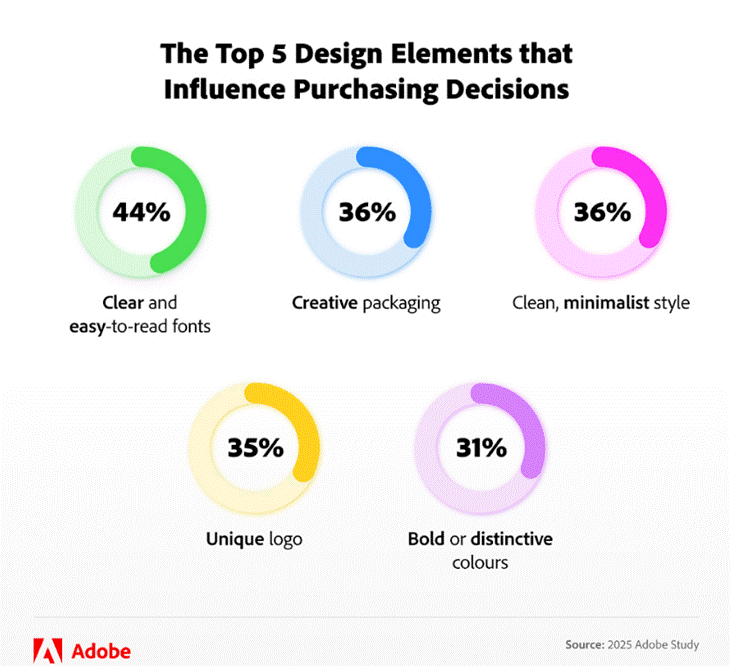
When it comes to the things that capture attention, clear, easy-to-read fonts are key for 44%, while over a third of consumers (36%) highlighted the importance of creative packaging. Interestingly, we also found that a clean, minimalist style is sometimes the most effective, with 36% preferring simplicity over complex designs.
Attitudes towards AI-generated content are more mixed. While 37% of consumers are open to AI-designs, especially when they look strong, 35% express concerns around authenticity. What’s more, a further 16% prefer the uniqueness of human-made designs.
Looking ahead, we found that nearly half of consumers (48%) believe that AI will replace designers in the coming years, or at least take over most routine design tasks.
How do things vary by gender?
Looking at the data by gender split, we found that attitudes are fairly consistent. Around two-thirds of both men (66%) and women (63%) feel that strong design is crucial when it comes to trusting a brand. Similarly, roughly four in ten men (42%) and 41% of women have avoided a small business in the past due to unprofessional designs.
We did find some subtle differences when it comes to capturing consumer attention, with unique logos being more likely to draw men’s attention (36%) than women’s (33%).
Views on AI-generated branding are closely aligned though, with around a third of both men and women saying they have no issues with it. Belief in AI replacing human designers is also similar, held by 20% of men and 18% of women.
Do thoughts change with age?
We found that age plays a more significant role in shaping attitudes towards design. Millennials, for instance, place the highest value on strong visuals (75%), compared to 65% of Gen Z and 50% of Baby Boomers. Poor design also appears to have a stronger impact on younger audiences, with 54% of Gen Z and 53% of Millennials avoiding brands due to unprofessional designs. In contrast, only 19% of Baby Boomers say the same.
Preferences around visual style also vary, with creative packaging regularly inspiring Millennials to make a purchase (43%), compared to just 24% of Baby Boomers. And when it comes to the role of AI, Gen Z are more likely to view AI branding as less authentic (31%), with around one-fifth of Millennials believing AI will replace human designers.
How do thoughts vary across different regions?
Perceptions vary by region too, with consumers in Northern Ireland and Eastern England placing the most importance on strong visual design (73%), whereas those in the West Midlands are less concerned (55%).
Avoiding small businesses due to unprofessional branding is the most common in Northern Ireland (52%) and the West Midlands (50%). Across all regions, however, clear and easy-to-read fonts remain the most popular design choice, especially in the South West (52%), South East (48%), and Scotland (43%).
Views on AI-generation differ regionally too, with people in Scotland (23%) and the West Midlands (25%) being more likely to view it as less authentic. Those in London are also the most likely to view AI as a handy tool rather than a replacement (12%).
What are the biggest hurdles for today’s creators?
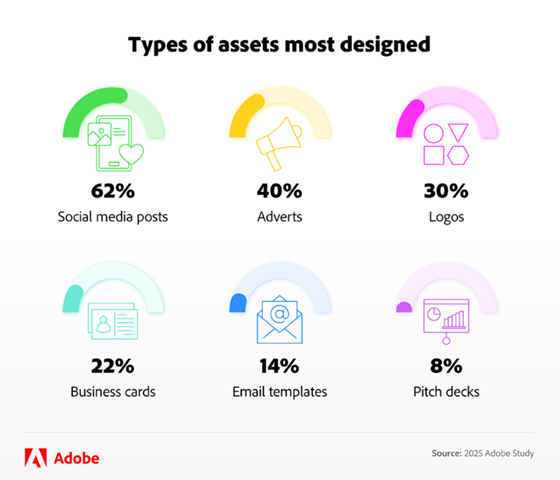
Our survey shows that social media content is by far the most common asset freelancers create for their brand (62%), followed by adverts (40%), logos (30%), and business cards (22%).
But creating these assets doesn’t come without challenges, and nearly half of freelancers say that brainstorming fresh ideas is a constant hurdle. 36% also cite a lack of time, while 35% point to the cost of design tools as a barrier to their creativity.
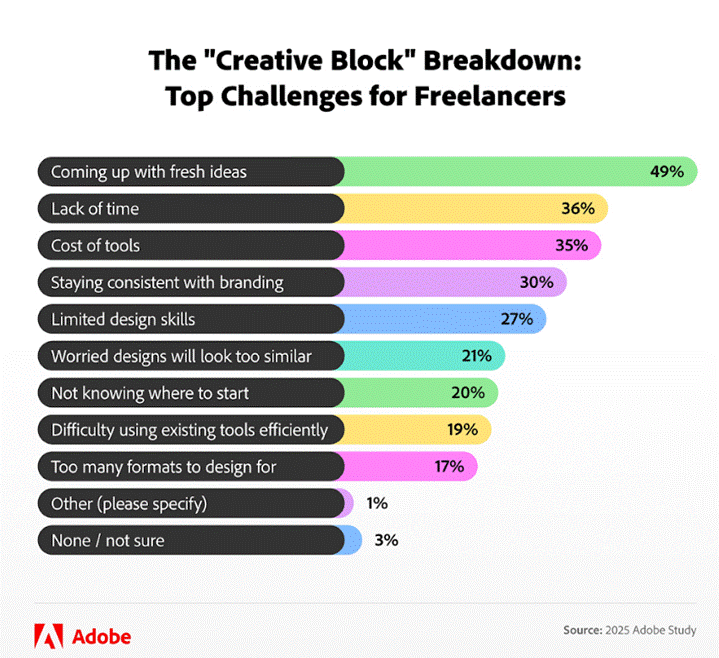
Other common struggles include maintaining brand consistency (30%), having limited skills (27%), and concerns that their designs might look too similar to others using the same templates. The hurdle of creative block affects 20% of freelancers regularly, while 19% expressed difficulty in using design tools effectively.
Adobe’s top tips to elevate your brand
The Design Index highlights just how influential strong visuals can be, not only in capturing attention but in building trust and driving purchasing decisions. So, if you’re a freelancer struggling with any of the challenges mentioned, here are some top tips for creating assets that stand out:
1. Focus on clarity: With 36% of consumers preferring simplicity, prioritising clear layouts, legible fonts, and simple messaging is key in many cases. If you’re unsure where to start, tools like our post maker make it easy to design professional graphics that clearly communicate your offerings.
2. Enhance creativity with AI: With 37% of consumers being open to AI-generated content, why not have a play around with different tools to see how they can help support your design process? Or if you prefer to start your designs from scratch, use AI for creative support including sparking fresh ideas.
3. Explore different templates: Our survey found that many freelancers struggle with time and costs when it comes to creating stand-out assets. Pre-made templates however, like our social media post maker, allow for quick creation while leaving room for personalisation.
4. Keep branding consistent: 30% of freelancers mentioned their struggles with maintaining brand consistency across platforms. From social media banners to profile pictures, we have a variety of resources to help you maintain a polished look.
And there you have it, our insights on the freelance landscape and the role of design in influencing purchasing decisions. If you’re looking for more insights like this, just head over to the Adobe Express blog. There you’ll find everything from marketing tips to branding wisdom and much more.

Methodology:
We surveyed 2,000 Brits and 500 freelancers to understand how business assets are designed and how important good design is to consumers. Freelancer questions focused on the most in-demand design types, time spent creating branded materials, and the impact of AI on their work. Consumer questions explored the importance of strong design for businesses and perceptions around the use of AI in creative work.


