Adobe empowers everyone, everywhere to imagine, create, and bring any digital experience to life. From creators and students to small businesses, global enterprises, and nonprofit organizations — customers choose Adobe products to ideate, collaborate, be more productive, drive business growth, and build remarkable experiences.

style
two up, grid-width-10, xl-spacing
background
#262430
How we’re making an impact.
Explore all the ways Adobe is innovating, breaking boundaries, and making a difference in our local communities and across the globe.
29 billion+
images generated with Adobe Firefly since launch
40 million+
K-12 students provided with Adobe Express for Education to support digital and media literacy
100+
Adobe Creative Campuses worldwide
700 million+
Adobe Stock assets
50 million+
members in the Behance community
style
static-links, l-spacing
masonry
Span 6, span 6
span 4, span 4, span 4
tab
about-adobe-quiet, 1
style
m spacing
90%
cost savings from documents created, signed, shared, and stored in Adobe Document Cloud compared with paper-based processes
1 billion
files read in Liquid Mode, our AI-powered mobile reading experience
400 billion
PDFs opened
18+ billion
PDF documents edited with Adobe Acrobat in the last year alone
style
static-links, l-spacing
masonry
Span 8, span 4
span 4, span 8
tab
about-adobe-quiet, 2
style
m spacing
87%
of Fortune 100 companies use Adobe Experience Cloud
60+
industry analyst reports named Adobe Experience Cloud products a leader in their product categories
1 trillion+
visits to US retail websites analyzed monthly by Adobe Analytics, offering the most comprehensive view of e-commerce
17 trillion+
segment evaluations per day by Adobe Experience Platform
50 million+
members in the Behance community
style
static-links, l-spacing
masonry
Span 6, span 6
Span 6, span 6
tab
about-adobe-quiet, 3
style
m spacing
24 years
on fortune’s list of 100 Best Companies to Work For
$33 million+
provided in employee donations, corporate grants, and Adobe matches in the last year
200K+ hours
employee volunteered in the last year
100%
renewable electricity by 2025 target
style
static-links, l-spacing
masonry
Span 4, span 8
span 8, span 4
tab
about-adobe-quiet, 4
style
m spacing
Our approach to generative AI.
Adobe is amplifying human ingenuity with AI, helping customers enhance their creativity, increase their productivity, and deliver more personalized experiences.

AI at Adobe is designed to enhance the creativity, intelligence, and ingenuity of our users, empowering people to work faster, focus on what’s important, and accomplish more.
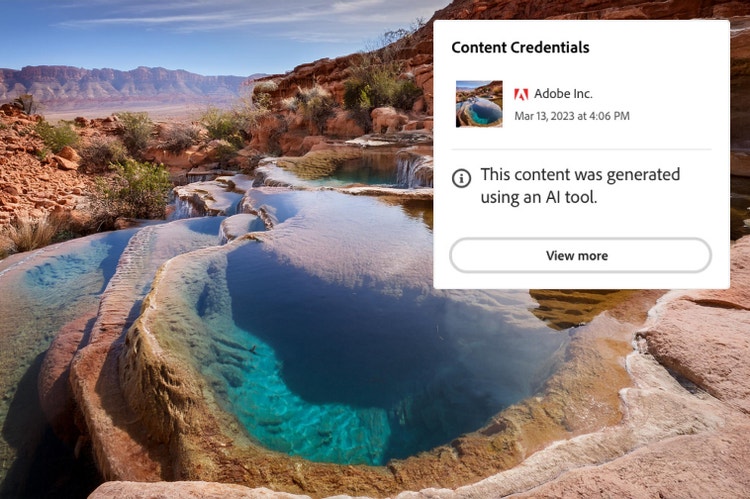
Developed responsibly and transparently.
We train our Firefly models on data that allows us to offer customers a solution designed to be commercially safe. Plus, through the Content Authenticity Initiative, we’re driving global industry standards for transparency.

Integrated seamlessly into your workflows.
At Adobe, AI is built into our tools and seamlessly integrated into workflows customers are already using. Our embedded AI features fuel creativity, enable greater productivity, and empower businesses to deliver personalization at scale.
style
Three up, xl-spacing
Making history since 1982.
Explore key moments in Adobe history — from the debut of PostScript, the introduction of Photoshop, the invention of PDF, and the creation of the digital marketing software category to our latest transformative innovations.
1982
John Warnock and Charles Geschke found Adobe to revolutionize printing and publishing with an all-digital approach.
1985
The release of Adobe PostScript marks the first international standard for computer printing.
1987
Adobe Illustrator gives artists the precision and freedom to create digital images.
1989
Adobe makes PostScript font technology an open standard.
1990
Adobe Photoshop redefines imaging and artistic expression.
style
Three-up, m-spacing
background
#1E1E1E
tab
timeline-tabs, 1
style
m spacing
1991
Adobe Premiere transforms professional video editing.
1993
Portable Document Format (PDF) and Adobe Acrobat usher in a new era of document productivity.
1999
Adobe InDesign introduces the next generation of digital publishing.
style
Three-up, m-spacing
background
#1E1E1E
tab
timeline-tabs, 2
style
m spacing
2003
Adobe pioneers the “freemium” software model with the launch of Acrobat Reader.
2005
Flash helps shape the future of video and gaming on the web, kick-starting the interactive web.
2008
Portable Document Format (PDF) is released as an open standard.
style
Three-up, m-spacing
background
#1E1E1E
Major acquisitions
Macromedia, Inc. 2005
Omniture, Inc. 2009
Day Software 2010
style
Three-up, m-spacing, grid-width-8
background
#1E1E1E
tab
timeline-tabs, 3
style
m spacing
2012
Adobe Marketing Cloud unifies analytics, advertising, targeting, and web experience management, creating the digital marketing software category.
Adobe becomes the first major software company to transition to a subscription-based model with the announcement of Adobe Creative Cloud
2016
Adobe Sensei enables the development of AI-powered features across Adobe’s product portfolio.
2019
Adobe founds the cross-industry Content Authenticity Initiative to build trust and transparency in digital content.
Adobe Experience Platform empowers organizations to centralize and standardize customer data from any system.
style
Three-up, m-spacing
background
#1E1E1E
Major acquisitions
Behance 2012
Fotolia 2015
Magento, Marketo 2018
Allegorithmic 2019
Workfront 2020
style
five-up, m-spacing, grid-width-10
background
#1E1E1E
tab
timeline-tabs, 4
style
m spacing
2021
Adobe Express brings the magic of technology from Photoshop, Illustrator, Premiere, Acrobat, and Firefly to make content creation quick and easy for everyone.
2023
Adobe Firefly becomes the first creative generative AI model designed to be commercially safe.
2024
Adobe GenStudio reimagines enterprise content supply chains, empowering marketers to quickly plan, create, manage, activate, and measure on-brand content.
style
Three-up, m-spacing
background
#1E1E1E
Major acquisitions
Frame.io
2021
tab
timeline-tabs, 5
style
m spacing
Tämä Adobe-sivusto ei vastaa sijaintiasi.
Sijaintisi perusteella suosittelemme Suomi-sivustoa, jolta löydät aluekohtaiset tarjoukset ja hinnat.
You can control how Adobe websites use cookies and similar technologies by making choices below. But note that if you disable cookies and similar technologies entirely, Adobe websites may not function properly.
Cookies are small text files stored by your web browser when you use websites. There are also other technologies that can be used for similar purposes like HTML5 Local Storage and local shared objects, web beacons, and embedded scripts. These technologies help us do things like remembering you and your preferences when you return to our sites, measure how you use the website, conduct market research, and gather information about the ads you see and interact with.
You can make choices in the menu below about what cookies and other technologies you want us to use on Adobe sites when you visit them from this browser. You can always change those choices later by clicking on the Cookie Preferences link at the bottom of the page.
If enabled:
We can improve your experience by tailoring the site and the content to things we think might be of interest
We can better keep track of your preferences — like what language you prefer to use
We will better understand your likely interests so we can provide you more relevant Adobe ads and content on non-Adobe websites and in non-Adobe apps
It will help us improve the performance of our website and those of our partners who use the Adobe Experience Cloud
If disabled:
We won’t be able to remember you from session to session so the experience may not be tailored to your interests
You’ll still have access to the content of the site but certain features that depend on cookies may not function
You’ll still see ads, they just may not be as relevant to you
General information
You can control how Adobe websites use cookies and similar technologies by making choices below. But note that if you disable cookies and similar technologies entirely, Adobe websites may not function properly.
Cookies are small text files stored by your web browser when you use websites. There are also other technologies that can be used for similar purposes like HTML5 Local Storage, web beacons, and embedded scripts. These technologies help us do things like remembering you and your preferences when you return to our sites, measure how you use the website, conduct market research, and gather information about the ads you see and interact with.
You can make choices in the menu below about what cookies and other technologies you want us to use on Adobe sites when you visit them from this browser. You can always change those choices later by clicking on the Cookie Preferences link at the bottom of the page.
If enabled:
We can improve your experience by tailoring the site and the content to things we think might be of interest
We can better keep track of your preferences — like what language you prefer to use
We will better understand your likely interests so we can provide you more relevant Adobe ads and content on non-Adobe websites and in non-Adobe apps
It will help us improve the performance of our website and those of our partners who use the Adobe Experience Cloud
If disabled:
We won’t be able to remember you from session to session so the experience may not be tailored to your interests
We’ll still count your use of our site and services
You’ll still have access to the content of the site but certain features that depend on cookies may not function
You’ll still see ads, they just may not be as relevant to you
Operate the site and core servicesOperate site and measure engagement
Always active
These cookies are required, and they are used to enable the site and related services core functionality. Without them the site could not operate, so they cannot be disabled.
These cookies enable the site and related services’ core functionality and collect statistics about user engagement, such as counting active use to help us understand trends. These cookies cannot be disabled.
Measure performance
These cookies are used to analyze site usage to measure and improve performance. Without them Adobe cannot know what content is most valued and how often unique visitors return to the site, making it hard to improve information we offer to you.
These cookies are used to analyze site usage to measure and improve performance. Without them Adobe cannot know what content is most valued, making it hard to improve information we offer to you.
Extend functionality
These cookies are used to enhance the functionality of Adobe sites such as remembering your settings and preferences to deliver a personalized experience; for example, your username, your repeated visits, preferred language, your country, or any other saved preference.
Personalize advertising
These cookies are used to enable Adobe and our partners to serve ads more relevant to your interests. Without them you will still see ads, but they might not be as relevant to you.