


Key findings:
- The top soft skills hiring managers prioritize in the age of AI include: time management (47%), adaptive problem-solving (44%), collaboration (41%), ethical AI oversight (33%), and creative intuition (28%).
- The single largest gap in soft skill expectations lies in ethical AI oversight, which hiring managers are 175% more likely to prioritize than job seekers.
- Remote hiring managers are 133% more likely than on-site counterparts to rank AI image generation as a critical hard skill when seeking candidates in the age of AI.
- Nearly three in five (58%) hiring managers say AI mastery directly improves an employee's job security.
- Nearly two in five (38%) hiring managers are incentivizing AI innovation with performance bonuses.
- Job seekers rank brainstorming with AI (30%), AI image generation (19%), and workflow automation (19%) as the top three hard skills to boost hireability this year.
AI is rapidly transforming the workforce and is a regular point of discussion in team and leadership meetings, reshaping what employers look for in candidates. Technical skills are no longer the only differentiator, and there’s a growing emphasis on how people work alongside AI, from refining outputs to applying judgment and creative direction. Job seekers are adapting their skillsets, often prioritizing the tools and capabilities they believe will give them an edge in an increasingly AI-driven job market.
To understand how expectations are shifting, we surveyed over 1,200 job seekers and hiring professionals. Looking across industries, roles, and experience levels, our findings reveal a growing gap between what employers are looking for and what candidates are prioritizing. The data also showcases a broader shift in how AI skills are defined, evaluated, and rewarded in the workplace which alters how candidates need to position themselves to stand out to hiring managers.
What truly sets candidates apart
Hiring managers and job seekers are approaching AI skills from different perspectives. Employers are prioritizing judgment and oversight. Meanwhile, candidates are leaning into technical and creative outputs.
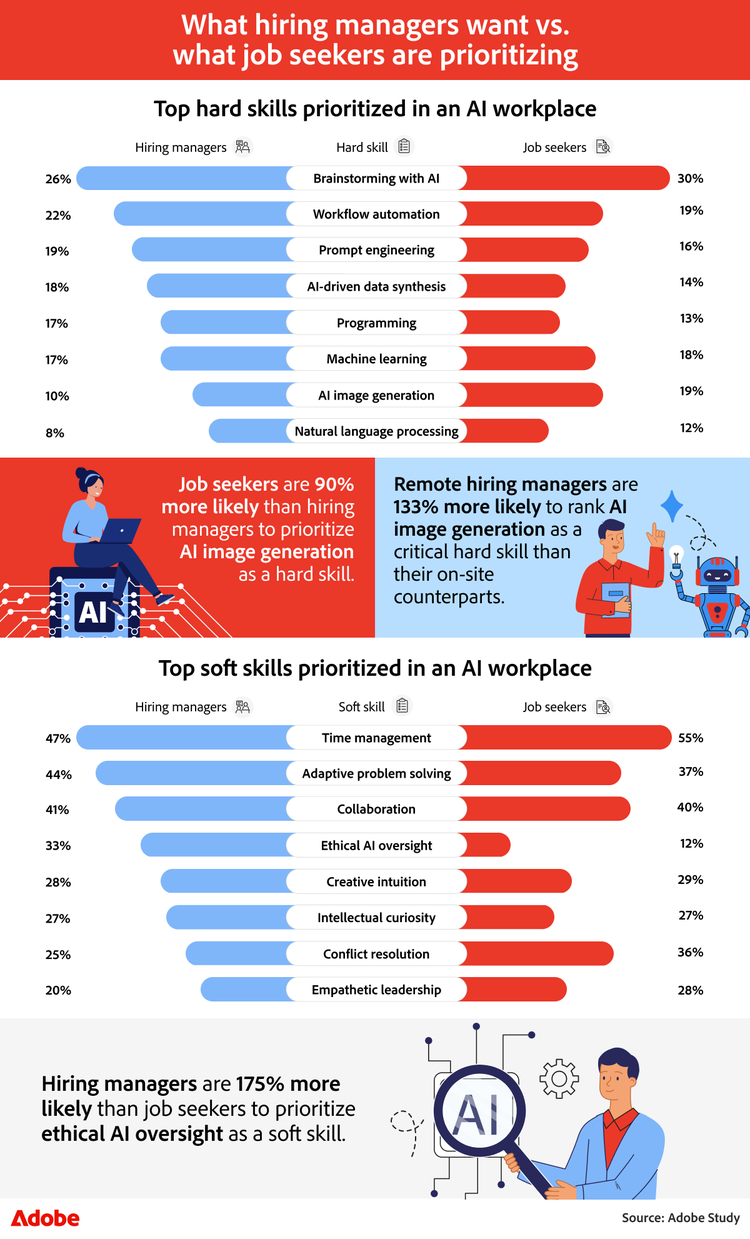
Among hiring managers and job seekers, AI is now part of the modern workplace, but a noticeable gap is emerging in how each group defines what AI-ready actually means. Brainstorming with AI ranks as a top hard-skill priority for both audiences, making human-AI collaboration the shared focus across the hiring landscape.
Confidence in foundational AI skills remains relatively low, with only 45% of job seekers reporting confidence in their prompting abilities, highlighting a gap between adoption and mastery.
Hiring managers are placing greater emphasis on soft skills requiring human judgment, prioritizing the ability to evaluate and guide AI outputs rather than simply generating them. Hiring managers are also 74% more likely to prioritize ethical AI oversight than prompt engineering, and soft skills such as decision-making, collaboration, and critical thinking are becoming key differentiators in AI-supported workflows.
As AI tools become more accessible, technical execution is becoming the baseline, while judgment is what sets candidates apart.
Job seekers, on the other hand, are leaning more heavily into technical and creative production skills, particularly those tied to visual output. Many are prioritizing experience with AI image generators, with these text-to-image tools–often referred to as AI image makers or AI photo generators–emerging as a key area of focus within the broader AI skill set–capabilities that can support creating visuals for portfolios and applications. Job seekers adding AI-image generation to their resumes vary by industry:
- Tech: 28%
- Creative arts: 24%
- Retail: 22%
- Finance/banking: 21%
- Healthcare: 20%
- Education: 19%
- Business/management: 18%
More senior candidates appear to be further ahead of this shift. Director-level professionals are 106% more likely than entry-level peers to list AI image generation as a core skill, suggesting that the skills gap is not just technical, but tied to experience and seniority.
A similar divide emerges across generations. Gen Z candidates place greater emphasis on soft skills. Making them 23% more likely than older generations to prioritize time management, 46% more likely to prioritize collaboration, and 30% more likely to value creative intuition. At the same time, they are less likely to include technical AI skills on their resumes, while older generations are 50% more likely to list experience with AI photo generators, including tools for creating AI-generated images, and 33% more likely to include AI-driven brainstorming.
While many candidates are experimenting with tools like a free AI image generator or features such as generative fill in Adobe Firefly, they may be underestimating the importance of the human layer that hiring managers are increasingly looking for.
For candidates who can bridge that gap, the advantage is clear. As AI becomes standard, it’s not just about using the tools effectively, but demonstrating the judgment to guide them.
How AI mastery is being evaluated in interviews
Among hiring managers, AI proficiency is about how candidates demonstrate critical thinking, transparency, and control over AI outputs in real-world scenarios.
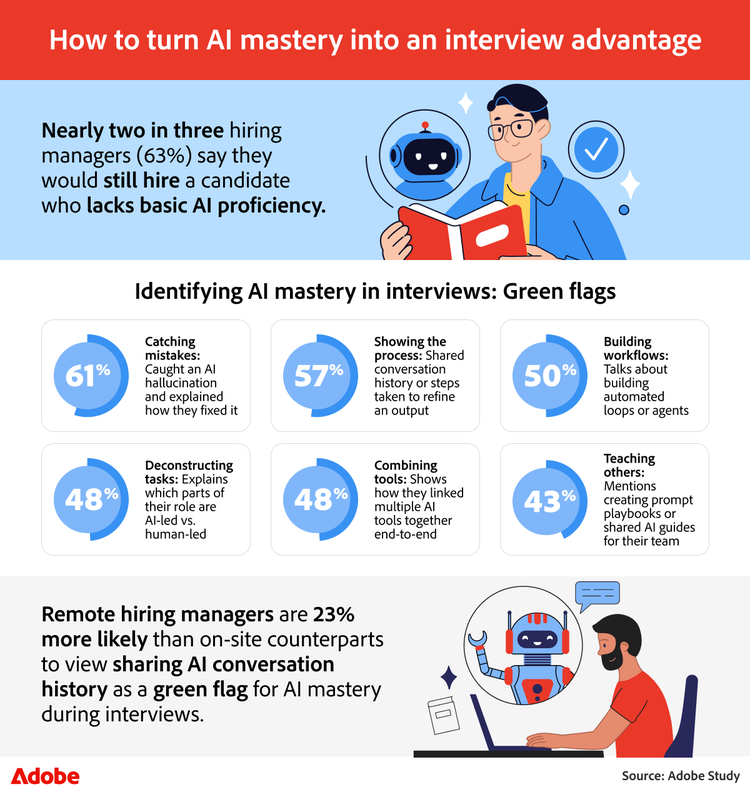
As AI becomes a baseline requirement in the workplace, the interview process is already changing. It’s no longer just about whether candidates can use AI tools, but how they demonstrate that use in practice. While hiring managers are increasingly evaluating how candidates think through AI outputs—how they question, refine, and apply them—many job seekers are still focused solely on building technical proficiency, creating a disconnect between how AI skills are developed and how they’re assessed.
Organizations are investing more in AI, but the support behind it at times is inconsistent. While employers are prioritizing efficiency-driven AI skills, the training needed to develop them isn’t always keeping pace.
Top AI-driven hard skills organizations are training employees on to increase efficiency include:
- Workflow automation: 52%
- Brainstorming with AI: 48%
- Prompt engineering: 32%
- AI output auditing: 30%
- AI-driven data synthesis: 29%
- Programming: 25%
- Machine learning: 25%
- AI image generation: 20%
While brainstorming with AI is one of the most prioritized skills, only about half of organizations are actively training employees in it, highlighting a gap between what’s valued and what’s being taught. Nearly two in three hiring managers (63%) say they would still hire a candidate who lacks basic AI proficiency, reinforcing how uneven expectations remain. This divide becomes even clearer across work environments, creating two different definitions of what AI-ready looks like:
- On-site teams are most likely to prioritize workflow automation training: 50%
- Remote teams are more focused on brainstorming with AI: 43%
At the same time, hiring criteria still reflect a balance between traditional and emerging expectations. Industry experience and technical foundations remain the top priorities, but soft skills and AI-synergy are close behind, reinforcing that as AI becomes more common, human judgment is becoming the real differentiator.
Hiring criteria ranked by importance:
- Industry experience
- Technical foundations
- Soft skills
- AI-synergy
- Cultural fit
While technical expertise remains essential, soft skills and the ability to work effectively with AI are quickly becoming key differentiators as expectations evolve.
This shift is already shaping how hiring managers assess candidates in interviews. Beyond technical ability, there are clear signals of how candidates work with AI in practice: how they show their process, catch and correct mistakes, choose and combine the right tools, and build structured, repeatable workflows that can be shared with others.
As a result, the most common red flags are less about technical ability and more about judgment, transparency, and critical thinking:
- Lack of fact-checking: 70%
- AI-generated outputs should be treated as a starting point, and before presenting any AI-assisted work, candidates should verify data and sources manually. Using an AI reader or AI summarizer is often used to review and validate AI-generated content before sharing insights.
- Blind compliance: 54%
- The strongest candidates are the ones who know when to challenge an output. Being able to explain where an AI response fell short, and how it was improved, demonstrates critical thinking and real ownership of the work.
- The “one-shot” trap: 47%
- Refining your prompts across a few attempts will lead to better results, and experimenting with text-to-image tools or an AI image generator is a simple way to show how your outputs improve over time.
- Taking 100% credit: 46%
- Transparency is becoming a green flag. Rather than concealing AI’s role, candidates should explain how they directed and refined outputs. Showing how AI-generated images or written content were developed demonstrates control instead of dependence.
- Over-automation: 40%
- Knowing when not to use AI is just as important as knowing how to use it. There are moments where human judgment matters more, and hiring managers are paying attention to candidates who understand that balance.
- Prompt secrecy: 37%
- Candidates who can’t explain their prompts risk appearing surface-level in their understanding. Building and documenting repeatable workflows—using tools like an AI document generator—can help demonstrate a more structured and intentional approach.
For both hiring managers and job seekers, the takeaway is clear: technical AI skills may get candidates through the door, but it’s soft skills—judgment, transparency, and critical thinking—that ultimately determine how they’re evaluated. As the interview evolves, demonstrating how you work with AI is quickly becoming as important as the outputs themselves.
How organizations are supporting AI skills—and where the gap remains
Hiring managers report widespread investment in AI training and tools. However, differences in access, incentives, and employee priorities demonstrate a growing gap between how organizations support AI adoption and what workers actually want from it.
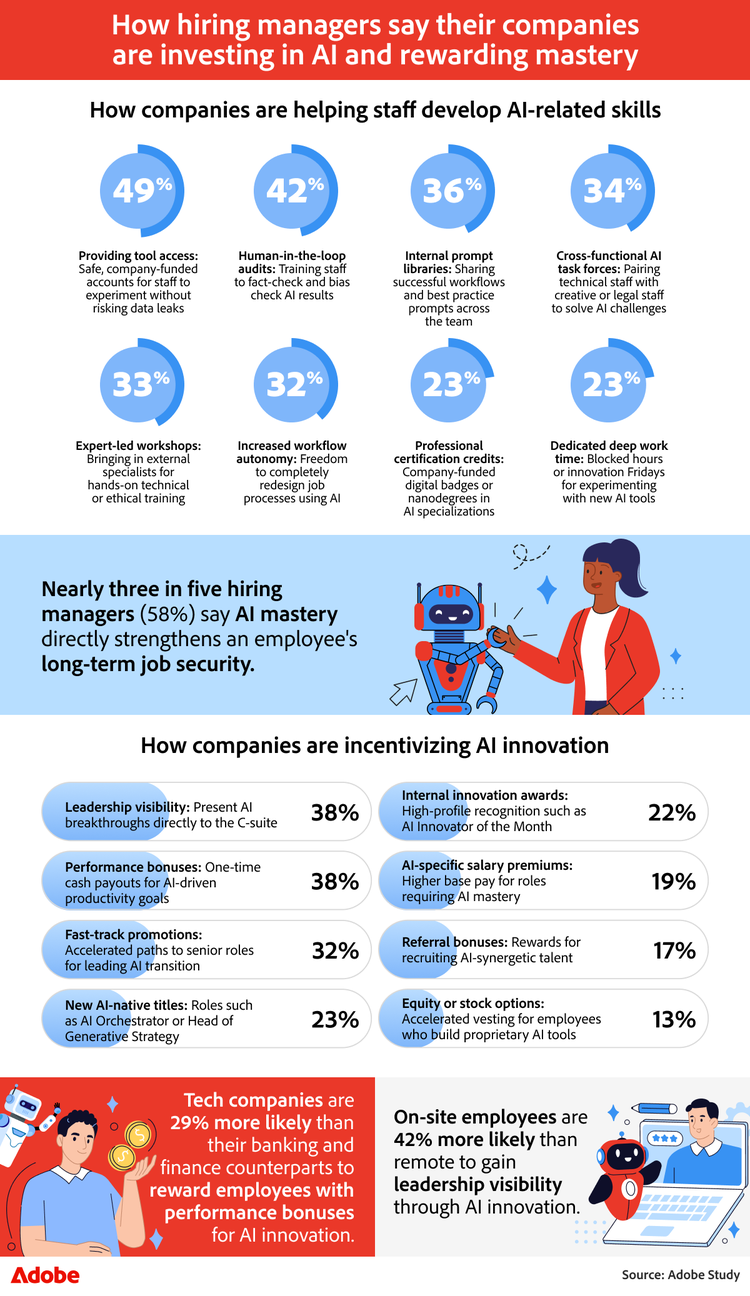
As AI becomes a standard part of the workplace, more companies are investing in tools and training to help employees keep up. While 91% of hiring managers say their organizations support AI skill development, in many cases, the systems needed to build long-term AI skills still aren’t in place. Even in tech, only about one in three organizations has a formal system for sharing and building on AI knowledge. It suggests that while AI adoption is moving quickly, the support behind it is still catching up.
This gap becomes more nuanced when looking at how support varies across work environments. Remote organizations are more likely to provide access to AI tools, but that doesn’t always come with the same level of visibility or recognition. In contrast, hybrid environments appear to offer the strongest balance—employees are more likely to have both the tools and the recognition needed to develop AI skills effectively. Hiring professionals in hybrid companies are 19% more likely than those in fully on-site roles to say AI proficiency directly improves long-term job security, positioning hybrid workers in an advantageous position.
As AI becomes more embedded across industries, the agreement that AI mastery improves job performance is strongest in:
- Tech: 79%
- Finance and banking: 69%
- Healthcare: 55%
AI fluency is quickly becoming an expectation among employers across roles and industries. Learning how to work with AI will help you get hired and then keep you competitive in the role you already have.
At the same time, there’s a growing disconnect between what employers are offering and what employees actually want from AI. While companies are focusing on financial incentives—like performance bonuses (38%), promotions (32%), and salary premiums (19%)—job seekers are often looking for something more practical:
- Elimination of grunt work: 36%
- Time recovery and reduced workload: 32%
- Job security and role irreplaceability: 27%
- Career fast-tracking: 16%
- Direct salary premium: 13%
- Creative autonomy: 12%
- Performance-based bonuses: 12%
- Intellectual leadership: 11%
For employers, AI is often positioned as a performance multiplier tied to productivity and revenue. On the other hand, for employees it’s a way to reclaim time, reduce burnout, and make work more manageable.
For many professionals, that means going beyond basic tool usage and focusing on how AI can enhance both output and efficiency. Whether it’s using an AI video generator to quickly produce content or experimenting with a free AI video generator to streamline creative workflows, these tools are helping employees reclaim hours in their working week. Similarly, AI photo generator tools and AI image makers are enabling professionals across industries to build the creative and technical skill sets that employers are increasingly seeking.
While organizations are still refining how they support and incentivize AI adoption, the most successful employees are those who know how to use AI tools to improve both performance and day-to-day work.
How you can stay interview-ready in the age of AI
Showing employers how you actually use AI tools is the best way to be interview-ready today. The candidates who stand out are the ones who can demonstrate both technical ability and the judgment behind it.
These tips focus on how to build, refine, and present your work in a way that reflects the skills hiring managers are now looking for.
1. Let AI refine your resume, not replace it
- Focus on outcomes: Highlight how you’ve used AI to improve workflows, outputs, or decision-making rather than listing platforms.
- Tailor for each role: Adjust tone and emphasis based on the job description so your experience feels intentional.
- Keep it clear and easy to scan: Strong formatting and concise language make your skills easier to evaluate.
Using tools like an AI summarizer or AI reader–often part of a broader AI tool for resume workflow–can help you quickly review and refine your resume, ensuring the most relevant skills stand out before it reaches a hiring manager.
2. Build a portfolio that shows how you work with AI
- Show progression: Include examples that demonstrate how an idea evolved from prompt to polished output.
- Put work in context: Use visuals within mock campaigns, decks, or product concepts rather than standalone images.
- Highlight your decisions: Make it clear where your input improved or shaped the result
Using an AI image generator, AI image maker, or text-to-image tool can help you create AI-generated images that demonstrate both creativity and control—two signals hiring managers are actively looking for.
3. Treat AI like a collaborator, not a shortcut
- Work in iterations: Test multiple prompts, adjust details, and compare outputs to improve quality.
- Challenge the output: Look for inaccuracies or areas where your input can elevate the result.
- Be ready to explain your process: Hiring managers are evaluating how you think, not just what you produce.
Experimenting with a free AI image generator is a simple way to practice refining ideas and showing how your outputs improve over time.
4. Use generative tools to elevate your work
AI can speed up execution, but your judgment defines the final result.
- Enhance, don’t outsource: Use AI to improve visuals, refine content, or test variations—not to replace your thinking.
- Focus on presentation quality: Polished outputs signal a higher level of AI fluency.
- Remove friction from repetitive tasks: Free up time to focus on creative direction and decision-making.
Tools that let you edit, expand, or refine visuals can help you quickly improve assets without getting stuck in repetitive editing.
5. Keep your process organized and explainable
Being able to explain how you work with AI is just as important as the work itself.
- Document your workflow: Keep track of prompts, iterations, and outputs so you can clearly walk through your process.
- Build repeatable systems: Structured workflows show consistency and scalability.
- Verify before you present: Always double-check AI-generated content for accuracy and clarity.
Using an AI document generator or AI reader can help you organize, review, and present your work in a way that clearly demonstrates both accuracy and intent.
Putting your AI skills to work
As AI continues to reshape the workplace, the expectations placed on candidates are evolving quickly. Technical skills may open the door, but the ability to guide, question, and refine AI outputs will set a candidate apart. AI proficiency is now a baseline, and those who can combine it with human judgment, creativity, and adaptability will have a measurable advantage.
Whether you’re looking to make sure your resume reflects the skills hiring managers are looking for with an AI tool for resume, present your experience professionally using an AI document generator, or build a portfolio using Adobe Firefly’s creative tools—from text to image to producing high-quality AI-generated images—the opportunity lies in how you apply these tools. Together, tools like Adobe Acrobat help you organize, refine, and present your work, while Adobe Firefly helps you create and experiment, giving you everything you need to demonstrate both your skills and your thinking in an AI-powered workplace.
Methodology
To explore how AI impacts the job seeking process, we surveyed 805 job seekers and 406 hiring pros. The job seeker data has a 95% confidence level and a low 3% margin of error. The hiring pro data has a 95% confidence level and a low 5% margin of error. Because this exploratory research relied on self-reported data, respondents may have biases, and discrepancies may exist between their answers and their actual experiences.
Keep exploring
title
Creative Skills Roadmap: Closing the AI Hiring Gap
cardImageAltText
Woman presenting AI-generated project to colleague, showcasing how AI skills are important for creative projects in the workplace.
cardImage

