Chicago style footnotes: What they are and how to use them
Learn how to create full and shortened footnotes in Chicago style for history papers, nonfiction books, museum exhibits, and more.

What are Chicago style footnotes?
Chicago style footnotes provide a systematic method for documenting sources in academic writing, particularly in humanities disciplines like history, literature, and the arts. Developed by the University of Chicago Press, this citation system places numbered superscript markers in your text that correspond to detailed source information at the bottom of each page.
The Chicago Manual of Style offers two distinct documentation systems. The Notes-Bibliography style uses footnotes or endnotes paired with a comprehensive bibliography, making it ideal for writers who need to cite diverse source types including archival materials, interviews, and historical documents. The Author-Date style, alternatively, uses parenthetical citations within the text and is more common in scientific and social science writing. When writing a research paper in the humanities, Chicago footnotes typically serve as the preferred citation method.
Beyond source attribution, footnotes allow you to provide additional context, explanatory information, or cross-references without interrupting your main argument. This flexibility makes them particularly valuable for complex scholarly work where supplementary discussion enhances the reader's understanding.
Understanding how to do Chicago style footnotes correctly demonstrates your commitment to academic integrity and strengthens the credibility of your research. Whether you're citing primary sources for a history paper or referencing literary criticism for an English essay, mastering this citation system will help you throughout your academic career.
How to format Chicago footnotes?
Proper formatting ensures your Chicago footnotes meet academic standards and help readers locate your sources efficiently. Chicago footnotes follow specific conventions for placement, typography, and structure that distinguish them from other citation styles.
In your main text, footnote numbers appear as superscript numerals placed after the relevant punctuation mark, typically a period or comma. Number footnotes consecutively throughout your paper, starting with 1.
At the bottom of each page, footnotes appear separated from the main text by a short horizontal line. Each footnote begins with its corresponding number, followed by a period and a space. Unlike bibliography entries, footnotes use standard paragraph indentation—the first line is indented while subsequent lines align with the left margin. This format helps readers quickly identify where each note begins.
Font size for footnotes is typically smaller than your body text. For example, 10-point compared to 12-point body copy. Consult your style guide or instructor for specific requirements, as some institutions have particular preferences.
For your first citation of any source, use a full note containing complete publication information. A full note for a book follows this pattern: Author First Name Last Name, Title of Book (Place of Publication: Publisher, Year), page number. For example: 1. Sarah Chen, Modern Research Methods (New York: Academic Press, 2023), 45.

Shortened footnotes: When and how to use them
After you've provided a full note for a source, all subsequent citations use shortened footnotes. This approach reduces repetition while maintaining clear source identification throughout your document.
A shortened footnote includes only the author's last name, a shortened version of the title, and the page number. Using the previous example, subsequent citations would appear as: 5. Chen, Modern Research Methods, 78. The shortened title should be distinctive enough for readers to identify the source in your bibliography.
When you need to cite an article or other source multiple times in succession, Chicago 17th edition still permits using "Ibid." (from the Latin ibidem, meaning "in the same place"), but many publishers now prefer shortened citations because they’re clearer when documents are edited or viewed digitally. That said, if you're citing the exact same page, use "Ibid." alone. For a different page in the same source, use "Ibid., 92." However, use Ibid. only when the reference immediately follows the previous citation of that source—if any other source intervenes, return to the shortened footnote format.
Maintaining consistency between full and shortened notes is essential. Ensure your shortened titles match how the work appears in your bibliography and verify that page numbers accurately reflect where information appears in each source. This attention to detail separates competent academic writing from work that appears rushed or careless.
Examples of Chicago style footnotes for different sources
Chicago footnotes require different formatting elements depending on the source type you're citing. The following examples demonstrate full note format for first citations—remember to use shortened notes for subsequent references to the same source.
1. Books
For a single-author book, format your footnote as follows:
For books with multiple authors, list authors in the order they appear on the title page, separating names with "and" for two authors or commas plus "and" for three. When you access books digitally, you may need to cite a PDF version, which follows the same format with the addition of a URL or database name if applicable.
For edited volumes, include the editor's name followed by "ed." before the title:
2. Journal articles
Journal article footnotes include the article title in quotation marks and the journal name in italics:
3. Websites
Website citations require the author (if known), page or article title, website name, publication or modification date, and access date:
4. Newspapers and magazines
Newspaper articles omit page numbers:
5. Interviews
Personal interviews you conducted list the interviewee's name, interview type, and date:
6. Videos and multimedia
For YouTube videos and similar content, include the creator, video title, platform, duration, and URL:
7. Government documents
Government publications require the issuing body, document title, publication information, and any identifying numbers:
How to do Chicago style footnotes with AI
Artificial intelligence tools can streamline the process of creating Chicago style footnotes, helping you generate accurate citations more efficiently. Many AI tools for students now include citation assistance features that understand various formatting styles, including Chicago. Here's how to leverage these tools effectively while maintaining citation accuracy.
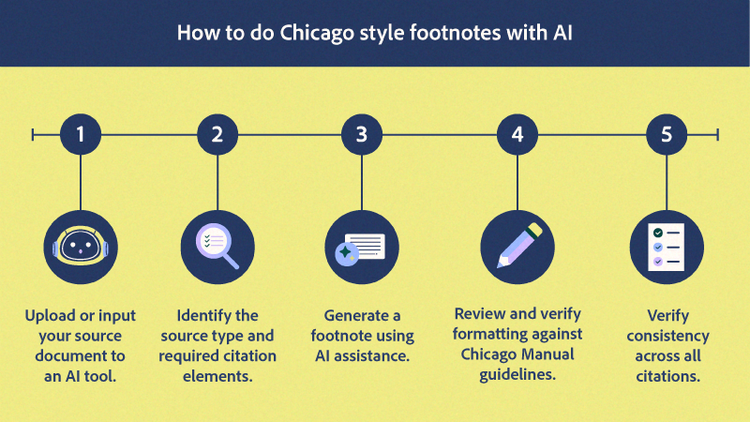
1. Upload or input your source document to an AI tool. You can chat with your PDF documents directly to extract citation information, or manually input key details like author, title, and publication date. Having the original source available ensures accuracy.
2. Identify the source type and required citation elements. Tell the AI what type of source you're citing—book, journal article, website, etc. Specify that you need Chicago Notes-Bibliography style formatting. This helps the AI apply the correct formatting rules for your specific source type.
3. Generate a footnote using AI assistance. Request both full note and shortened note versions. The AI should provide properly formatted citations with correct punctuation, italicization, and element ordering. Use student study tools that specialize in academic formatting for best results.
4. Review and verify formatting against Chicago Manual guidelines. AI tools occasionally make errors with punctuation placement, italics, or element ordering. Cross-check the generated footnote against the official Chicago Manual of Style, particularly for unusual source types.
5. Verify consistency across all citations. After generating multiple footnotes, review your entire document to ensure formatting consistency. Check that all shortened notes correspond to full notes appearing earlier, and that Ibid. references point to the correct sources.
Common mistakes and how to avoid them
Even experienced writers make errors when formatting Chicago footnotes. Recognizing common pitfalls helps you produce polished, professionally cited work that meets academic standards.
Inconsistent formatting between full and short notes creates confusion for readers. Establish a tracking system to record which sources have received full notes, ensuring you switch to shortened format for all subsequent citations. A simple spreadsheet or document noting first citation locations prevents duplication.
Missing page numbers ranks among the most frequent citation errors. Every footnote referencing specific information should include the exact page or page range where that information appears. General references to an entire work may omit page numbers, but direct quotes and specific facts always require them.
Incorrect punctuation within footnotes undermines your credibility. Pay attention to comma placement between elements, periods at the end of notes, and the proper use of parentheses around publication information. Chicago style has specific rules for each element's punctuation that differ from other citation formats.
Forgetting access dates for online sources can make your citations incomplete. Web content changes frequently, so recording when you accessed online materials helps readers understand your source context. Include the full date in Month Day, Year format.
Confusing footnotes with endnotes affects document organization. Footnotes appear at the bottom of each page, while endnotes collect at the document's end. Choose one system and apply it consistently throughout your paper. Use a PDF editor to review your final document and verify all notes appear in their correct locations.
Not matching footnotes to bibliography entries creates citation gaps. Every source cited in a footnote should have a corresponding bibliography entry with matching information. The author names, titles, and publication details must align between your notes and bibliography. AI study tools can help you cross-reference your notes and bibliography for consistency and identify discrepancies.
Over-reliance on Ibid. without verification leads to errors when editing changes your footnote order. If you insert, delete, or rearrange footnotes, previously correct Ibid. references may become inaccurate. Always verify Ibid. references point to the intended source after making document changes. Consider replacing Ibid. with shortened notes during the drafting phase, then converting to Ibid. only during final formatting.
Forgetting to update superscript numbers after revisions can create mismatched citations. When you add or remove footnotes during editing, ensure all subsequent numbers update correctly. Word processors typically handle this automatically, but always verify before submitting.
Frequently asked questions
Does Chicago style have to use footnotes?
What is the difference between a citation and a footnote?
How do I handle multiple sources in one footnote?
What should I do if publication information is missing?
When should I use explanatory footnotes versus citation footnotes?
You may also like