Adobe Acrobat
What is the Outline method and how it works
The Outline method has gained immense popularity among students and professionals alike as one of the most efficient ways to organize and take notes.
What is the Outline method?
The Outline method is a systematic approach to note-taking that organizes information hierarchically. It starts with a main topic or heading and breaks it down into subpoints, which are further divided into supporting details. Each level of indentation represents a deeper layer of information, creating a structured and logical flow.
This method is particularly useful for lectures, textbooks, or any content that follows a clear structure. The Outline method of note-taking offers several advantages, such as:
- Improved organization: Notes are arranged logically, making it easier to locate specific information.
- Clarity: The hierarchical format allows users to see the relationship between ideas and concepts at a glance.
- Easy review: Skimming through outline notes is faster than scanning unstructured text.
- Adaptability: It works well across various subjects, from science to history.
For the method to be most effective, as it’s true for any note-taking technique, it’s important that students have a strong grasp on how to organize study notes, and prep their materials beforehand.
How to use the Outline method step by step
Mastering the Outline method requires consistency and a clear understanding of the process. By following specific steps, you can ensure your notes are efficient and easy to review. Whether you’re attending a lecture or summarizing a book, these steps will help you use the technique effectively.
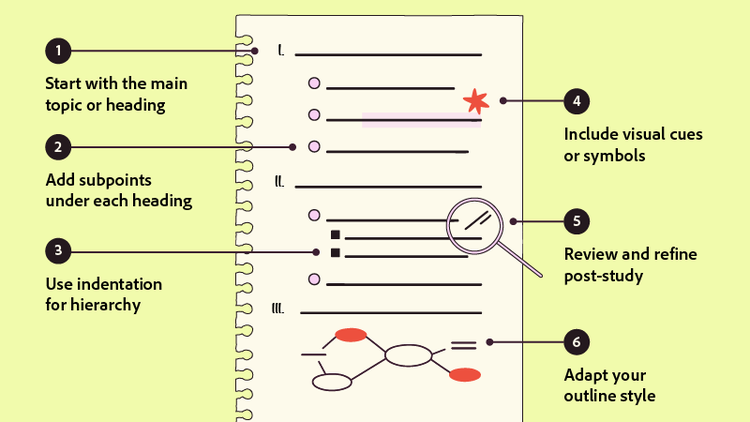
1. Start with the main topic or heading:
- Choose the primary subject of the discussion and write it clearly at the top of the page.
- If you’re attending a lecture, listen for the overarching theme or key question being addressed.
- For textbooks, use chapter titles or section headings as your starting point.
2. Add subpoints under each heading:
- Identify the major ideas or arguments that support the main topic.
- Focus on capturing key phrases or sentences rather than writing verbatim.
- If listening to a lecture, pay attention to transitions or signal words like “first,” “next,” or “finally” to identify subpoints.
3. Use indentation for hierarchy:
- Structure your notes by indenting subpoints and breaking them into smaller supporting details or examples.
- For example, use bullet points or numbers to create layers of hierarchy:
- Main topic
- Subpoint 1
- Supporting detail 1
- Supporting detail 2
- Subpoint 2
- Main topic
- Consistent indentation ensures that relationships between ideas are clear at a glance.
4. Include visual cues or symbols:
- To highlight important information, use symbols like asterisks (*) or arrows (→).
- For example, mark definitions with a bold heading (e.g., Definition) or underline key terms. This adds clarity and helps during review sessions.
5. Review and refine your notes post-study:
- After class or your study session, revisit your notes to fill in gaps or clarify concepts.
- If possible, compare your notes with your textbook or supplementary materials to ensure accuracy.
- Use this opportunity to organize thoughts further, clean up messy sections, and add any missed examples.
6. Adapt your outline style to suit your needs:
- Customize the format based on the material. For instance, use diagrams or flowcharts alongside outlines for topics requiring visual representation.
- Experiment with spacing, indentation, or color coding to make your notes more engaging and easier to navigate.
Pros and cons of the Outline method
Like any note-taking technique, the Outline method of note-taking has strengths and weaknesses. Knowing these can help you determine whether this method suits your learning style and needs.
Pros
- Logical organization: Information is structured in a way that reflects its importance and relationships.
- Efficient for review: The format allows for quick scanning and easy recall of details.
- Adaptability: Works across various subjects and types of content.
- Encourages active listening: The method requires you to identify key points and organize them as you listen or read.
Cons
- Challenging in fast-paced settings: Following the hierarchy can be difficult during rapid lectures.
- Not ideal for visual learners: Those who prefer diagrams or charts may find the linear format less engaging.
If you can’t decide whether or not the Outline method is the right one for you, try comparing it to other note-taking techniques, such as the Cornell Method. Through comparison, students can understand how one emphasizes hierarchical organization (the Outline method), while the other divides notes into sections for summaries and key points (the Cornell notes).
Outline notes example
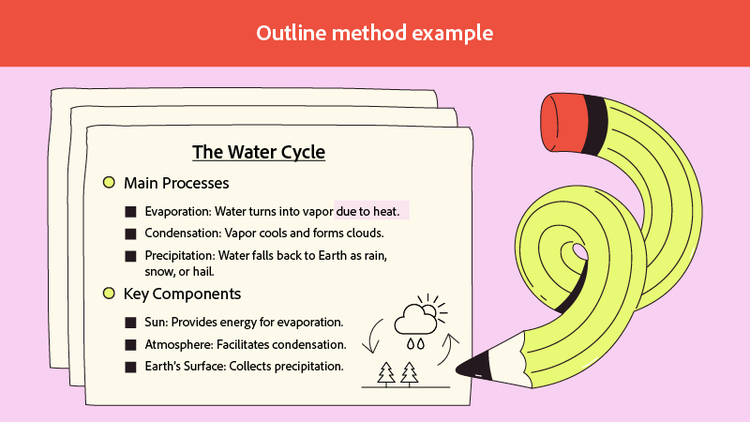
Outlining can transform complex topics into simple, digestible pieces of information. If you have shared notes or course materials in PDF format, you can even chat with your PDF and ask questions around the hierarchy to help with the outlining. By breaking a subject into hierarchical levels, the method reveals relationships between ideas and ensures clarity. To better understand its effectiveness, let’s create an outline notes example using the topic “The Water Cycle”:
The Water Cycle
- Main Processes
- Evaporation: Water turns into vapor due to heat.
- Condensation: Vapor cools and forms clouds.
- Precipitation: Water falls back to Earth as rain, snow, or hail.
- Key Components
- Sun: Provides energy for evaporation.
- Atmosphere: Facilitates condensation.
- Earth’s Surface: Collects precipitation.
As it may be apparent from the example above, the Outline method works best for:
- Summarizing lectures: Capture main ideas and supporting details effectively.
- Planning projects: Organize tasks and subtasks hierarchically.
- Creating study guides: Break down complex topics for easier review.
Students can leverage tools like Acrobat AI Assistant, which offers features such as chat with PDFs, AI-powered summaries, and note editing. These tools can enhance your workflow and save time. Here are a few tips to optimize note-taking:
- Pre-read materials: Familiarize yourself with the topic before class.
- Use abbreviations: Save time by shortening common terms.
- Review regularly: Reinforce your understanding by revisiting notes frequently.
Frequently asked questions
What is the outline method best for?
What are the 5 Rs of note-taking?
The 5 Rs are:
- Record: Write down key points.
- Reduce: Summarize important ideas.
- Recite: Review notes aloud.
- Reflect: Connect concepts to prior knowledge.
- Review: Regularly revisit notes to reinforce learning.
What’s the difference between the outline and the Cornell method?
What are the 5 basic principles of outlining?
- Start with a clear main topic.
- Use consistent indentation for hierarchy.
- Keep points concise.
- Use supporting details to clarify subpoints.
- Continuously refine and review your outline.