Adobe Acrobat
Note-taking methods: 10 note‑taking styles for students
Effective note-taking is fundamental to the learning process.


Adobe Acrobat
Effective note-taking is fundamental to the learning process.

Taking notes is more than just jotting down information. It plays a critical role in enhancing learning and retention. Equally important for students is organization, whether it’s course materials or ways to organize study notes effectively. Here are some key benefits of note-taking:

Understanding when to take notes can maximize their effectiveness. During your academic life, there are common situations where note-taking is indispensable, such as:
Whether you're a student or a professional, mastering various types of note-taking can enhance your productivity and learning outcomes.
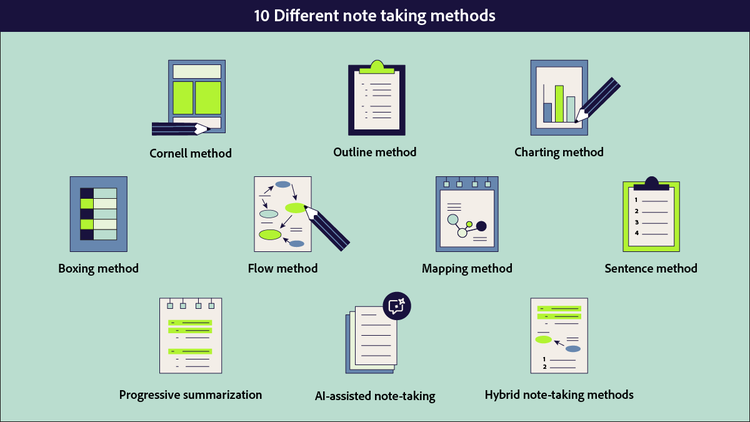
The beauty of note-taking lies in its versatility. There are numerous note - taking methods designed for different learning styles and scenarios. Below, we explore 10 popular methods, including their benefits and best use cases:
This structured approach divides your page into sections: notes, cues, and a summary. It’s ideal for reviewing and retaining essential concepts. You can learn more about this method with Cornell note-taking explained. The Cornell method is very popular because it encourages active engagement with material and simplifies reviewing and studying by summarizing key points. It also helps students structure thoughts and connect ideas.
Perfect for organizing hierarchical information, this method uses bullet points and indentation to create a clear structure. If you want to master this approach, check out how to use the outline method. There are many benefits to this method, from providing a clear and organized view of complex information to making review easy for exams or presentations. The outline method works well for linear thinkers.
Best for comparative information, the charting method organizes data in rows and columns, making it easy to identify relationships between concepts. There are 3 easy steps to this method:
In addition to simplifying complex comparisons, this note-taking method is ideal for analyzing data-heavy content like statistics or historical timelines. It saves time during review by presenting clear relationships.
This visual approach divides your notes into boxes for different topics, helping you compartmentalize information effectively. It’s also visually appealing and easy to navigate, which makes it ideal for visual learners who prefer organized layouts. The steps are simple:
Suitable for creative thinkers, the flow method captures ideas non-linearly, allowing for spontaneity and connections across concepts. To follow this method:
The flow note-taking method allows students a deeper understanding of relationships. It’s perfect for brainstorming sessions because it encourages dynamic thinking rather than rigid structures.
This method visually represents relationships between ideas, using diagrams or mind maps to show connections. Similar to the charting method, it highlights connections between concepts, but it provides a greater visualization of complex topics, which enhances memory. The steps for the mapping method are:
In this straightforward technique, you write down key sentences in a linear format, focusing on capturing the most critical points:
This note-taking method is simple and quick to implement. It’s ideal for fast-paced lectures and it reduces clutter and focuses on critical points.
This method involves layering information progressively to focus on key ideas and extract the most critical insights. To implement this method, you can:
Progressive summarization encourages deep engagement with material over multiple reviews. It simplifies complex content into manageable insights, which makes it ideal for synthesizing and prioritizing information.
Advanced tools like Acrobat's AI Assistant can generate quick summaries, while AI-powered solutions let you chat with PDFs, making interactive note-taking easy. These AI tools for students can save time and effort, while at the same time enhancing comprehension via an interactive process. They offer dynamic ways to engage with the course materials and content.
Combining multiple techniques, hybrid methods enable you to adapt to different scenarios or personal preferences. The steps to engage more than one note-taking method can look something like:
There are several benefits to using hybrid note-taking methods, from the flexibility and adaptability they provide to combining the strengths of different techniques. Hybrid methods are ideal for diverse learning scenarios.
Each of these different note-taking methods offers unique advantages. Experiment with them to find the style that best aligns with your learning goals and use note-taking templates to start.
Choosing the right note-taking method starts with understanding your learning preferences. If you are:
Sometimes, it’s not about the type of learner you are, but more about what you need to study. Different methods can align with specific objectives:
The note-taking method of choice can also sometimes depend on the type of course materials a student has. Regardless of file types, you can easily convert Word to PDF for easy sharing and collaboration with your study group.
The three general categories of note-taking techniques include:
The 5 Rs provide a systematic framework:


