How to practice interview questions with AI
Job interviews determine your career path. Learn how AI tools can help you practice interview questions, build confidence, and prepare winning answers before the big day.

Artificial intelligence (AI) tools now offer innovative ways to practice interview questions, simulate realistic conversations, and refine your responses until they shine. Instead of rehearsing alone or relying solely on mock interviews with friends, job seekers can now use AI interview tools to generate common and role-specific interview questions, receive instant feedback, and improve their answers in real time. From behavioral interview practice to technical interview prep, AI-powered platforms function like on-demand interview coaches, available anytime you need them.
Practicing interview questions with AI helps candidates build confidence, structure stronger answers using proven frameworks like STAR, and identify weak spots before facing a hiring manager. Whether you’re preparing for your first internship, a competitive graduate program, or a senior-level role, understanding how to use AI for interview preparation can give you a measurable edge.
How to practice interview questions with AI
The traditional approach to interview preparation often involved rehearsing answers in front of a mirror or asking friends to quiz you on common questions. While these methods still have value, AI has transformed how candidates can prepare for high-stakes conversations. Using AI for interview practice offers several distinct advantages. These tools are available around the clock, allowing you to practice at midnight or during your lunch break. They provide judgment-free environments where you can stumble through answers without embarrassment. Perhaps most importantly, they deliver instant, objective feedback that helps you improve rapidly.
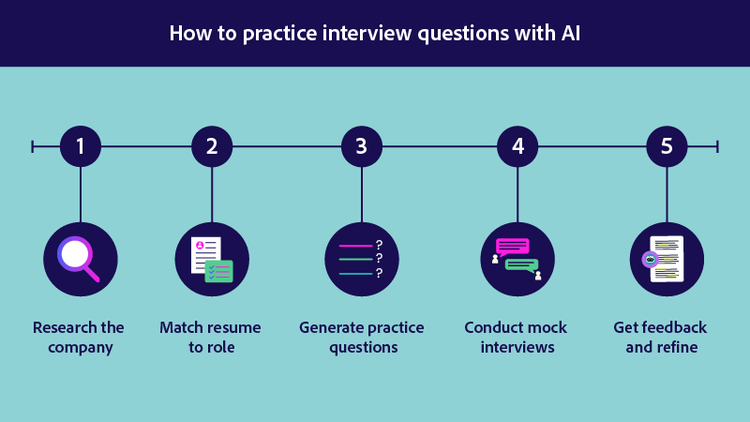
1. Research the company using AI
Before you can answer questions convincingly, you need deep knowledge about your prospective employer. Start by gathering company materials such as annual reports, press releases, and the job posting itself. Upload these documents to AI tools that can chat with PDF documents and extract key insights. Ask the AI to summarize the company's core values, recent achievements, challenges in their industry, and cultural priorities. This foundational research will inform every answer you give.
Try this prompt: “Summarize the main values, mission, and recent news about this company based on the documents I’ve provided.”
2. Review your resume and job description together
Your interview answers should create clear connections between your experience and the role’s requirements. Use resume AI tools to analyze both your resume and the job description side by side. Ask the AI to identify skill gaps you should address, experiences you should emphasize, and potential concerns a hiring manager might raise. This analysis helps you anticipate questions and prepare targeted responses.
Try this prompt: “Compare my resume to this job description and identify the top five skills I should highlight during my interview.”
3. Generate practice questions tailored to the role
Generic interview questions only get you so far. The most effective interview practice involves questions specific to your target role, industry, and company. Ask AI to generate questions based on the job title, company type, and seniority level. Request a mix of behavioral, technical, and situational questions to ensure comprehensive preparation. Understanding how AI prompts work helps you get more relevant and challenging questions from these tools.
Try this prompt: “Generate 15 interview questions for a senior marketing manager position at a technology startup, including behavioral, situational, and role-specific questions.”
4. Conduct realistic mock interviews
The most powerful use of AI for interview practice involves simulating actual interview conversations. Ask the AI to role-play as a hiring manager and conduct a mock interview. Request that it ask questions one at a time, waiting for your response before continuing. Practice answering out loud rather than typing, as this builds the verbal fluency you’ll need in the actual interview. Learning how to ask AI a question effectively makes these simulations more realistic and valuable.
Try this prompt: “Act as a hiring manager for a financial services company and conduct a behavioral interview with me. Ask questions one at a time and wait for my response before continuing.”
5. Get feedback and refine your answers
After practicing your responses, ask AI to evaluate your answers critically. Request feedback on clarity, structure, relevance, and persuasiveness. Ask for specific suggestions on how to improve weak areas. If you’re using the Situation, Task, Action, Result (STAR) method for behavioral questions, ask the AI to assess whether your answer follows this framework effectively.
Try this prompt: “Evaluate my answer to this behavioral question using the STAR method. Rate each component and suggest specific improvements.”
AI interview practice tips
Beyond the core steps above, these strategies will maximize your interview practice effectiveness.
- Practice with different question types including behavioral, technical, situational, and case-based questions to build versatility.
- Record yourself answering questions, then compare your responses to AI-generated suggestions for improvement.
- Use AI to research industry-specific terminology and trends so you can speak knowledgeably about your field.
- Ask AI to play devil’s advocate with challenging follow-up questions that push you to think deeper.
- Practice explaining complex concepts simply, as interviewers often assess your ability to communicate clearly.
- Request that AI generate questions based on potential weaknesses in your resume or experience gaps.
- Use AI to help you prepare thoughtful questions to ask the interviewer at the end of your conversation.
Why is interview practice important?
Interviews represent high-stakes conversations where first impressions and articulate responses can determine whether you receive an offer. Research consistently shows that candidates who prepare thoroughly outperform those who rely on improvisation. Understanding what interviewers evaluate helps you focus your practice effectively and present yourself as the ideal candidate.
What interviewers evaluate
Hiring managers assess multiple dimensions during interviews beyond just your technical qualifications. They evaluate your communication skills, noting whether you express ideas clearly and listen actively. They assess confidence and composure, watching how you handle pressure and unexpected questions. Cultural fit matters tremendously—interviewers want to know whether you’ll thrive within their team dynamics and company values. They examine your problem-solving abilities through behavioral questions that reveal how you approach challenges. Finally, they gauge your genuine interest in both the role and the organization.
Why questions reveal so much
Interview questions serve as windows into your personality, thinking patterns, and professional capabilities. Your answers reveal critical thinking skills that don’t appear on resumes. They demonstrate how you’ve handled real situations in the past, which predicts how you’ll perform in the future. Questions about challenges and failures show your resilience and growth mindset. Your responses to company-specific questions indicate how much research you’ve conducted and how seriously you’re pursuing the opportunity.
Understanding the STAR method
The STAR method provides a powerful framework for structuring behavioral interview answers. This approach helps you deliver complete, compelling responses that showcase your capabilities.
- Situation: Describe the context and background of a specific example from your experience.
- Task: Explain your responsibility or the challenge you needed to address.
- Action: Detail the specific steps you took to handle the situation.
- Result: Share the outcome, including quantifiable achievements when possible.
Using this framework ensures your answers have clear beginnings, middles, and ends. It prevents rambling and keeps your responses focused on demonstrating relevant competencies.
The benefits of consistent practice
Regular interview practice delivers measurable improvements in performance. Practice reduces anxiety by making the interview format familiar rather than frightening. It helps you identify gaps in your knowledge or experience that you can address before the actual interview.
Rehearsing answers improves clarity and conciseness. You learn to make your points efficiently without unnecessary tangents. Practice also helps you refine the personal stories and examples that bring your experience to life. Modern generative AI tools make this practice more accessible and effective than ever before.
Building confidence through preparation
Confidence comes from competence, and competence comes from practice. When you’ve rehearsed your answers dozens of times, you enter the interview room knowing you can handle whatever questions arise. This confidence manifests in your body language, vocal tone, and overall presence. Interviewers notice the difference between candidates who have clearly prepared and those who are improvising on the spot. The investment you make in practice pays dividends not just in better answers, but in the calm assurance that helps you connect with your interviewer as a fellow professional rather than approaching the conversation from a position of anxiety.
Most common interview prep questions
Interview questions generally fall into distinct categories, each serving a specific purpose in the evaluation process. Understanding these categories helps you prepare targeted answers that address what interviewers really want to know. Below are the most common interview prep questions organized by type, along with frameworks for crafting effective responses.
Tell me about yourself and background questions
These questions assess your communication skills, self-awareness, and ability to present your professional narrative coherently. Interviewers use them to understand your career trajectory and what motivates you.
- Tell me about yourself.
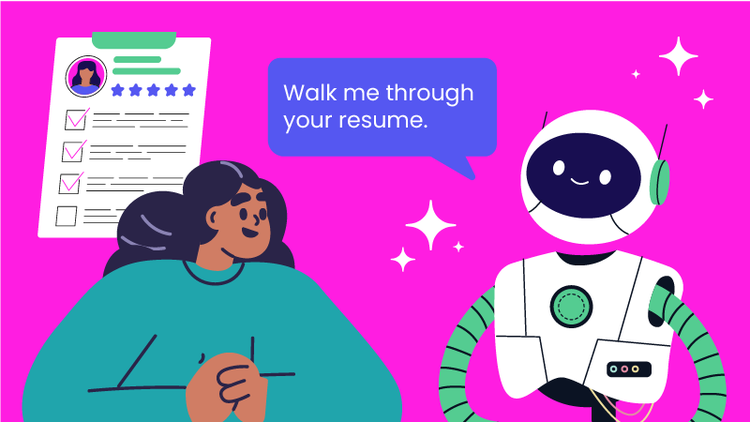
- Walk me through your resume.
- What are you most proud of in your career?
- What would your previous manager say about you?
- Describe your ideal work environment.
When answering “tell me about yourself,” structure your response as a brief professional story. Start with your current role and key responsibilities, mention relevant past experiences that led you here, and conclude with why you’re excited about this opportunity. Keep your answer under two minutes and focus on professional rather than personal details.
Sample framework: “I’m currently a [role] at [company], where I [key responsibility]. I developed my skills in [relevant area] during my time at [previous company], where I [notable achievement]. I’m excited about this opportunity because [specific reason related to the role or company].”
Company and role fit questions
These questions evaluate your genuine interest in the organization and how thoroughly you’ve researched the opportunity. Strong answers demonstrate that you’ve done your homework and have specific reasons for pursuing this particular role.
Common questions in this category include:
- Why do you want to work at this company?
- Why are you interested in this role?
- What do you know about our company?
- How does this position fit into your career goals?
- What attracted you to our industry?
Avoid generic answers that could apply to any company. Instead, reference specific aspects of the organization such as their mission, recent projects, company culture, or market position. Explain how these elements align with your values and career objectives.
Sample framework: “I’m drawn to [company] because of [specific reason—recent initiative, company value, market position]. In my research, I was particularly impressed by [specific detail]. This role excites me because [connection to your skills and goals].”
Strengths and weaknesses questions
These questions assess your self-awareness and capacity for growth. Interviewers want to see that you understand your capabilities while also demonstrating humility and commitment to improvement.
Common questions in this category include:
- What are your greatest strengths?
- What is your biggest weakness?
- How do you handle criticism?
- What skills are you currently developing?
- What would you change about yourself professionally?
For strengths, choose qualities directly relevant to the role and support them with brief examples. For weaknesses, select genuine areas for improvement that won’t disqualify you from the position, and explain concrete steps you're taking to address them.
Sample framework for weakness: “I’ve found that [specific weakness] has been a growth area for me. For example, [brief situation]. I’ve been working on this by [specific action], and I’ve seen improvement in [measurable outcome].”
Behavioral and situational questions
These questions predict future performance based on past behavior. Interviewers believe that how you’ve handled situations previously indicates how you’ll perform in similar circumstances going forward. The STAR method works particularly well for these questions.
Common questions in this category include:
- Tell me about a time you faced a significant challenge at work.
- Describe a situation where you led a team through a difficult project.
- Give an example of how you handled conflict with a colleague.
- Tell me about a time you failed and what you learned.
- Describe a situation where you had to adapt to unexpected changes.
Prepare three to five detailed examples from your experience that demonstrate different competencies. Each example should follow the STAR structure and include specific, quantifiable results when possible.
Sample STAR response: “In my previous role, we faced [Situation—specific challenge]. My responsibility was to [Task—your role]. I approached this by [Action—specific steps you took]. As a result, [Result—quantifiable outcome and impact].”
Technical and role-specific questions
Many positions require demonstrating specific knowledge or skills during the interview process. These questions assess whether you have the technical foundation needed to succeed in the role from day one.
Common questions in this category include:
- What tools and software are you proficient in?
- How do you stay current with industry developments?
- Describe your approach to [role-specific process].
- What methodologies have you used in previous roles?
- How would you handle [specific scenario related to the role]?
Salary and logistics questions
These questions assess whether your expectations align with what the company can offer. They also gauge your flexibility and professionalism in handling potentially awkward topics.
Common questions in this category include:
- What are your salary expectations?
- When can you start?
- Are you interviewing with other companies?
- Are you willing to relocate?
- What questions do you have for us?
Research salary ranges for similar positions in your market before the interview. When discussing compensation, provide a range based on your research rather than a single number. Be honest about your timeline and other opportunities while remaining professional and positive.
Sample framework: “Based on my research and experience level, I’m targeting a range of [range] for this type of role. However, I’m open to discussing the complete compensation package, including benefits and growth opportunities.”
Best practices for interview success
Beyond preparing answers to common questions, these practices will help you make the strongest possible impression.
- Research the company thoroughly before the interview, including recent news, competitors, and industry trends.
- Prepare three to five specific examples from your experience that demonstrate different competencies.
- Practice answers out loud rather than just reviewing them mentally, as verbal fluency requires verbal practice.
- Prepare thoughtful questions to ask the interviewer that demonstrate genuine interest and strategic thinking.
- Dress appropriately for the company culture and arrive ten to fifteen minutes early.
- Send a thank-you letter within 24 hours of in-person interviews to reinforce your interest.
- Follow up with a brief thank-you email after the interview after phone screens and video interview.
- Bring copies of your resume and any relevant work samples to in-person interviews.
- Prepare a brief explanation for any gaps or transitions in your employment history.
- Practice your handshake, eye contact, and other nonverbal communication elements.