



The STAR method transforms rambling interview responses into clear, compelling stories. STAR stands for Situation, Task, Action, and Result—a framework that helps you answer behavioral questions with precision. Combined with AI-powered practice tools, you can rehearse your responses, refine your delivery, and build the muscle memory needed to impress interviewers. This guide walks you through the STAR interview method and shows you how to leverage AI for smarter preparation.
What is the STAR method for interviews?
The STAR method for interviews is a structured approach to answering behavioral interview questions—those questions that begin with phrases like "Tell me about a time when..." or "Describe a situation where..." Instead of offering vague or meandering responses, the STAR framework helps you deliver focused, memorable answers that showcase your skills and experience.
STAR is an acronym that breaks down an interview answer into four components:
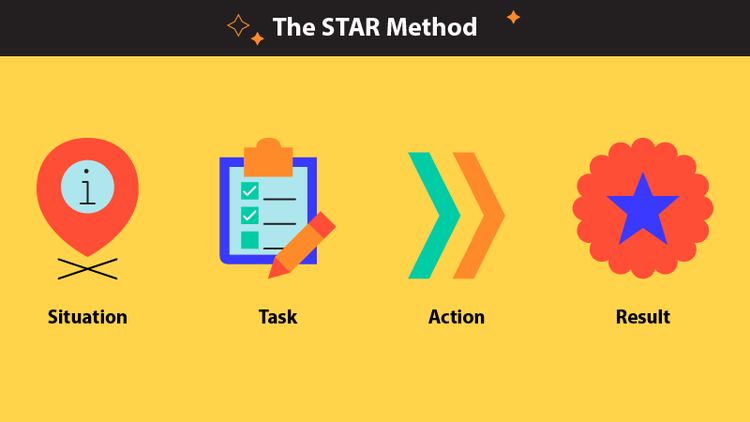
Situation. Start by setting the scene. Describe the context or background of the experience you're sharing. Where were you working? What was the project or challenge? Keep this brief—just enough detail to help the interviewer understand the circumstances.
Task. Explain your specific responsibility within that situation. What were you asked to do? What goal were you working towards? This clarifies your role and establishes what was at stake.
Action. This is the heart of your answer. Describe the specific steps you took to address the task. Focus on what you did, not what your team did collectively. Use "I" statements and be concrete about your contributions.
Result. Conclude with the outcome. What happened because of your actions? Whenever possible, quantify your results with numbers, percentages, or other measurable impacts. Even if the outcome wasn't perfect, explain what you learned.
When preparing for interviews, AI tools can accelerate your practice significantly. By asking AI the right questions, you can generate realistic STAR method questions tailored to your industry, receive instant feedback on your responses, and identify gaps in your examples before your actual interview. AI serves as an always-available practice partner that helps you refine your stories until they feel natural and polished.
Why use the STAR method
Interviewers rely on behavioral questions because past behavior is one of the strongest predictors of future performance. When hiring managers ask about specific experiences, they're looking for evidence that you've successfully handled situations similar to what you'll face in the new role. The STAR method gives you a reliable system for delivering that evidence clearly.
For interviewees, the benefits of the STAR method are substantial. Structure eliminates rambling—you know exactly where to start and where to end. Clarity helps interviewers follow your story without getting lost in unnecessary details. And comprehensive answers ensure you cover all the elements that matter: context, your role, your actions, and the impact.
The STAR format also helps you demonstrate competencies that might otherwise be difficult to convey. Leadership, problem-solving, communication, adaptability—these qualities become tangible when you illustrate them through specific examples rather than simply claiming to possess them.
Modern interview preparation has evolved alongside technology. Where candidates once practiced alone in front of mirrors or recruited reluctant friends to run mock interviews, today's job seekers can leverage generative AI tools to simulate realistic interview scenarios. These tools can generate industry-specific questions, evaluate the structure of your responses, and suggest improvements—giving you a significant advantage over candidates who rely on traditional preparation methods alone.
The combination of a proven framework like STAR with AI-powered practice creates a preparation approach that's both efficient and effective.
Prepping to use STAR interview answers with AI
Preparing for behavioral interviews used to mean guessing which questions might come up and hoping your examples would fit. AI changes that equation entirely. You can now chat with your documents using AI to analyze job descriptions, generate targeted questions, and practice your responses with immediate feedback.
Below are common STAR method interview questions along with sample answers that demonstrate the framework in action. Use these as templates to develop your own responses, then practice with AI to refine them.

Question 1: Tell me about a time you led a team through a difficult project.
Sample answer: At my previous company, our department was tasked with launching a new customer portal within eight weeks—half the typical timeline. As project lead, I was responsible for coordinating a cross-functional team of six people while managing stakeholder expectations. I implemented daily fifteen-minute standups to identify blockers quickly, created a shared dashboard for real-time progress tracking, and negotiated with leadership to temporarily reassign two additional developers to our team. We launched the portal on schedule, and it achieved a 92% customer satisfaction rating in its first month, exceeding our target by twelve points.
Question 2: Describe a situation where you had to solve a complex problem.
Sample answer: During a product launch, we discovered a critical bug in our payment processing system just three days before go-live. As the senior developer on call, I needed to diagnose the issue and implement a fix without delaying the launch. I assembled a small team for a focused debugging session, traced the error to a third-party API integration, and developed a workaround that maintained security while bypassing the faulty connection. We deployed the fix within 36 hours, launched on time, and processed over $2 million in transactions during the first week without a single payment failure.
Question 3: Give me an example of how you handled a conflict with a coworker.
Sample answer: A colleague and I disagreed strongly about the direction of a marketing campaign. He wanted to focus entirely on social media, while I believed we needed a multi-channel approach. As the campaign manager, I needed to resolve this quickly to meet our deadline. I scheduled a one-on-one meeting where I asked him to walk me through his reasoning, then shared data from our previous campaigns showing that multi-channel approaches had consistently outperformed single-channel efforts. We agreed to allocate 60% of the budget to social media while testing other channels with the remainder. The campaign exceeded our lead generation goals by 23%, and my colleague later acknowledged that the hybrid approach had been the right call.
Question 4: Tell me about a time you had to meet a tight deadline.
Sample answer: Our annual compliance report was due to regulators in two weeks, but a key team member had resigned unexpectedly, leaving critical sections incomplete. I was assigned to fill the gap while maintaining my regular responsibilities. I mapped out all remaining tasks, identified which required my specific expertise versus which could be delegated, and negotiated with my manager to postpone two lower-priority projects. I also worked two additional hours each day and brought in a contractor for data verification. We submitted the report three days early with zero compliance flags—the first time our department had achieved that in four years.
Question 5: Describe your greatest professional achievement.
Sample answer: I'm most proud of redesigning our company's onboarding process, which had a 40% new-hire dropout rate within the first 90 days. As the HR coordinator responsible for employee experience, I needed to identify why we were losing people and fix it. I conducted exit interviews with recent departures, surveyed current employees about their onboarding experiences, and benchmarked our process against industry best practices. Based on my findings, I implemented a buddy system, created a structured 30-60-90 day plan, and introduced weekly check-ins during the first month. Within one year, our dropout rate fell to 12%, saving the company an estimated $180,000 in recruiting and training costs.
Question 6: Tell me about a time you failed and what you learned from it.
Sample answer: I once underestimated the time needed to complete a software migration, which caused our team to miss a major deadline. As the technical lead, I had been responsible for creating the project timeline. I had based my estimates on ideal conditions without accounting for potential complications. After the missed deadline, I implemented a new estimation process that included buffer time for unknowns and required sign-off from team members on their individual task estimates. I also started conducting pre-mortems on major projects to identify risks before they materialized. My next three projects all delivered on schedule, and the estimation framework I developed was adopted by other teams in the department.
Question 7: Give an example of how you communicated a complex idea to a non-technical audience.
Sample answer: Our engineering team needed budget approval for a major infrastructure upgrade, but the executive committee had limited technical background. As the lead engineer presenting the proposal, I needed to make the case in terms they would understand and care about. I translated technical specifications into business outcomes—instead of discussing server capacity, I talked about customer wait times. I used analogies comparing our current system to a two-lane road during rush hour and the upgrade to adding express lanes. I also created a simple visual showing projected cost savings over three years. The committee approved the full budget request, and one executive later told me it was the clearest technical presentation she had ever seen.
Question 8: Describe a time when you took initiative without being asked.
Sample answer: I noticed that our sales team was spending significant time manually entering data from trade show leads into our CRM system. Nobody had asked me to address this—I was in marketing operations, not sales support. But I recognized the inefficiency and proposed a solution to my manager. I researched integration options, identified a tool that could automate the process, and built a business case showing we could save approximately 15 hours per week. After receiving approval, I implemented the integration and trained the sales team on the new workflow. The time savings allowed our sales representatives to follow up with leads 48 hours faster on average, contributing to an 18% increase in trade show conversion rates.
Tips in using AI to prep for STAR method interview questions
Getting the most from AI interview practice requires setting up your sessions thoughtfully. Start by providing the AI with rich context about the role you're pursuing. Share the job description, company information, and any details about the team or department. The more specific information you provide, the more relevant and challenging the questions will be. You can even build your resume with AI and then use that document as a reference point for generating questions that probe your specific experiences.
Treat the AI as your personal mock interviewer. Ask it to play the role of a hiring manager for your target company and industry. Request that it ask follow-up questions just as a real interviewer would—probing for more detail, asking for clarification, or challenging your conclusions. This creates a more realistic practice environment than simply answering standalone questions.
Generate questions customized to your target role. If you're interviewing for a project management position, ask the AI to focus on questions about stakeholder management, resource allocation, and deadline pressure. For a customer service role, request scenarios involving difficult customers, de-escalation techniques, and service recovery. Industry-specific questions help you prepare examples that directly your relevant skills.
Use AI feedback to strengthen your responses. After delivering a practice answer, ask the AI to evaluate whether you clearly addressed all four STAR components. Request suggestions for making your results more quantifiable or your actions more specific. Practice delivering the same answer multiple times, incorporating feedback with each iteration until your response feels polished and natural.
When practicing with AI, the quality of your prompts directly influences the quality of your practice session. Consider this approach: I'm interviewing for a senior marketing manager role at a technology company. The job description emphasizes cross-functional collaboration and data-driven decision making. (You also have the option to share the full job description here.) Please ask me a behavioral interview question that would test these competencies, then provide feedback on my response using the STAR framework.
You might also try: Here's my answer to the question about handling conflict. Please evaluate whether I clearly stated the situation, defined my task, described specific actions I took, and quantified the results. Suggest specific improvements. This kind of detailed prompt helps you generate actionable feedback.
For iterative improvement, follow up with: Based on your feedback, here's my revised answer. How does this version compare to my original? Are there any remaining gaps in my STAR structure? This back-and-forth refinement process mirrors how you might work with a professional interview coach, but with unlimited availability and instant responses.
Best practices and benefits
To maximize your AI-powered interview preparation, follow these proven strategies:
- Record your practice sessions and review them afterward to catch verbal tics, filler words, or areas where you lose confidence
- Vary your question types across different competency areas—don't just practice your strongest examples repeatedly
- Practice under time constraints, limiting yourself to two minutes per response as you would in an actual interview
- Iterate on feedback by practicing the same question multiple times until your answer feels natural
- Customize your practice for specific industries, asking for questions that reflect the unique challenges of your target field
AI-powered preparation offers distinct advantages over traditional methods, including:
- Available around the clock whenever you have time to practice, not just when a friend is free
- Provides immediate, objective feedback without social awkwardness
- Offers unlimited practice sessions so you can rehearse until you feel genuinely confident
- Personalizes questions to your specific experience and target role
- Creates a low-pressure environment where mistakes become learning opportunities rather than embarrassments
Frequently asked questions
While interviewers can ask countless variations, five common categories of STAR question appear frequently: leadership and teamwork questions, problem-solving and analytical thinking scenarios, conflict resolution situations, time management and prioritization challenges, and questions about handling failure or setbacks. Prepare at least one strong example for each category to ensure you're ready for most behavioral questions you'll encounter.
Success comes from preparation and authenticity. Develop a bank of five to seven versatile examples from your experience that can be adapted to different questions. Practice delivering them until the structure feels natural, not rehearsed. During the interview, listen carefully to the specific question being asked and select the example that best demonstrates the competency being evaluated. Be specific about your individual contributions, quantify results whenever possible, and keep your answers focused—aim for responses between ninety seconds and two minutes.
The most frequent errors are spending too much time on the situation and task while rushing through actions and results. Other pitfalls include: using "we" instead of "I" throughout your answer, failing to quantify outcomes, choosing examples that don't match the competency in question, and providing answers that are either too brief to be compelling or too long to hold attention. Practice helps you find the right balance and ensures you emphasize your individual contributions.
Absolutely. The STAR framework works across all interview formats. For phone interviews, keep notes nearby with your key examples outlined—you can reference them without the interviewer seeing. For video interviews, maintain eye contact with your camera rather than looking at notes, and practice speaking at a slightly slower pace since audio quality can vary. In both formats, the structured approach of STAR helps you stay organized and deliver complete answers even without the visual cues of an in-person conversation.
You may also like
title
STAR method for interviews: How to practice with AI
cardImageAltText
Visual representation of the STAR method framework
cardImage
primaryTag
caas:content-type/article
Tags
caas:content-type/article,caas:products/acrobat,caas:topic/ai-chat-pdf,caas:topic/students,caas:topic/job-search

