Most common SAT vocabulary words
Mastering SAT vocabulary words can significantly boost your test scores and college readiness. This guide covers essential words, testing formats, and proven study strategies.

How is vocabulary tested on the SAT?
The SAT approaches vocabulary differently than you might expect. Rather than asking you to memorize definitions in isolation, the test evaluates your ability to understand words within the context of reading passages. This approach reflects how vocabulary knowledge functions in real academic settings and prepares you for the reading demands of college coursework.
The Reading and Writing section of the digital SAT contains approximately 54 questions, with vocabulary-related questions making up a significant portion. These "Words in Context" questions typically present a short passage with a blank or an underlined word, then ask you to select the most appropriate word choice based on meaning and context. Understanding these SAT vocabulary words in their natural habitat—within sentences and paragraphs—is essential for success.
Types of vocabulary questions you will encounter
You will encounter several distinct types of vocabulary questions on the test. The first type asks you to determine the meaning of a word as used in a specific passage. These questions test whether you can identify which definition of a word applies in a particular context, especially for words with multiple meanings.
The second type requires you to choose a word that best completes a sentence while maintaining the intended meaning. These fill-in-the-blank style questions test both your vocabulary breadth and your understanding of how words function within sentences. You must consider not only the dictionary definition but also the tone, connotation, and logical flow of the passage.
A third type tests your understanding of connotation—the subtle emotional or associative meaning of words beyond their dictionary definitions. Two words might have similar denotations but very different connotations. For example, "thrifty" and "cheap" both relate to spending money carefully, but they carry different implications about the person being described.
Understanding question complexity
The complexity level varies throughout the test. Some questions feature straightforward vocabulary in clear contexts, while others present more challenging words or nuanced distinctions between similar options. The test often includes words with multiple meanings, requiring you to identify which definition applies in the given context.
For instance, the word "arrest" might appear not in its common meaning of police detention, but in its secondary meaning of stopping or halting something. Similarly, "novel" might be tested as an adjective meaning new or unusual rather than as a noun referring to a book. These SAT vocab words with multiple meanings require careful attention to context clues.
Understanding this testing format is crucial for effective preparation. Rather than simply memorizing word lists, successful test-takers develop skills in reading comprehension, context analysis, and recognizing how word choice affects meaning. Utilizing exam preparation tools can help you practice these skills systematically before test day.
The SAT vocabulary questions assess your readiness for college-level reading and writing. Academic texts frequently use sophisticated vocabulary, and your ability to navigate these words demonstrates preparedness for higher education coursework. By understanding how the test works, you can focus your SAT vocabulary practice on the skills that matter most.
300 SAT vocabulary words to know
Building a strong vocabulary foundation requires consistent practice with high-frequency SAT words. While memorizing every possible word is impractical, focusing on commonly tested vocabulary gives you the best return on your study time. Learning to improve your vocabulary through active engagement with words—not just passive reading—creates lasting knowledge.
The following curated list presents essential SAT vocab words with definitions and example sentences. These words appear frequently on the test and in academic writing. Study them carefully, paying attention to how each word functions in context. As you review, consider how you might chat with study documents to explore word meanings and generate additional practice examples.

Essential SAT vocabulary words A-C
- Aberration — A departure from what is normal or expected. The unusually warm December weather was an aberration from the typical frigid temperatures.
- Acclaim — Enthusiastic approval or praise. The novel received widespread acclaim from literary critics.
- Acumen — The ability to make good judgments and quick decisions. Her business acumen helped the company navigate the economic downturn.
- Adversity — Difficulties or misfortune. She demonstrated remarkable resilience in the face of adversity.
- Advocate — To publicly support or recommend a cause or policy. Environmental groups advocate for stricter pollution regulations.
- Aesthetic — Concerned with beauty or artistic appreciation. The architect prioritized aesthetic appeal alongside functionality.
- Ambiguous — Open to multiple interpretations; unclear. The contract's ambiguous language led to disputes between the parties.
- Ameliorate — To make something better or more tolerable. The new policies were designed to ameliorate working conditions.
- Anomaly — Something that deviates from the standard or expected. The data point was dismissed as an anomaly in the research findings.
- Apathy — Lack of interest, enthusiasm, or concern. Voter apathy contributed to the low election turnout.
- Arduous — Involving or requiring strenuous effort; difficult. The arduous journey through the mountains took several weeks.
- Articulate — To express thoughts clearly and effectively. She was able to articulate her position with remarkable clarity.
- Ascertain — To find out or discover with certainty. Investigators worked to ascertain the cause of the accident.
- Astute — Having sharp judgment or keen insight. His astute observations about market trends proved accurate.
- Bolster — To support, strengthen, or reinforce. Additional evidence helped bolster the prosecution's case.
- Candid — Truthful and straightforward; frank. The interview provided a candid look at the challenges facing the organization.
- Capricious — Given to sudden changes of mood or behavior. The capricious weather made planning outdoor events difficult.
- Compelling — Evoking interest or attention in a powerful way. The documentary presented a compelling argument for conservation efforts.
- Complacent — Showing smug satisfaction with oneself or one's achievements. Success made the team complacent, leading to their eventual defeat.
- Concede — To admit that something is true after first denying it. After reviewing the evidence, he had to concede his initial assessment was wrong.
- Concise — Giving information clearly and briefly. The report was praised for its concise presentation of complex data.
- Conjecture — An opinion based on incomplete information. Without more evidence, any explanation remains mere conjecture.
- Contemplate — To think about something deeply and at length. She took time to contemplate the implications of her decision.
- Corroborate — To confirm or support with evidence. Multiple witnesses corroborated the defendant's alibi.
- Credible — Able to be believed; trustworthy. The journalist relied only on credible sources for the investigation.
- Cursory — Hasty and superficial. A cursory glance at the document revealed several obvious errors.
Essential SAT vocabulary words D-F
- Daunting — Seeming difficult to deal with; intimidating. The scope of the project was daunting but not impossible.
- Deliberate — Done consciously and intentionally. The word choice was deliberate, designed to evoke a specific response.
- Delineate — To describe or portray something precisely. The report delineated the steps necessary for implementation.
- Derive — To obtain something from a specified source. Many English words derive from Latin and Greek roots.
- Deter — To discourage someone from doing something. The security measures were designed to deter potential intruders.
- Didactic — Intended to teach or instruct. The novel's didactic tone made it feel more like a lecture than a story.
- Discern — To perceive or recognize something. It was difficult to discern the speaker's true intentions.
- Disparage — To belittle or speak negatively about. Critics disparaged the film for its predictable plot.
- Disparity — A great difference or inequality. The study highlighted the disparity between urban and rural healthcare access.
- Divergent — Tending to develop in different directions. The two scientists held divergent views on the interpretation of results.
- Dubious — Hesitating or doubting; questionable. The claim seemed dubious without supporting evidence.
- Elicit — To draw out a response or reaction. The comedian's performance elicited laughter from the audience.
- Eloquent — Fluent and persuasive in speaking or writing. Her eloquent speech moved many in the audience to tears.
- Empirical — Based on observation or experience rather than theory. The hypothesis required empirical evidence to be accepted.
- Enhance — To intensify, increase, or improve the quality of something. The renovation was designed to enhance the building's energy efficiency.
- Ephemeral — Lasting for a very short time. Social media trends are often ephemeral, disappearing within weeks.
- Equivocal — Open to more than one interpretation; ambiguous. The politician gave an equivocal response that satisfied no one.
- Erratic — Not consistent or regular; unpredictable. His erratic behavior raised concerns among his colleagues.
- Exacerbate — To make a problem or situation worse. The drought conditions exacerbated the risk of wildfires.
- Exemplify — To serve as a typical example of something. Her career exemplifies dedication and perseverance.
- Explicit — Stated clearly and in detail, leaving no room for confusion. The instructions were explicit about the proper procedure.
- Facilitate — To make an action or process easier. New software was implemented to facilitate communication between departments.
- Feasible — Possible and practical to accomplish. The engineers determined that the project was technically feasible.
- Fluctuate — To rise and fall irregularly. Stock prices fluctuate based on market conditions.
- Formidable — Inspiring fear or respect through impressiveness. The team faced a formidable opponent in the championship game.
- Fortuitous — Happening by chance, especially in a favorable way. Their fortuitous meeting at the conference led to a lasting partnership.
- Frugal — Sparing or economical with money or resources. Her frugal habits allowed her to save for retirement early.
Essential SAT vocabulary words G-N
- Galvanize — To shock or excite someone into taking action. The crisis galvanized the community into organizing relief efforts.
- Garner — To gather or collect something. The campaign garnered significant support from young voters.
- Hinder — To create difficulties that delay or prevent progress. Poor communication can hinder project completion.
- Hypothetical — Based on a suggested idea rather than fact. The professor posed a hypothetical scenario for class discussion.
- Impartial — Treating all rivals or parties equally; fair. The judge was expected to remain impartial throughout the proceedings.
- Impede — To delay or prevent by obstructing. Heavy traffic impeded our progress to the airport.
- Implication — A conclusion that can be drawn from something not explicitly stated. The study's implications extended far beyond its original scope.
- Implicit — Suggested though not directly expressed. There was an implicit understanding between the two parties.
- Inadvertent — Not resulting from or achieved through deliberate planning. The error was inadvertent, not intentional.
- Incisive — Intelligently analytical and clear-thinking. Her incisive questions revealed flaws in the argument.
- Indifferent — Having no particular interest or sympathy. The committee appeared indifferent to the concerns raised.
- Inherent — Existing as a natural or permanent quality. There are inherent risks in any investment strategy.
- Innovate — To introduce new methods, ideas, or products. Companies must continuously innovate to remain competitive.
- Instigate — To bring about or initiate an action. Protesters instigated a movement for policy reform.
- Integrate — To combine parts into a whole. The curriculum integrates theory with practical application.
- Integrity — The quality of being honest and having strong moral principles. Her integrity was never questioned by colleagues.
- Mitigate — To make less severe, serious, or painful. Steps were taken to mitigate the environmental impact.
- Nuanced — Characterized by subtle differences or distinctions. The issue requires a nuanced understanding of multiple perspectives.
Essential SAT vocabulary words O-Z
- Obscure — Not clearly expressed or easily understood. The reference was too obscure for most readers to recognize.
- Paradox — A seemingly contradictory statement that may be true. The more we learn, the more we realize how much we don't know—a classic paradox.
- Peripheral — Of secondary importance; marginal. The discussion focused on core issues rather than peripheral concerns.
- Pervasive — Spreading widely throughout an area or group. Technology's influence has become pervasive in modern education.
- Pragmatic — Dealing with things sensibly and realistically. The committee took a pragmatic approach to solving the budget crisis.
- Precedent — An earlier event or action regarded as an example. The court's decision set a precedent for future cases.
- Profound — Very great or intense; having deep meaning. The discovery had profound implications for medical research.
- Proliferate — To increase rapidly in number; multiply. Social media platforms have proliferated in recent years.
- Propensity — An inclination or natural tendency. He showed a propensity for taking unnecessary risks.
- Proximity — Nearness in space, time, or relationship. The proximity of the two events suggested a connection.
- Redundant — Not or no longer needed or useful; superfluous. The editing process eliminated redundant phrases from the text.
- Refute — To prove a statement or theory to be wrong. The new evidence refuted the previously accepted hypothesis.
- Relevant — Closely connected or appropriate to the matter at hand. Only relevant information should be included in the summary.
- Reticent — Not revealing thoughts or feelings readily. She remained reticent about her plans for the future.
- Scrutinize — To examine or inspect closely and thoroughly. Auditors scrutinized the company's financial records.
- Substantiate — To provide evidence to support a claim. The researcher was unable to substantiate her initial findings.
- Subtle — So delicate or precise as to be difficult to analyze. The subtle differences between the two options required careful consideration.
- Superfluous — Unnecessary, especially through being more than enough. The editor removed superfluous details from the manuscript.
- Tenuous — Very weak or slight; insubstantial. The connection between the two events was tenuous at best.
- Undermine — To erode the base or foundation of something. Constant criticism can undermine a person's confidence.
- Unprecedented — Never done or known before. The company achieved unprecedented growth in its first year.
- Validate — To confirm the truth or value of something. The experiment was designed to validate the theoretical model.
- Viable — Capable of working successfully; feasible. The team presented several viable alternatives to the original plan.
- Volatile — Liable to change rapidly and unpredictably. The volatile market conditions made investors nervous.
- Wary — Feeling or showing caution about possible dangers. Consumers should be wary of deals that seem too good to be true.
How to prepare for the SAT vocabulary test
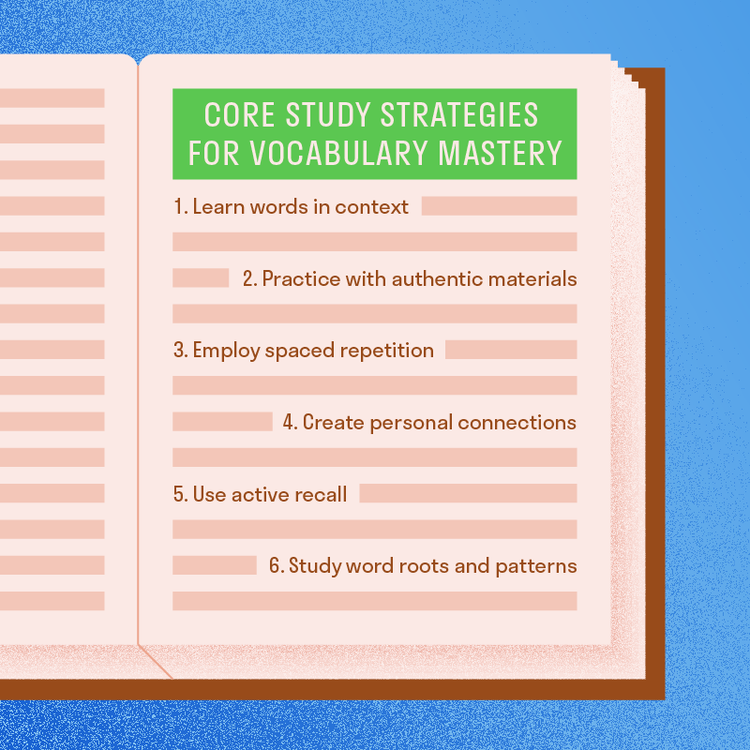
Effective SAT vocabulary practice goes beyond simple memorization. The most successful approach combines multiple study strategies that reinforce word knowledge from different angles. When you create a study guide tailored to your learning style, you establish a foundation for systematic vocabulary building that will serve you well on test day and beyond.
Core study strategies for vocabulary mastery
Use digital tools to enhance your vocabulary practice
Digital resources offer powerful ways to reinforce vocabulary learning. A flashcard maker allows you to create custom study cards from any vocabulary list, complete with definitions, example sentences, and personal notes. Digital flashcards can be shuffled, filtered by difficulty, and reviewed on any device, making your SAT vocabulary practice more flexible and effective.
Self-testing is one of the most effective study strategies, and a quiz generator can create practice assessments from your study materials. These quizzes help identify which words you have mastered and which require additional review, allowing you to focus your study time efficiently. Regular self-assessment keeps you honest about your progress and prevents overconfidence.
AI study tools can transform how you interact with vocabulary content. Upload your word lists or study guides, then ask questions about word meanings, request example sentences, or generate practice exercises. This interactive approach keeps study sessions engaging and provides immediate clarification when you encounter confusing concepts.
Building a comprehensive study plan
Effective SAT vocabulary practice requires consistency and structure. Set aside dedicated time each day for vocabulary study—even 15 to 20 minutes of focused practice yields better results than occasional lengthy sessions. Track which words you have mastered and which need additional review.
Consider creating a vocabulary journal where you record new words, their definitions, example sentences, and personal associations. Writing by hand can enhance memory formation, and the act of creating your own definitions helps deepen understanding.
Read widely from sources that use sophisticated vocabulary. Publications like The New York Times, The Atlantic, and academic journals expose you to SAT-level words in authentic contexts. When you encounter unfamiliar words, look them up immediately and add them to your study materials.
Practice using new words in your own writing and speech. The transition from recognition to production demonstrates deeper mastery. Try incorporating recently learned SAT vocab words into essays, discussions, or even casual conversations.
Combining traditional study methods with digital tools creates a comprehensive vocabulary practice system. Use reading and context-based learning to encounter words naturally, then reinforce that knowledge with flashcards, quizzes, and AI-assisted review sessions. This multi-modal approach ensures that vocabulary learning sticks.
Frequently asked questions
What are the most common vocabulary words on the digital SAT?
How do I memorize vocabulary for the SAT?
You may also like