What is self-plagiarism and how to avoid it?
Understanding self-plagiarism helps you maintain academic integrity and produce genuinely original work.

What is self-plagiarism?
Self-plagiarism refers to the practice of reusing your own previously submitted or published work without proper disclosure or citation. Also known as text recycling or auto-plagiarism, this occurs when a writer presents old material as if it were new and original. Understanding what is self-plagiarism helps you recognize when you might inadvertently cross ethical boundaries in academic or professional writing.
Can you plagiarize yourself? The answer is yes. While it may seem counterintuitive since you created the original content, self-plagiarism violates the fundamental expectation that submitted work represents fresh thinking and effort. When instructors assign papers, they expect students to engage with the material anew, developing their analytical skills through each assignment. Similarly, academic journals expect submitted manuscripts to contain original contributions to the field.
The distinction between self-plagiarism and legitimate reuse often comes down to transparency and context. Properly paraphrasing and citing your previous work transforms recycled content into an acceptable building block for new ideas. Without such acknowledgment, even your own words become problematic.
Self-plagiarism should be avoided for several important reasons:
- It violates academic integrity policies that most educational institutions enforce strictly. These policies exist to ensure fairness among students and to uphold the value of academic credentials. According to a survey by the International Center for Academic Integrity, approximately 68% of undergraduate students admitted to some form of cheating, including text recycling, highlighting how widespread these issues have become (McCabe, 2012).
- It breaches the implicit expectation of original effort. Every academic assignment serves a pedagogical purpose, designed to help students develop specific skills and demonstrate particular competencies. When you recycle previous work, you undermine this learning process and shortcut genuine intellectual engagement.
- It can have severe consequences. Academic penalties for self-plagiarism range from failing grades on individual assignments to course failure and even expulsion from academic programs. Many institutions maintain records of academic integrity violations that can affect future educational and professional opportunities.
- It may constitute a breach of contract or copyright issues when previously published work is involved. When you publish work in a journal, you often transfer certain rights to the publisher. Reusing that content without permission can create complications beyond academic settings.
Recognizing specific examples helps clarify what constitutes self-plagiarism in practice. The most obvious form involves reusing entire past essays for new assignments. A student who submits a paper written for one class to fulfill requirements in another class commits self-plagiarism, even if both classes cover similar topics. This practice, sometimes called duplicate submission, misrepresents the student's effort and violates the expectation of original work.
Recycling sections or paragraphs without disclosure represents another common form of self-plagiarism. You might be tempted to lift a well-crafted literature review or methodology section from a previous paper. After all, you spent considerable time perfecting that section, and the information remains relevant. However, without explicit acknowledgment and instructor permission, this practice crosses ethical lines.
In professional publishing, republishing previously published research without acknowledgment creates serious ethical problems. Academic journals require disclosure of any prior publication, and many have strict policies against republication without proper citation and permission. The Committee on Publication Ethics (COPE) provides guidelines indicating that text recycling without disclosure can constitute research misconduct.
A related concern involves salami slicing, where researchers divide one significant study into multiple smaller publications to artificially inflate their publication count. While each individual paper might contain original analysis, the practice raises ethical concerns about efficiency and honesty in scholarly communication.
Understanding these boundaries helps you navigate academic expectations while building appropriately on your previous work. The goal is not to prevent you from ever referencing your past ideas but to ensure transparency about what is genuinely new. Academic writing often builds on previous research, including your own, and the scholarly community recognizes the value of developing ideas over time. The key is approaching this development with honesty and proper attribution.
How to avoid self-plagiarism
Maintaining academic integrity while building on your previous work requires intentional strategies. The following approaches help you develop original content while appropriately leveraging your past research and insights. By implementing these steps systematically, you can produce work that meets ethical standards while still benefiting from your accumulated knowledge.
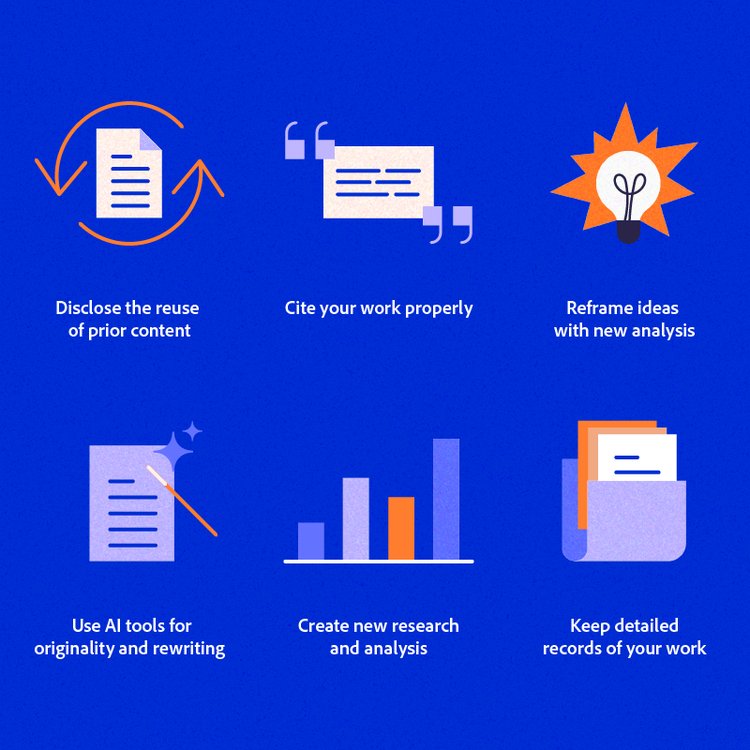
1. Disclose the reuse of prior content
Transparency forms the foundation of ethical content reuse. Before incorporating material from previous assignments, consult with your instructor about the specific assignment requirements. Many professors allow students to build on prior work when properly disclosed, particularly for long-term research projects or thesis development.
When approaching instructors, be specific about what you want to reuse and how it connects to the new assignment. Explain your rationale for building on previous work rather than starting fresh. Most educators appreciate this honesty and can provide guidance on acceptable approaches. Keep written records of any permissions granted, including emails or signed forms, to protect yourself from future misunderstandings.
In publishing contexts, disclose any prior publication to journal editors during the submission process. Many journals have specific policies about acceptable levels of text overlap with previously published work. Being upfront about your publication history prevents accusations of misconduct and allows editors to make informed decisions. Some journals provide specific forms for disclosure that you should complete thoroughly and honestly.
Additionally, consider whether your institution has formal processes for obtaining permission to reuse work. Some universities require students to submit petitions or obtain signatures from multiple instructors when work spans different courses. Following these procedures demonstrates your commitment to academic integrity and protects you from inadvertent violations.
2. Cite your prior work properly
Self-citation represents an acceptable and often expected practice in academic writing. When you reference ideas, data, or text from your previous work, treat that material as you would any other source. The detailed methods for proper citation appear in the following section but understanding that self-citation is legitimate helps you approach it confidently. It is different than knowing how to cite an article or other third party sources.
Citing your own work demonstrates intellectual honesty and helps readers trace the development of your ideas over time. It also gives proper credit to the effort you invested in previous projects while clearly distinguishing new contributions. Scholars frequently cite their own previous publications to establish context for new research or to direct readers to more detailed treatments of foundational concepts.
When self-citing, maintain the same standards you would apply to citing other sources. Include complete bibliographic information, use quotation marks for direct quotes, and clearly indicate which ideas come from previous work versus new analysis. This practice not only protects you from plagiarism accusations but also enhances the credibility of your scholarship by demonstrating a consistent research program.
3. Reframe ideas with new analysis
Rather than copying previous text, use your past work as a foundation for deeper exploration. Consider how your thinking has evolved since your original analysis. What new perspectives can you bring to familiar material? Have you encountered new sources, theories, or methodologies that would enrich your previous conclusions?
Learning to paraphrase quotes effectively helps you express ideas in fresh language while maintaining their essential meaning. This skill proves valuable whether you are working with your own previous writing or incorporating sources from other authors. Effective paraphrasing involves more than simply substituting synonyms; it requires genuinely reconceptualizing information and presenting it from a new angle.
Develop new arguments from old foundations by asking different questions about your research. If your previous paper examined causes, your new paper might explore solutions or implications. If you previously focused on one case study, consider how your findings apply to different contexts or populations. This approach generates genuinely original content while legitimately building on established work.
Consider creating entirely new outlines before drafting, even when working with familiar material. Starting with fresh organizational structures naturally leads to new writing and helps you avoid the temptation to copy previous passages. You might discover connections between ideas that you had not previously recognized or identify gaps in your earlier analysis that warrant exploration.
4. Use AI tools for originality and rewriting
Modern technology offers powerful assistance for maintaining originality. Generative AI tools for PDFs can help you analyze your previous documents and identify opportunities for fresh approaches. These tools assist with reframing content in new ways while preserving core insights, making the revision process more efficient and thorough.
An AI summary generator helps you distill sources into concise summaries without inadvertently copying language. This proves particularly useful when synthesizing multiple previous works into a new paper. By generating fresh summaries of your own previous research, you create new text that captures essential ideas without duplicating original phrasing.
Consider using AI to generate fresh outlines from existing research. Starting with a new organizational structure naturally leads to new writing, even when the underlying ideas connect to previous work. AI tools can suggest alternative frameworks, highlight underexplored aspects of your research, and prompt you to consider new angles on familiar topics.
These tools can also help identify duplicate passages before submission, allowing you to revise problematic sections proactively. Running your draft through plagiarism detection software, many of which now incorporate AI capabilities, helps catch unintentional text recycling before it becomes a problem.
Creating an originality checklist with AI assistance ensures you systematically review your work for potential self-plagiarism. This proactive approach demonstrates your commitment to academic integrity and helps you develop habits that prevent problems throughout your academic and professional career.
5. Create new research and analysis
The most effective way to avoid self-plagiarism is to generate genuinely new content. While building on previous work is acceptable with proper citation, each new assignment should contain substantial original contribution. This might involve conducting new research, applying different analytical frameworks, or exploring aspects of a topic you had not previously addressed.
When revisiting familiar topics, challenge yourself to find new sources published since your previous work. Academic fields evolve continuously, and incorporating recent scholarship demonstrates engagement with current conversations in your discipline. New sources often provide fresh perspectives that naturally lead to original analysis.
You can expand your methodology or analytical approach. If your previous work relied primarily on qualitative analysis, incorporating quantitative methods for a new assignment generates different insights. If you previously examined your topic through one theoretical lens, applying an alternative framework produces genuinely new conclusions.
Seek feedback from instructors, peers, or writing center staff before completing your work. Fresh perspectives can help you identify areas where your analysis remains too similar to previous work and suggest directions for development that you might not have considered independently.
6. Keep detailed records of your work
Maintaining organized records of your previous submissions helps you manage self-plagiarism risks effectively. Create a system for storing past papers, including information about submission dates, course names, instructor names, and any permissions granted for reuse.
Detailed records allow you to accurately cite your previous work when appropriate. They also help you remember what you have written previously, reducing the risk of inadvertent duplication. When you have written extensively on a topic over time, it becomes easy to forget the specific language you used in earlier papers.
You can go as far as maintaining a personal database of your academic writing that includes key phrases, arguments, and findings from each paper. This reference tool helps you identify when new writing too closely resembles previous work and prompts you to revise before submission.

How to cite prior work
Proper self-citation protects you from accusations of self-plagiarism while demonstrating scholarly integrity. The principles of attribution remain consistent regardless of authorship.
Self-citation is appropriate when your previous work provides relevant background, methodology, or findings that inform your current project. It demonstrates the development of your research program and helps readers understand how your ideas have evolved.
Many academic disciplines value scholars who develop sustained research agendas, and self-citation reflects this intellectual continuity. However, self-citation becomes problematic when citations primarily serve to inflate your publication metrics rather than genuinely supporting your argument. Most style guides and journal policies recommend limiting self-citations to those truly necessary for reader comprehension. The goal is transparent attribution, not self-promotion.
Different citation styles require specific formats for referencing your own work. The following examples demonstrate proper self-citation in major academic formats, providing models you can adapt for your own previous publications.
- APA Style (7th Edition)
In APA Style, cite your previous work as you would any other source. The format follows standard guidelines for the type of publication you are citing.
For a journal article:
Smith, J. A. (2022). Understanding academic integrity in higher education. Journal of Educational Research, 45(3), 234-256. https://doi.org/10.1000/example
For an unpublished manuscript or thesis:
Smith, J. A. (2021). Exploring student perceptions of plagiarism policies [Unpublished master's thesis]. University of Example.
For in-text citations, use your last name and year in parentheses, such as (Smith, 2022). When your previous work has multiple authors, follow standard APA guidelines for author formatting. The key principle is treating your own work with the same rigor you apply to other sources.
- MLA Style (9th Edition)
In MLA Style, format your self-citation following standard guidelines for the source type:
For a journal article:
Smith, Jane. "Understanding Academic Integrity in Higher Education." Journal of Educational Research, vol. 45, no. 3, 2022, pp. 234-56.
For an unpublished essay or thesis:
Smith, Jane. "Exploring Student Perceptions of Plagiarism Policies." 2021. University of Example, MA thesis.
Parenthetical citations in MLA include your last name and page number, such as (Smith 45). The Works Cited entry follows the same format as citations for other authors, with no special notation required for self-citation.
- Chicago Style (17th Edition)
In Chicago Style, use footnotes or endnotes to cite your previous work:
For a journal article:
Jane Smith, "Understanding Academic Integrity in Higher Education," Journal of Educational Research 45, no. 3 (2022): 240.
For a thesis or dissertation:
Jane Smith, "Exploring Student Perceptions of Plagiarism Policies" (MA thesis, University of Example, 2021), 78.
Subsequent references to the same work can use shortened forms, such as: Smith, "Understanding Academic Integrity," 245. The bibliography entry follows a similar format with adjustments to punctuation and author name order.
- Harvard Referencing Style
Harvard style formats self-citations as follows:
Smith, J. (2022) 'Understanding academic integrity in higher education', Journal of Educational Research, 45(3), pp. 234-256.
In-text citations appear as (Smith, 2022, p. 240) or as Smith (2022, p. 240) when the author name is part of the sentence.
Maintaining accurate citation records simplifies the self-citation process considerably. Keep organized files of your previous submissions, including full bibliographic information, submission dates, and publication status. This documentation proves invaluable when you need to reference previous work accurately and demonstrates professional scholarly practices.
You can chat with your PDF documents to quickly locate specific passages, dates, and other details needed for accurate citations. This capability streamlines the process of finding relevant information in your previous work, ensuring your self-citations contain complete and correct details. Rather than manually searching through lengthy documents, you can query your PDFs directly to find the exact information you need.
When citing unpublished coursework, include as much identifying information as possible: the assignment title, course name and number, instructor name, institution, and date. This information helps readers locate the original work if necessary and demonstrates your commitment to transparent attribution.
Frequently asked questions
Is self-plagiarism illegal?
Can you get kicked out of college for self-plagiarism?
What is a famous example of self-plagiarism?
How much self-plagiarism is acceptable?
What are the three types of plagiarism?
Does Turnitin detect self-plagiarism?
How do I ask my professor for permission to reuse my work?
You may also like