
Choose an image from your photo library that is less than 40MB in size.
2. Convert.
Upload your image to automatically convert it to SVG format.
3. Continue editing.
Your new image will download as an SVG file. Save it, share it, or keep editing it to make it your own.
Convert PNG or JPG images to SVG files.
Scalable Vector Graphics (SVG) is a web-friendly vector file format. This means you can resize your SVG as needed without losing quality, which makes it great to use for logos, infographics, illustrations, and more.
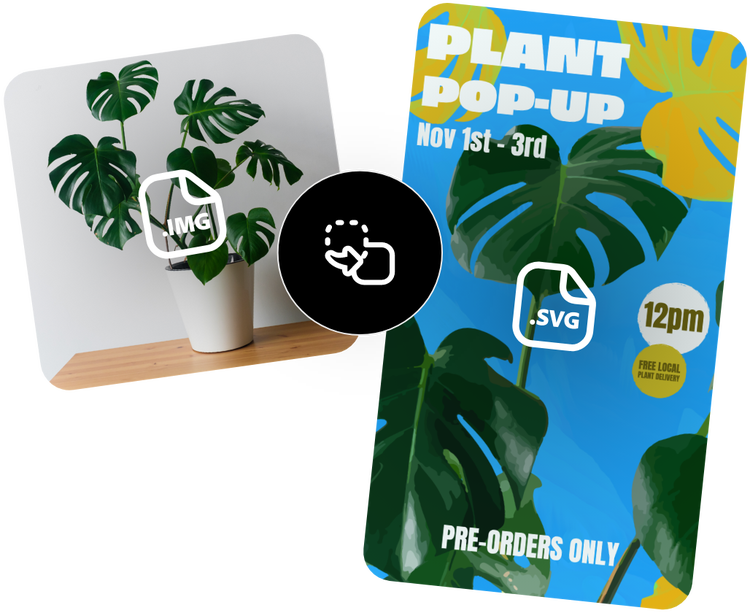
Make a stunning SVG file in just a few taps.
The Adobe Express quick action tools allow you to make impressive edits on the go. Easily upload a JPG or PNG image right from your device to convert it to SVG in seconds. Instantly download your new SVG and you’re ready to go — share it with friends or followers or use it in a future project.
Turn an Adobe Express project into an SVG.
Working on a design project you love? Download it to your device as a JPG or PNG file, then use the SVG converter to transform it. There are countless ways to create a compelling image in no time at all.
Hundreds of thousands of templates and assets to start customizing today.
Get inspired and save time with expertly designed templates to get you started. Adobe Express has an ever-growing collection of portrait, landscape, square, and vertical templates to create designs that stand out on any channel, any device.
Easily convert images to SVG files with Adobe Express.
Frequently asked questions.
What is the best free SVG converter?
The Adobe Express SVG converter is fast, free, and easy to use. But what sets our SVG converter apart from other tools is that our converter is powered by Adobe Illustrator, which allows you to make professional quality SVG files in seconds.
What are SVG files best for?
Unlike raster files (i.e., JPGs), which are made up of pixels, vector graphics like SVGs always maintain their resolution — no matter how large or small you make them. This makes them great for digital graphics like logos, icons, or infographics. Because SVG files treat text as text (and not as design), screen readers can scan any words contained in SVG images. This is very useful for people who need help reading webpages. Search engines can also read and index SVG image text.
You can easily open your newly converted SVG image in Adobe Illustrator or other vector graphics editor to create even bigger and better designs.
Can you convert a JPG to SVG?
Absolutely. Upload any JPG image from your desktop or mobile device to convert to an SVG file.
Can a PNG be converted to SVG?
Yes, our SVG converter can also convert PNG images. Easily upload a PNG from your device to convert it in seconds.
Can I get Adobe Express for free? If so, what’s included?
Yes, we have a free plan available for anyone. Enjoy everything you need to stand out, including thousands of templates, hundreds of Adobe Stock images, photo editing and effects, and much more. Visit our plans and pricing for details.
You can control how Adobe websites use cookies and similar technologies by making choices below. But note that if you disable cookies and similar technologies entirely, Adobe websites may not function properly.
Cookies are small text files stored by your web browser when you use websites. There are also other technologies that can be used for similar purposes like HTML5 Local Storage and local shared objects, web beacons, and embedded scripts. These technologies help us do things like remembering you and your preferences when you return to our sites, measure how you use the website, conduct market research, and gather information about the ads you see and interact with.
You can make choices in the menu below about what cookies and other technologies you want us to use on Adobe sites when you visit them from this browser. You can always change those choices later by clicking on the Cookie Preferences link at the bottom of the page.
If enabled:
We can improve your experience by tailoring the site and the content to things we think might be of interest
We can better keep track of your preferences — like what language you prefer to use
We will better understand your likely interests so we can provide you more relevant Adobe ads and content on non-Adobe websites and in non-Adobe apps
It will help us improve the performance of our website and those of our partners who use the Adobe Experience Cloud
If disabled:
We won’t be able to remember you from session to session so the experience may not be tailored to your interests
You’ll still have access to the content of the site but certain features that depend on cookies may not function
You’ll still see ads, they just may not be as relevant to you
General information
You can control how Adobe websites use cookies and similar technologies by making choices below. But note that if you disable cookies and similar technologies entirely, Adobe websites may not function properly.
Cookies are small text files stored by your web browser when you use websites. There are also other technologies that can be used for similar purposes like HTML5 Local Storage, web beacons, and embedded scripts. These technologies help us do things like remembering you and your preferences when you return to our sites, measure how you use the website, conduct market research, and gather information about the ads you see and interact with.
You can make choices in the menu below about what cookies and other technologies you want us to use on Adobe sites when you visit them from this browser. You can always change those choices later by clicking on the Cookie Preferences link at the bottom of the page.
If enabled:
We can improve your experience by tailoring the site and the content to things we think might be of interest
We can better keep track of your preferences — like what language you prefer to use
We will better understand your likely interests so we can provide you more relevant Adobe ads and content on non-Adobe websites and in non-Adobe apps
It will help us improve the performance of our website and those of our partners who use the Adobe Experience Cloud
If disabled:
We won’t be able to remember you from session to session so the experience may not be tailored to your interests
We’ll still count your use of our site and services
You’ll still have access to the content of the site but certain features that depend on cookies may not function
You’ll still see ads, they just may not be as relevant to you
Operate the site and core servicesOperate site and measure engagement
Always active
These cookies are required, and they are used to enable the site and related services core functionality. Without them the site could not operate, so they cannot be disabled.
These cookies enable the site and related services’ core functionality and collect statistics about user engagement, such as counting active use to help us understand trends. These cookies cannot be disabled.
Measure performance
These cookies are used to analyze site usage to measure and improve performance. Without them Adobe cannot know what content is most valued and how often unique visitors return to the site, making it hard to improve information we offer to you.
These cookies are used to analyze site usage to measure and improve performance. Without them Adobe cannot know what content is most valued, making it hard to improve information we offer to you.
Extend functionality
These cookies are used to enhance the functionality of Adobe sites such as remembering your settings and preferences to deliver a personalized experience; for example, your username, your repeated visits, preferred language, your country, or any other saved preference.
Personalize advertising
These cookies are used to enable Adobe and our partners to serve ads more relevant to your interests. Without them you will still see ads, but they might not be as relevant to you.