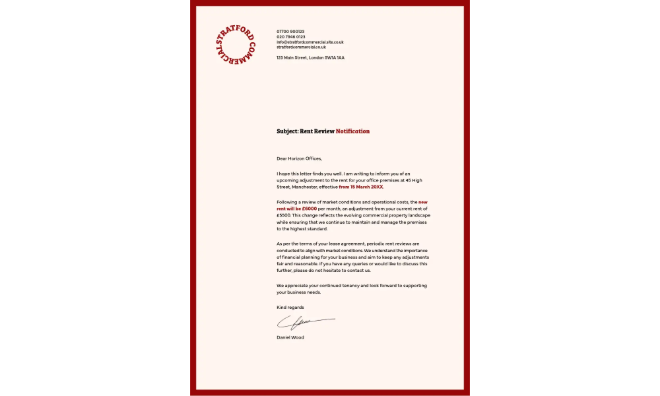
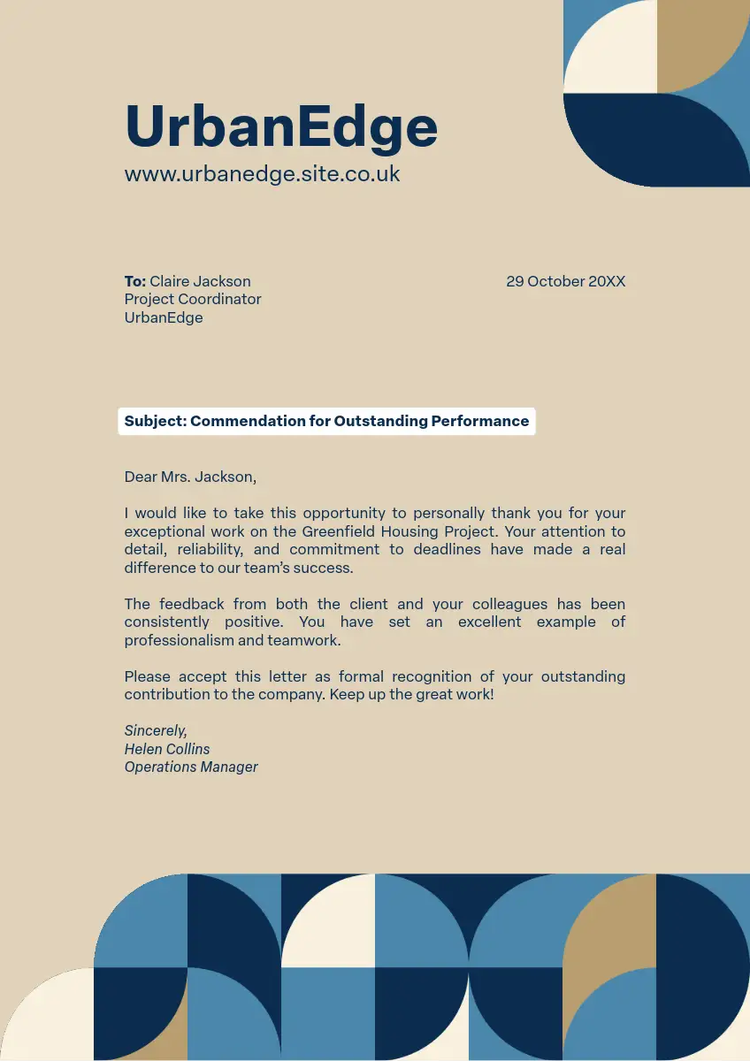
What is an official letter?
An official letter is also known as a formal letter. It’s a professionally written document that informs the recipient of any official information from a business or organisation.
Here are some official letter examples:
- A formal letter of communication from a business, such as correspondence with clients or partners
- A professional cover letter for a job application
- A letter of recommendation or job reference
- A letter of resignation from an employee to employer
- A project proposal
- An official written warning or complaint
- An official update on regulatory issues.
What to include in an official letter.
Luckily, formatting an official letter is relatively easy. Formal letters follow a common standard that is simple to recreate – whatever the scenario.
Here are some of the key elements to include when setting out and writing an official letter:
Your name and address are the first things on the page. This could be your personal or company name and address, depending on who you’re writing on behalf of.
The address should be at the top of the page and aligned on the right-hand side. Follow these steps:
- Write your name first and then put your address underneath.
- Each line of the address should have its own line, following the standard format.
- Leave a line space beneath your address.
- Beneath this, put your contact details, including your phone number and email address.
Make sure all information is up to date if you plan on creating a business letter template to reuse.
2. Date.
Beneath the address, add the date in full and in the UK date format. For example, 20th January 2026. The date should be right-aligned with a line space beneath it.
3. Recipient’s address.
Next, you need to add your recipient’s full name with their correct title and full address. The address can be their place of work, if more appropriate. You can include the recipient’s telephone number and email address too, but this isn’t essential.
Leave a line space beneath this address – it should be one line below your contact information but aligned to the left.
4. Reference.
If the formal letter is responding to a matter that requires a reference, you can include this near the top. Add ‘REF’ followed by the number. You should include the reference before the salutation.
5. Salutation.
The salutation is how you greet the recipient. It sets the tone and mood for your formal letter, and how you write it depends on how well you know who you’re writing to.
Typically, you would use a formal greeting of ‘Dear Mr/Mrs/Ms [Surname]’. If you know their first and last name but are unsure on their pronouns, you can write their full name without the title – for example: ‘Dear Ashley Smith’. However, if you are unsure of the recipient’s surname, you can simply write ‘To Whom It May Concern’, or ‘Dear Sir or Madam’.
The salutation sits on its own line, aligned to the left of the page.
6. State your reason for writing.
Beneath the salutation, you can begin writing your official letter. Keeping to British business etiquette, ensure that your tone remains formal, polite, and professional. Use paragraphs to organise your messages and use proper grammatical rules to ensure your letter is written in a polished and comprehensible manner.
If you haven’t met them before, you can introduce yourself. E.g. ‘My name is [Name], and I am writing to you today because…’. Starting your letter with who you are and what the letter is about will help give the reader some insight into the official matter and ensure they understand your intent.
7. Body of the letter.
The next paragraph should then expand on the introduction. If you’ve said you’re writing to express interest in a job position, this is where you can explain what experience you have. For example, you can say, ‘In my 10 years’ experience in the sales industry, I have developed valuable skills such as…’.
Keep expanding on each statement you make and provide evidence until you feel like you’ve made your point.
For more help with structuring the body of your formal letter, check out these top 20 business letter examples.
8. Closing statement.
Conclude your official letter with a polite and formal statement. You should wrap up and repeat your main points to add emphasis and remind the reader of the letter’s purpose.
Once you’ve finished the letter, you can then add a closing signature. Use ‘Yours faithfully’ if you don’t know the recipient, or ‘Yours sincerely’ if you’ve addressed them by name.
Other options include:
Leave a space between your closing statement and the previous paragraph, and another after your closing statement – before your signature.
9. Your signature.
Your formal letter should always include a handwritten or electronic signature after your closing statement. Beneath your signature, ensure that your full name is clearly typed out. You can import a digital signature or print your letter and sign it by hand.
10. Enclosed documents.
If your formal letter includes additional documents or information, such as a supporting portfolio or evidence, make sure that you list these attachments at the end. For example, you may include an invoice, job offer, letter of intent or resume with a formal letter.
Browse our letter templates to find formal UK letter layouts.