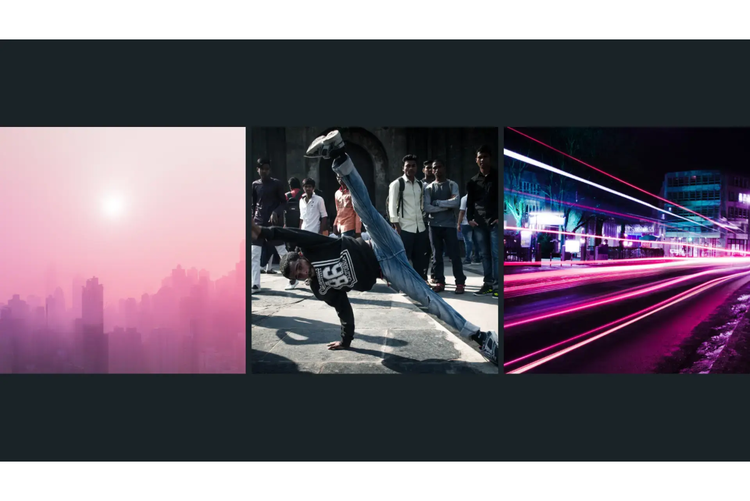
Photography as an artform can deliver clear photos, distorted visuals, narrative depth or aesthetic charm – Lomography sits firmly near the latter. This artistic genre is a creative form of photography inspired by the Lomo Kompakt Automat. With a focus on blurry, colourful imagery, Lomography is a striking and timeless style.
Get the low-down on Lomography, and capture light in the way only Lomo can with Adobe Express today.
What is Lomography?
If you’ve ever browsed someone’s photography on Instagram, you may have noticed these grainy, blurry, colourful images – there’s a good chance that’s Lomography.
Lomography is made beautiful in its imperfections – light leaks, vignettes, warping and blurring are all a result of Lomography’s origins in the shutter of a cheaper camera.
There are some key characteristics that comprise Lomography:
- Lo-fi cameras – often imperfect, or simulating that imperfection.
- Unpredictability – the way shots appear can be unexpected and not true to life.
- Spontaneity – Lomography offers a sense of spontaneity, often giving a dream-like quality to the world through its imagery.
Because of the ways Lomography works, using lo-fi equipment and holding imperfections, these images develop a vintage quality.
The origins of Lomography.
Lomography’s etymology and history can be linked back to the Russian LOMO LC-A compact camera. It was cheap, simple to use and took snaps that were imperfect. Students at an Austrian University in the 1990s discovered this camera and thought those “flawed” shots to be uniquely and whimsically beautiful.
In the snap of a shutter, Lomography became its own style – its legacy and influence outlasting the LOMO LC-A compact camera itself.
The Lomography philosophy.
At its heart, Lomography is about imperfections and experimentation – though Lomo is a philosophy, rather than a ruleset.
Spontaneity is an essential component of Lomography – carrying your camera with you, connecting to the vistas and moments around you, rather than planning a shoot. Forget where the light comes from, disregard the perfect composition – shoot, and shoot again. Be quick, playful and spontaneous and allow your photos to embody that.
If you over-think in a bid to be original, you’re already missing out on the potential of Lomography. Find joy in the art, rather than stress in the execution. If something piques your interest, then investigate and experiment. That may mean shooting from a new angle, one where you can’t even see your camera. In many ways, Lomography shares a philosophical thread with dance or improv – feel the rhythm of the moment and see how you want to respond.
To be authentic to the aesthetic of Lomography, you need to allow for “mistakes” – that could be light bleeding, overexposure, blur, unusual perspectives, things in the foreground and so on. Be eccentric – remember how you played with paints or other materials when you were younger.
Lomography is joyful, experimental and non-standard – so try those things you were told not to do and see what happens. Then you can understand what it is you enjoy about your Lomography photos.
Editable lomo photography and design examples.
recipe
The characteristics of Lomography.
Aesthetics.
Think bright, saturated colours and lens distortions, light leaks and overexposure. Play with lens distortions and experiment with lenses – distort the world, as seen through the viewfinder.
Rule-breaking.
There are no rules with Lomography – it’s a style which commands experimentation. Play with filters, try new angles, and don’t think about what good lighting should be. You’re not in the studio – warp the rules.
Values.
Lomography is an experiment and an experience – so be in the moment and learn to play again. To really embody Lomo, try to use an analogue camera, and share your findings with other Lomo artists (and your results with your friends). Because of its nature, Lomo is a constant process of learning.
How to achieve a Lomography look in your own photos.
To truly achieve a Lomography style in your photos, there are some things you need to consider:
Choose the right camera.
Lomography as a style prefers analogue – so, for authentic images an analogue camera is best. The original LOMO LC-A shot in 35mm, but different lenses aren’t just accepted, they’re encouraged.
When it comes to Lomography cameras, anything lo-fi, as well as avoiding the pixel-chasing trend of modern digital cameras, will probably yield better (more authentic) results.
Experiment with image editing tools.
While it goes against the tenet of trying to go analogue, you can achieve a Lomography style through images editors. For many, this may be more practical (and it can be just as experimental).
Edit your photos with Adobe Express
Test out different photo effects.
Lomography is about experimentation – light exposure, colour saturation, vignettes, lens distortions and more can be replicated with image effects. Who knows, you may even find something altogether new as you try things out.
Experiment with image effects from Adobe Express
Add a filter to your photos.
Image filters can be an easy way to replicate the style of Lomography without dedicating yourself to the art. This could be ideal for marketing materials, or to create some lo-fi photos to fit the vibe of something you’re creating.
Use AI to generate a Lomography-inspired image.
AI can generate Lomography-inspired images in seconds, whatever you want them for. Experiment with your prompts and other AI generative image tools, and see what results you can create.