What is auditory learning style? (Examples and tips)
Understanding how you learn best can transform your academic performance and confidence. If you identify with the auditory learning style, using sound, speech, and listening-based strategies can make studying feel more natural and effective.

What is the auditory learning style?
The auditory learning style refers to a preference for processing information through hearing and speaking. Auditory learners thrive when they can listen to explanations, participate in conversations, and verbalize their thoughts. Rather than relying heavily on visual aids or hands-on activities, these learners find that information truly clicks when it enters through their ears.
In practice, this learning style influences everything from how students approach homework to how professionals absorb information in meetings and trainings.
Auditory learners often demonstrate distinct characteristics that set them apart in educational settings. Understanding these traits can help you determine whether this learning style resonates with your own experiences.
Common characteristics of auditory learners include:
- Exceptional storytelling skills, with the ability to remember and recount details from conversations
- Strong communication skills that make them effective speakers and presenters
- A clear preference for verbal instructions over written directions
- Remarkable ability to remember spoken information, including names, dates, and facts heard in lectures
- Genuine enjoyment of discussions, debates, and collaborative conversations
- A tendency to talk through problems aloud, working through challenges verbally
- Strong musical or rhythmic abilities, often remembering songs and melodies easily
- Natural ability to detect tone, pitch, and nuances in spoken language
Auditory learning styles appear throughout everyday life. You might notice an auditory learner repeating phone numbers aloud to remember them, preferring to call a friend rather than text, or humming while they work. In academic settings, these students often excel in classes with lecture-heavy formats and struggle with silent reading assignments. Understanding your dominant learning style helps you choose study methods that align with how your brain naturally processes information, ultimately making your study sessions more productive and less frustrating.
The science behind auditory learning connects to how the brain processes sound and language. When auditory learners hear information, their brains create stronger neural connections compared to when they read the same material silently. This neurological preference explains why certain students remember every word a professor says but struggle to recall information from textbooks.
How to identify if you are an auditory learner
Recognizing your learning style requires honest self-reflection about how you naturally absorb and recall information. While formal assessments exist, you can gain valuable insights by examining your everyday habits and preferences.

Consider these indicators that suggest you might be an auditory learner:
- You possess strong listening skills and can accurately recall conversations from days or weeks ago
- You have better recollection of discussions than written reports or textbooks
- You gravitate toward podcasts and audiobooks rather than traditional reading
- You tend to read aloud or move your lips while reading silently
- You follow verbal directions with ease but struggle when given written instructions
- You prefer phone calls over emails or text messages for important communications
- You find that background music helps rather than hinders your concentration while working
- You often remember what people said but forget what they wrote in emails
- You learn new words more easily when you hear them pronounced
- You prefer listening to the news rather than reading it
These tendencies reveal how your brain prefers to receive and process information. If several of these descriptions resonate with you, auditory learning likely plays a significant role in how you absorb new material.
Self-assessment questions can further clarify your learning style. Ask yourself: Do you remember names better when you hear them or see them written? When studying for an exam, do you prefer reading your notes silently or discussing them with a friend? When someone gives you directions, do you remember them better if they tell you verbally or write them down?
Keep in mind that most people exhibit characteristics of multiple learning styles. You might be primarily an auditory learner while still benefiting from visual aids in certain situations. The goal is not to limit yourself to one approach but to recognize your dominant preferences so you can leverage them effectively. Once you understand your auditory tendencies, you can adapt your note-taking methods and study techniques to work with your natural inclinations rather than against them.
Understanding the spectrum of learning preferences helps auditory learners appreciate both their strengths and areas where they might need to develop compensating strategies. Some auditory learners are strongly dominant in this style, while others show moderate preferences that blend with visual or kinesthetic tendencies.
Study tips for auditory learners
Once you recognize that you learn best through listening and speaking, you can implement targeted strategies that play to your strengths. The following techniques transform how auditory learners approach their studies, making learning more natural and retention more reliable.
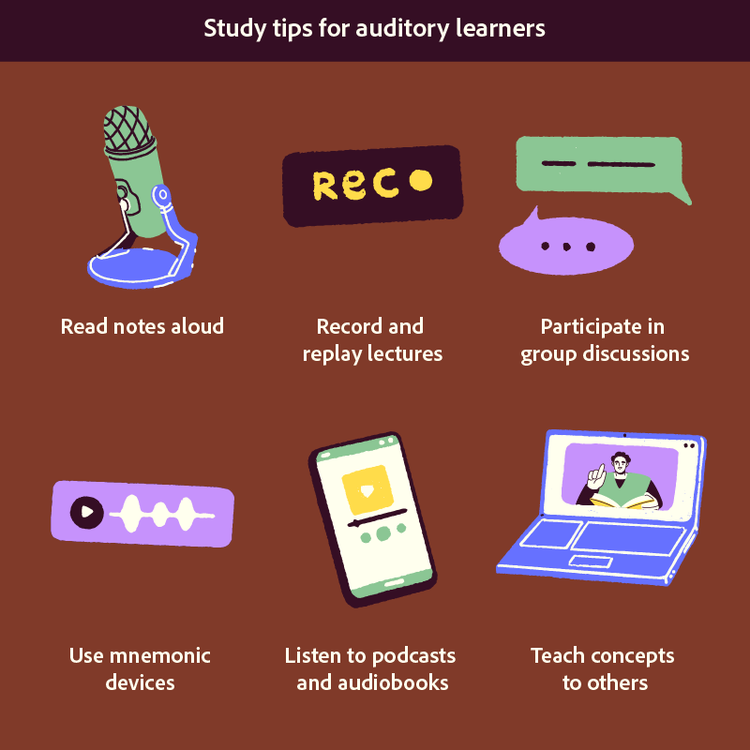
1. Read your notes aloud
One of the most straightforward auditory learning style examples is reading your study materials out loud. When you vocalize written content, you engage your auditory processing system, essentially giving yourself a mini-lecture on the material.
This technique works because hearing information activates different neural pathways than silent reading alone. To implement this effectively, find a private space where you can speak freely without disturbing others. Read through your notes as if you were explaining them to someone else, using natural intonation and emphasis on key points. Some students find it helpful to record themselves reading notes, creating personalized audio study guides they can replay during commutes or exercise.
Vary your tone and pace to keep your brain engaged. Emphasize key terms and definitions by speaking them more slowly or loudly. This variation signals to your brain that certain information deserves special attention, improving retention of crucial concepts.
2. Record and replay lectures
Recording lectures provides auditory learners with an invaluable study resource. While you might absorb much of the content during the live session, replaying recordings allows you to catch details you missed and reinforce concepts through repetition.
Before recording, always obtain permission from your instructor. During playback, practice active listening by pausing to take notes on particularly important sections. Many students find that listening to lectures while walking or doing light exercise helps cement information in memory. Combine this technique with other study tips to create a comprehensive approach that addresses all aspects of your coursework.
Create a system for organizing your recordings by date, topic, and course. This organization ensures you can quickly locate specific lectures when reviewing for exams. Consider creating shorter clips of particularly important explanations that you can replay multiple times before tests.
3. Participate in group discussions
Verbal exchange serves as a powerful learning tool for auditory learners. When you discuss concepts with others, you hear multiple perspectives and explanations, reinforcing your understanding through varied auditory input.
Study groups offer ideal environments for this type of learning. Seek out classmates who are serious about their studies and establish regular meeting times. During discussions, don't hesitate to ask questions or offer your own explanations of difficult concepts. If finding a study group proves challenging, consider forming a virtual group through video calls or joining online forums where you can engage in written discussions that you then read aloud to yourself.
Structure your study group sessions to maximize auditory learning opportunities. Take turns explaining concepts to each other, quiz one another verbally, and debate different interpretations of course material. The back-and-forth nature of discussion creates multiple opportunities for auditory processing.
4. Use mnemonic devices and rhymes
Auditory-based memory techniques harness the power of rhythm, melody, and wordplay to make information stick. Your brain naturally remembers patterns and sounds, making mnemonics particularly effective for auditory learners.
Create acronyms where the first letter of each word you need to remember spells out a memorable phrase. Set lists of facts to familiar tunes, turning dry information into catchy songs. Develop rhymes that encode important concepts, such as "i before e, except after c" for spelling rules. The sillier or more unusual your mnemonic, the more likely you are to remember it. Many students find that information learned through song or rhyme stays with them for years after they've forgotten traditionally studied material.
Consider creating your own jingles for complex processes or formulas. The act of composing these musical memory aids reinforces learning, and the resulting songs provide powerful recall triggers during exams.
5. Listen to educational podcasts and audiobooks
Audio-based learning materials offer auditory learners access to vast amounts of educational content in their preferred format. Podcasts and audiobooks transform passive time, like commuting or exercising, into productive study sessions.
Explore podcast directories for shows covering your subject areas. Many professors and experts host educational podcasts that dive deep into specific topics. For textbook material, check whether audio versions are available through your library or audiobook services. When listening, practice active engagement by mentally summarizing key points, pausing to reflect on complex ideas, and taking voice memo notes on important concepts. The difference between passive and active listening dramatically affects how much you retain.
Create playlists organized by subject or exam date to streamline your audio study sessions. Adjust playback speed to match the complexity of the material—slower for difficult concepts, faster for review sessions.
6. Teach concepts to others
Explaining material aloud to another person represents one of the most effective learning strategies for auditory learners. The act of teaching forces you to organize your thoughts verbally and identify gaps in your understanding.
Find a study partner willing to listen to your explanations, or practice teaching to an imaginary audience. Some students record themselves explaining concepts, then play back the recordings to evaluate their understanding. You might also consider tutoring younger students in subjects you've mastered, which reinforces your knowledge while helping others. When you can explain something clearly enough for someone else to understand, you've truly internalized the material.
The Feynman Technique aligns perfectly with auditory learning preferences. This approach involves explaining a concept in simple terms as if teaching a child, identifying gaps in your explanation, returning to the source material, and refining your verbal explanation until it flows naturally.
Common challenges of the auditory learning style
Every learning style comes with its own set of obstacles. Recognizing the challenges associated with auditory learning helps you develop strategies to overcome them.
Common difficulties auditory learners face include:
- Being easily distracted by sounds and background noise, making noisy environments particularly challenging for concentration
- Difficulty studying independently in complete silence, which many traditional study spaces require
- Struggles with written instructions or exams that don't allow for verbal processing
- Missing visual cues or important details presented in diagrams, charts, or graphs
- Finding quiet library environments challenging or uncomfortable for extended study sessions
- Tendency to talk too much in group settings, potentially dominating conversations
- Difficulty processing information presented only in written format without verbal explanation
- Challenges with timed written exams where reading aloud isn't permitted
These challenges don't diminish the value of auditory learning. Instead, they highlight areas where you might need to develop compensating strategies. For instance, using white noise or instrumental music can provide the auditory input you need without the distraction of lyrics or conversations. Practicing with written exam formats helps you adapt to testing environments that don't accommodate verbal processing. With awareness and preparation, you can navigate these challenges while still leveraging your auditory strengths.
Consider wearing noise-canceling headphones with ambient sounds or instrumental music to create a consistent auditory environment. Practice subvocalizing—silently mouthing words—as a compromise when reading aloud isn't possible. These adaptations help auditory learners succeed in environments not designed for their learning preferences.
AI tools for auditory learners
Artificial intelligence is revolutionizing how students study, and auditory learners stand to benefit enormously from these technological advances. Modern AI study tools can transform written materials into audio formats, making dense textbooks and lengthy notes accessible in your preferred learning style.
Acrobat's Generate Podcast feature is a particularly powerful resource for auditory learners. This tool converts your PDFs, notes, and study materials into podcast-style audio content, allowing you to listen to your coursework rather than read it. Imagine transforming a 50-page reading assignment into an engaging audio experience you can absorb during your morning routine or workout. The Generate Podcast feature essentially creates a personalized educational podcast from any document, complete with natural-sounding narration that makes studying feel less like work and more like listening to your favorite show.
Acrobat AI Assistant further helps auditory learners by summarizing lengthy documents into digestible chunks. You can interact with your documents through conversation to extract key information, ask questions about the content, and generate summaries that you can then convert to audio or read aloud. This interactive approach aligns perfectly with auditory learners' preference for dialogue and verbal exchange.
Student Spaces in Acrobat provides organizational support that helps auditory learners keep their materials structured and accessible. When your study materials are well-organized, converting them to audio formats becomes seamless, and you can quickly locate the content you need for your listening sessions.
Frequently asked questions
What are the 4 learning styles?
How would you teach someone with an auditory learning style?
What are three activities for auditory learners?
Is auditory learning rare?
Can you combine auditory learning with other learning styles?
What careers are best suited for auditory learners?
You may also like