How to Cite a Book (APA, MLA, and Chicago)
Master the art of book citations for your academic papers. This guide walks you through APA, MLA, and Chicago citation styles, covering standard formats, special cases, and AI tools that simplify the process.

What is a book citation and why is it important?
A book citation is a standardized reference that identifies a source you used in your writing, providing readers with the author's name, book title, publisher, publication year, and other details needed to locate the original work. Proper citations establish credibility, protect against plagiarism, and contribute to academic integrity by allowing others to verify your claims.
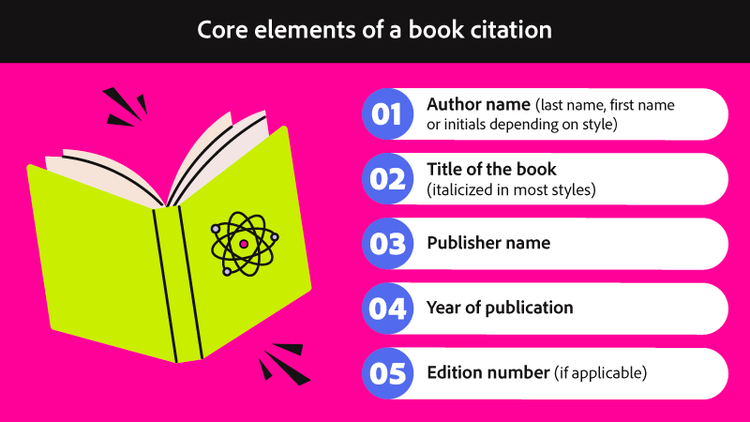
When creating a book citation, you'll typically need to include these core elements:
- Author name (last name, first name or initials depending on style)
- Title of the book (italicized in most styles)
- Publisher name
- Year of publication
- Edition number (if applicable)
The three major citation styles each have distinct formatting requirements. APA style, commonly used in social sciences, emphasizes the publication date. MLA style, preferred in humanities, focuses on authorship. Chicago style, favored in history and publishing, offers flexibility through two different systems.
Understanding these differences matters whether you're conducting a literature review or citing an article alongside your book sources. Each discipline expects specific formatting, and using the wrong style can affect your grade or professional reputation.
Here's a quick comparison of the three major styles:
How to cite a book in APA style
APA style, developed by the American Psychological Association, is the standard citation format for social sciences, including psychology, sociology, education, and business. The current APA 7th edition places strong emphasis on the publication date, reflecting the importance of recent research in these fields.
APA citations appear in two places: a reference list entry at the end of your paper and an in-text citation within the body of your writing. The reference entry provides complete source information, while the in-text citation directs readers to the full reference.
Basic book citation:
- Reference entry: Kahneman, D. (2011). Thinking, fast and slow. Farrar, Straus and Giroux.
- In-text citation: (Kahneman, 2011) or Kahneman (2011) argues that...
Edited book citation:
- Reference entry: Sternberg, R. J. (Ed.). (2020). The Cambridge handbook of intelligence (2nd ed.). Cambridge University Press.
- In-text citation: (Sternberg, 2020) or According to Sternberg (2020)...
Chapter in an edited book:
- Reference entry: Bandura, A. (2001). Social cognitive theory: An agentic perspective. In A. Tesser & N. Schwarz (Eds.), Blackwell handbook of social psychology: Intraindividual processes (pp. 169–194). Blackwell Publishers.
- In-text citation: (Bandura, 2001) or Bandura (2001) explains...
E-book citation:
- Reference entry: Newport, C. (2016). Deep work: Rules for focused success in a distracted world. Grand Central Publishing. https://doi.org/xxxxx (if available)
- In-text citation: (Newport, 2016) or Newport (2016) suggests...
How to cite a book in MLA style
MLA style, established by the Modern Language Association, serves as the primary citation format for humanities disciplines, including literature, languages, philosophy, and cultural studies. The current MLA 9th edition emphasizes authorship and uses a container system that adapts to various source types.
MLA citations consist of a Works Cited entry and parenthetical in-text citations. The Works Cited page appears at the end of your paper, while in-text citations include the author's last name and page number.
Basic book citation:
- Works Cited entry: Adichie, Chimamanda Ngozi. Americanah. Alfred A. Knopf, 2013.
- In-text citation: (Adichie 45) or Adichie writes that "..." (45).
Edited book citation:
- Works Cited entry: Morrison, Toni, editor. Burn This Book: PEN Writers Speak Out on the Power of the Word. HarperStudio, 2009.
- In-text citation: (Morrison 12) or As Morrison notes (12)...
Chapter in an edited book:
- Works Cited entry: Coates, Ta-Nehisi. "Letter to My Son." The Fire This Time: A New Generation Speaks about Race, edited by Jesmyn Ward, Scribner, 2016, pp. 17–30.
- In-text citation: (Coates 22) or Coates argues (22)...
E-book citation:
- Works Cited entry: Kendi, Ibram X. How to Be an Antiracist. E-book, One World, 2019.
- In-text citation: (Kendi) or Kendi explains...
How to cite a book in Chicago style
Chicago style, based on The Chicago Manual of Style, is the preferred citation format for history, art history, and many publishing contexts. Unlike APA and MLA, Chicago offers two distinct citation systems: notes-bibliography and author-date.
The notes-bibliography system uses footnotes or endnotes with superscript numbers in the text, paired with a bibliography at the end. This system is standard in history and humanities. The author-date system resembles APA format and is common in sciences and social sciences.
The examples below follow the notes-bibliography system, which is more common in academic history writing.
Basic book citation:
- Bibliography entry: Lepore, Jill. These Truths: A History of the United States. New York: W. W. Norton, 2018.
- Footnote (first reference): Jill Lepore, These Truths: A History of the United States (New York: W. W. Norton, 2018), 45.
- Footnote (subsequent): Lepore, These Truths, 67.
Edited book citation:
- Bibliography entry: Foner, Eric, ed. The New American History. Rev. ed. Philadelphia: Temple University Press, 1997.
- Footnote: Eric Foner, ed., The New American History, rev. ed. (Philadelphia: Temple University Press, 1997),
Chapter in an edited book:
- Bibliography entry: Berlin, Ira. "American Slavery in History and Memory." In Slavery and Public History: The Tough Stuff of American Memory, edited by James Oliver Horton and Lois E. Horton, 1–28. New York: The New Press, 2006.
- Footnote: Ira Berlin, "American Slavery in History and Memory," in Slavery and Public History: The Tough Stuff of American Memory, ed. James Oliver Horton and Lois E. Horton (New York: The New Press, 2006), 15.
E-book citation:
- Bibliography entry: Graeber, David. Debt: The First 5,000 Years. Brooklyn: Melville House, 2011. Kindle.
- Footnote: David Graeber, Debt: The First 5,000 Years (Brooklyn: Melville House, 2011), Kindle edition, chap. 3.
How to cite a book in special cases
Standard citation formats don't always cover every situation you'll encounter. Here are guidelines for handling common special cases across all three major styles.

1. Multiple authors present different challenges depending on the number of contributors. For two authors, list both names in the order they appear on the title page. For three or more authors, APA and MLA allow using the first author's name followed by "et al." in in-text citations, though the reference or Works Cited entry should include all authors (APA) or the first author plus et al. (MLA for more than two). Chicago typically lists all authors in bibliography entries but uses et al. for four or more authors in footnotes.
2. No author situations require alternative approaches. When a book lacks an identified author, begin the citation with the title. For organizational authors (such as government agencies or corporations), use the organization name in place of an individual author. APA and Chicago may abbreviate well-known organization names in subsequent citations.
3. Translated works require crediting both the original author and the translator. Place the translator's name after the title, typically preceded by "Translated by" or "Trans." The original author remains the primary citation element for in-text references.
4. Different editions matter when you're not using the first edition of a book. Include the edition number (2nd ed., Rev. ed., Updated ed.) after the title in your citation. This information appears in parentheses in APA, after the title in MLA, and before the publication information in Chicago.
How to generate a book citation with AI
AI-powered tools have transformed how students and researchers manage citations. Rather than manually formatting each reference, you can use intelligent assistants to extract information, verify details, and generate properly formatted citations.
Adobe Acrobat offers several features that streamline the citation process. The AI Assistant helps you extract citation details directly from PDF documents, identifying author names, publication dates, and other metadata. You can chat with your PDF to ask specific questions about source material, making it easier to understand complex texts before citing them.
The ability to summarize documents quickly helps you evaluate sources and determine their relevance to your research. This saves time during the research phase and ensures you're citing the most appropriate materials.
For physical books or scanned materials, optical character recognition (OCR) technology converts images of text into searchable, selectable content. This makes it possible to copy author names, titles, and publication information directly rather than retyping them manually.
Adobe's AI tools for students include citation features designed specifically for academic work. These tools help generate formatted citations in multiple styles, reducing the risk of formatting errors.
Many AI citation generators can assist with citing sources as part of a broader research workflow. When preparing your final paper, you can convert Word to PDF to ensure your formatting remains consistent across different viewing platforms.
While AI tools significantly speed up citation work, always verify generated citations against official style guidelines. AI can occasionally misinterpret metadata or apply outdated formatting rules.
Frequently asked questions
How do you correctly cite a book in a paper?
Can I use online citation generators for academic papers?
What's the difference between a reference list and a bibliography?
How do I cite a book I found through a database?
Do I need to include page numbers in every citation?
How do I cite an audiobook?
You may also like