How to cite a podcast
Podcasts have become valuable academic sources, but citing them correctly can be tricky. Learn the proper formats for MLA, APA, and Chicago styles to give credit where it's due and strengthen your research.

Knowing how to cite a podcast properly helps maintain academic integrity in your research. Whether you're writing a research paper or preparing a presentation, podcasts offer unique insights from experts, journalists, and thought leaders that deserve proper attribution.
Mastering podcast citations across MLA, APA, and Chicago formats ensures your work meets scholarly standards while honoring the original content creators.
When to cite a podcast
Podcasts have emerged as legitimate academic sources, offering everything from expert interviews to investigative journalism and scholarly discussions. Understanding when to cite a podcast ensures you maintain credibility and avoid plagiarism in your academic work.
You should cite a podcast whenever you:
- Give credit to podcast creators, hosts, or guests: Original ideas, unique perspectives, and expert opinions shared in podcasts deserve proper attribution, just as you would credit any other form of intellectual contribution.
- Reference first-hand information or expert interviews: Podcasts frequently feature primary sources, including eyewitness accounts, expert testimony, and original research findings that provide first-hand information not available elsewhere.
- Support academic arguments with podcast evidence: When you quote, paraphrase, or build upon ideas presented in a podcast, citation maintains academic integrity and strengthens your credibility.
The rise of digital media has expanded what counts as a credible source. Just as you would cite a journal article or book, you should cite podcasts when their content informs your work. This applies equally to direct quotes and paraphrased ideas.
Failing to cite podcasts properly can lead to serious consequences. Academic institutions treat uncited sources as potential plagiarism, which can result in failing grades, academic probation, or even expulsion. Beyond academic penalties, improper citation undermines the trust readers place in your research.
Modern citation challenges extend beyond traditional sources. Similar to citing AI-generated content, podcasts require careful attention to authorship, publication dates, and access information. As audio content continues to grow in academic relevance, developing strong podcast citation skills becomes increasingly important for researchers at every level.
Different types of podcast citation styles
Three major citation styles dominate academic writing, each with distinct requirements for how to cite a podcast. Understanding these differences helps you format citations correctly for your specific discipline or assignment requirements.
The Modern Language Association (MLA) style is commonly used in humanities disciplines, including literature, philosophy, and cultural studies. MLA emphasizes the creator's name and places the podcast title in italics. This style prioritizes accessibility and readability, making it popular in undergraduate courses.
The American Psychological Association (APA) style serves social sciences, education, and psychology fields. APA format focuses on the publication date, placing it prominently after the host's name. This style uses a specific structure that highlights when the content was created, reflecting the social sciences' emphasis on current research.
Chicago style offers flexibility through two systems: notes-bibliography and author-date. Historians, business professionals, and fine arts scholars frequently use Chicago style. The notes-bibliography system uses footnotes or endnotes with a corresponding bibliography, while the author-date system resembles APA formatting.
Each citation style requires specific elements presented in a particular order. The following table compares what information each style requires:
Selecting the appropriate style depends on your academic discipline and instructor requirements. When in doubt, consult your assignment guidelines or ask your professor which format they prefer. Consistency matters most—once you choose a style, apply it uniformly throughout your paper.
Note: When using AI research tools to gather podcast information, ensure you verify all citation details against the original source. Automated tools can help identify relevant episodes, but accurate citations require human verification.
How to cite a podcast
Learning how to cite a podcast follows a systematic process regardless of which citation style you use. By gathering the right information and understanding format requirements, you can create accurate citations efficiently.
1. Gather essential information from the podcast platform, including the host's full name, complete episode title, podcast series name, publication or air date, and the direct URL to the episode.
2. Identify the required citation style for your assignment by checking your syllabus, assignment instructions, or asking your instructor directly.
3. Determine whether you're citing the entire podcast series or a specific episode, as the format differs slightly between these two approaches.
4. Format the citation according to your style's guidelines, paying careful attention to punctuation, italicization, and the order of elements.
5. Include timestamps when citing specific quotes or references, formatted according to your chosen style's conventions. An AI summary generator can help you identify key quotes and timestamps from longer episodes, making it easier to pinpoint exactly what you need to cite. However, always verify AI-generated information against the original audio.
6. Verify accuracy by comparing your citation against official style guide examples and checking that all URLs work correctly.
How to cite a podcast episode
Citing a specific podcast episode differs from citing an entire podcast series. Episode citations require additional details that help readers locate the exact content you referenced.
When citing an individual episode, include the episode title in quotation marks before the italicized podcast series name. This structure mirrors how you would cite a chapter within a book or an article within a journal. The episode title identifies the specific content while the series name provides broader context.
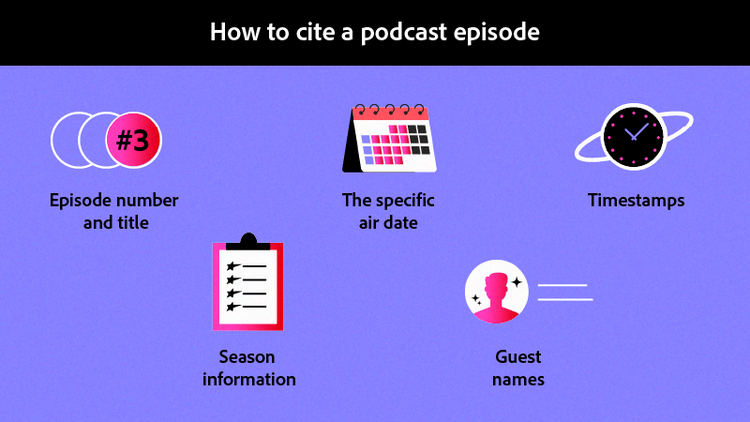
Key elements unique to episode citations include:
- Episode number and title, which help listeners find the exact content
- The specific air date or publication date for that episode
- Timestamps indicating where quoted material appears
- Season information, the podcast organizes content into seasons
- Guest names if you're citing information from an interview
Locating episode metadata sometimes requires checking multiple sources. The podcast's official website often provides more complete information than streaming platforms. Show notes frequently include guest names, topic summaries, and links to resources mentioned during the episode.
For research organization, you can chat with PDF documents containing your notes to quickly locate specific podcast references. This approach works especially well when managing multiple sources across a lengthy research project.
Some podcasts release standalone episodes outside a regular series structure. These one-off episodes should be cited similarly to regular episodes, using whatever identifying information the creator provides. When episode numbers don't exist, rely on the publication date and episode title to distinguish your source.
Podcast citation examples
The following templates demonstrate proper formatting for both full podcast series and individual episode citations.
Use these examples as models when creating your own citations. Pay close attention to punctuation placement, italicization patterns, and the specific order of elements. Small details matter in academic citations—a misplaced comma or incorrect capitalization can affect your grade.
Best practices apply across all citation styles. Always double-check spelling of names and titles against the original source. Ensure URLs are complete and functional. When in doubt about formatting details, consult the official style guide for your chosen format.
Citing a podcast in MLA format
MLA format places the host's name first, followed by the episode title in quotation marks and the podcast title in italics. This style emphasizes the creator while maintaining a clean, readable format.
For a full podcast series in MLA format, structure your citation as follows:
Host Last Name, First Name, host. Podcast Title. Publisher or Network, Year Range, URL.
For example:
For a specific episode in MLA format:
Host Last Name, First Name, host. "Episode Title." Podcast Title, season number, episode number, Publisher, Day Month Year, URL.
For example:
When paraphrasing quotes from podcast content, MLA requires an in-text citation with the host's last name. If you reference a specific moment, include the timestamp in your parenthetical citation: (Koenig 00:15:30).
MLA style treats the podcast host as the primary creator unless another individual serves as the episode's main contributor. For interview-based podcasts where the guest provides the information you're citing, consider listing the guest as the author with the host noted afterward.
Citing a podcast in APA format
APA format emphasizes the publication date and uses a specific structure for audiovisual sources. This style requires the host's last name and initials, followed by their role in parentheses.
For a full podcast series in APA format:
Host Last Name, Initials. (Host). (Year Range). Podcast title [Audio podcast]. Production Company. URL
For example:
For a specific episode in APA format:
Host Last Name, Initials. (Host). (Year, Month Day). Episode title (No. Episode Number) [Audio podcast episode]. In Podcast title. Production Company. URL
For example:
In-text citations in APA use the host's last name and year: (Koenig, 2014). For direct quotes, add a timestamp: (Koenig, 2014, 15:30). APA capitalizes only the first word of episode titles and any proper nouns.
When multiple hosts share equal responsibility, list all names separated by commas with an ampersand before the final name. For podcasts with more than two hosts, use "et al." after the first host's name in subsequent in-text citations.
Citing a podcast in Chicago format
Chicago style offers two citation systems. The notes-bibliography system uses footnotes or endnotes with a corresponding bibliography, while the author-date system places citations in parentheses within the text.
For notes-bibliography format (footnote):
First Name Last Name, host, "Episode Title," Podcast Title, Publisher, Month Day, Year, audio, timestamp, URL.
For example:
Chicago style allows more flexibility than MLA or APA, particularly regarding timestamp placement and publisher information. Both Chicago systems require consistent application throughout your paper. Choose one system and maintain it for all citations, including podcasts and other source types.
Finally, when finalizing your citations, you may want to convert documents to PDF format to preserve formatting across different devices and submission platforms.
Frequently asked questions
How do you cite a podcast in MLA?
How to cite a podcast in APA format in text?
How do I cite a podcast in a text citation?
How do I cite a podcast in academic writing?
How do I cite a podcast with no host?
Can I cite a podcast transcript instead of the audio?
You may also like