Top AI research tools and how to use them
Artificial intelligence is revolutionizing how researchers find, analyze, and organize information. Discover the best AI research tools to accelerate your workflow and uncover insights faster than ever before.
How AI is used to support research
The landscape of research has fundamentally shifted with the introduction of artificial intelligence. What once required weeks of manual searching, reading, and organizing can now happen in hours or days. Understanding which AI research tools work best for your needs requires knowledge of both the capabilities and limitations of these systems.
Types of research that benefit from AI
Different research disciplines can benefit from AI research tools in distinct ways.
- Graduate students build comprehensive background research for a thesis and organize relevant sources efficiently.
- Market analysts and competitive intelligence professionals use AI to monitor industry trends in real time, track competitor activities and strategies, and aggregate and synthesize insights from diverse sources.
- Legal professionals are able to search case law at scale, identify relevant precedents, and analyze contract language more quickly than ever.
- Scientific and medical researchers can stay current with rapid changes to the field and discover connections across studies and disciplines.
AI versus traditional research methods
The most significant advantage of AI research tools lies in their speed and scale. While a human researcher might review dozens of sources in a day, AI systems can process thousands of documents in minutes. This capability proves especially valuable when you need to boost productivity with AI across large-scale research projects.
Pattern recognition is another key strength of AI. AI excels at identifying connections across large datasets that human researchers might overlook due to cognitive limitations or time constraints. These systems can spot emerging trends, unusual correlations, and thematic patterns across vast collections of information.
Unlike static reference materials, many AI tools provide real-time updates and can incorporate the latest publications into their recommendations. However, human judgment remains essential for interpreting findings, evaluating source quality, and drawing meaningful conclusions from AI-generated insights.
Fact-checking and accuracy considerations
While the best AI research tools offer remarkable capabilities, they also require careful verification. AI systems can sometimes generate inaccurate information or "hallucinate" facts that seem plausible but are inaccurate. Researchers must stay in the habit of cross-referencing AI-generated findings against primary sources.
Developing a validation workflow is essential. This includes checking citations to ensure they exist and say what the AI claims, comparing findings across multiple AI tools, and consulting authoritative sources in your field. Understanding these limitations helps you use AI as a powerful assistant while maintaining the rigor your research demands.
AI research tools for search and discovery
Finding relevant sources is one of the most time-consuming aspects of research. Traditional keyword-based searches often miss conceptually related materials or bury the most relevant results beneath less useful options. AI-powered search and discovery tools address these challenges through more sophisticated approaches to information retrieval.
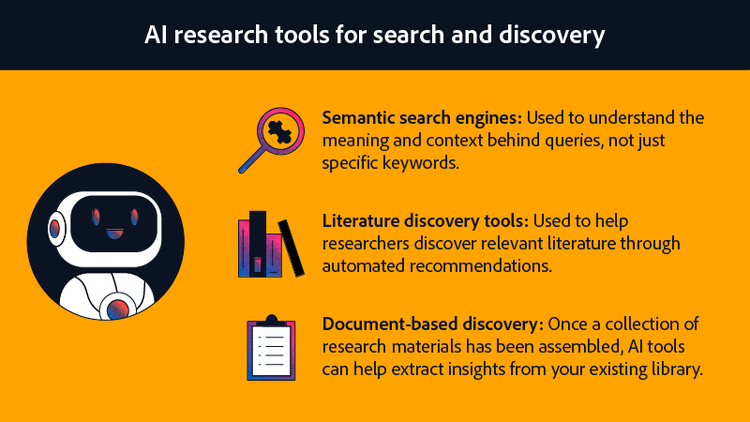
Semantic search engines
Modern AI research tools use semantic search to understand the meaning and context behind your queries, not just the specific words you type. This capability allows these systems to return results that match your intent even when sources use different terminology.
Semantic search proves particularly helpful in cross-disciplinary research. A concept discussed in psychology literature might use entirely different language than the same concept in business case studies. AI tools can bridge these terminology gaps, helping you discover relevant sources you might never have found through traditional keyword searches.
These systems also improve over time, learning from user interactions to refine their understanding of relevance within specific contexts.
Literature discovery tools
Beyond basic search, specialized AI research tools help researchers discover relevant literature through automated recommendations. These systems analyze the papers you have already identified and suggest related works based on citation patterns, topical similarity, and methodological connections.
For example, citation network exploration is a powerful technique that can be enhanced with AI. By mapping how papers cite each other, AI tools can help you identify foundational works in a field, track how ideas have evolved, and spot emerging research directions before they become mainstream.
These discovery tools also excel at identifying gaps in the literature, showing you areas where research questions remain unanswered or where your work might make original contributions.
Document-based discovery
Once you have assembled a collection of research materials, AI tools can help you extract insights from your existing library. You can chat with PDF documents to ask questions, find specific answers, and identify connections across multiple sources.
Conversational interfaces make it possible to query your research collection using natural language. Instead of manually searching through dozens of papers, you can ask specific questions and receive synthesized answers with citations to the relevant sources.
These document-based tools also help connect information across materials, identifying when different sources discuss related concepts or when findings from one paper might inform your interpretation of another.
AI research tools for citation and analysis
Managing citations and analyzing sources has long been a critical component of any research project. AI tools have transformed these traditionally tedious tasks, automating much of the mechanical work while providing deeper analytical capabilities.
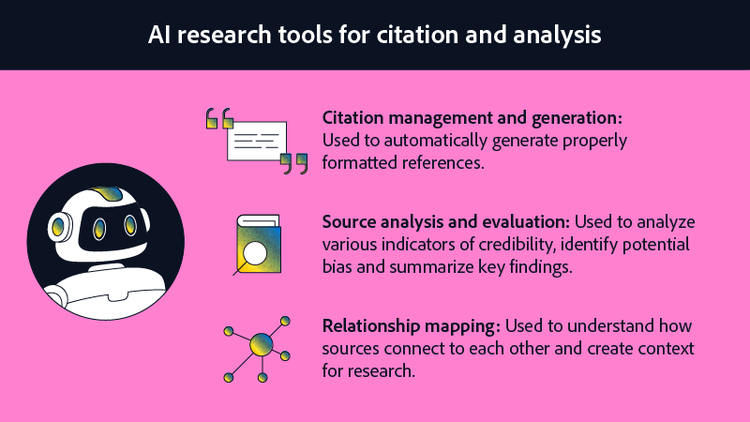
Citation management and generation
Accurate citation formatting takes significant time in any research project. AI-powered citation tools automatically generate properly formatted references in virtually any style, from American Psychological Association (APA) to Chicago to discipline-specific formats.
Beyond formatting, these tools help organize and tag your references. You can categorize sources by theme, methodology, or relevance, making it easier to locate specific materials when writing. Many systems also detect duplicate entries and help clean up reference libraries that have grown unwieldy over time.
Integration with word processors and writing tools means citations can be inserted automatically as you write, with bibliography generation happening in the background instead of interrupting your flow.
Source analysis and evaluation
Evaluating source quality and relevance traditionally required significant expertise and time. AI tools for research now assist with this process by analyzing various indicators of credibility, identifying potential bias, and summarizing key findings.
When summarizing documents with AI, you can quickly extract the essential points from lengthy papers. This proves especially useful during initial literature review phases when you need to assess many sources quickly.
These analysis tools can also compare findings across multiple papers, helping you identify areas of consensus, ongoing debates, and contradictory results in a particular field.
Relationship mapping
Understanding how sources connect to each other creates valuable context for your research. AI tools can visualize citation networks, showing which papers cite which others and how ideas have flowed through a field over time.
These visualizations identify influential works that serve as hubs in the citation network, as well as clusters of related research that might represent distinct schools of thought or methodological approaches.
Relationship mapping also reveals research gaps, showing you areas where connections between fields or topics remain unexplored and where your work might make novel contributions.
AI tools for writing and organization
The writing and organization phase of research often proves as challenging as discovery and analysis. AI tools now support every aspect of this process, from summarizing sources to drafting content.
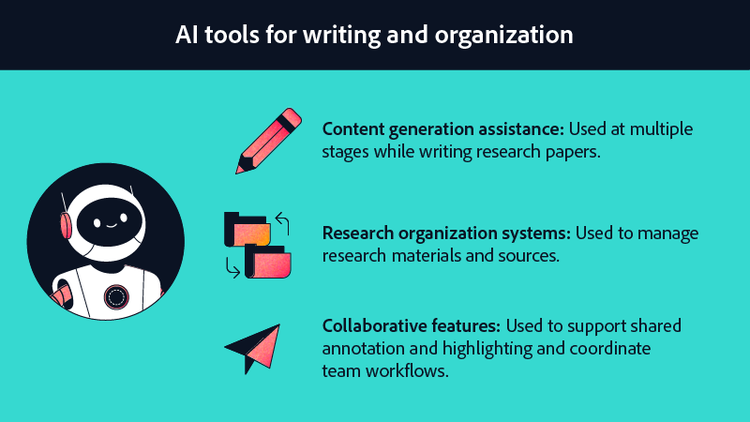
Content generation assistance
When you need to write a research paper, AI tools can assist at every stage. From generating initial outlines to drafting sections to refining language for clarity, these systems serve as capable writing partners.
Using generative AI for documents allows you to create a first draft that captures the key points you want to make. You can then revise and expand your draft, adding your own analysis and ensuring accuracy.
Paraphrasing tools help you express ideas from sources in your own words while maintaining accuracy. This capability proves especially valuable when synthesizing findings from multiple papers or translating technical concepts for broader audiences.
Research organization systems
Managing the complexity of a large research project requires robust organizational systems. The best AI research tools help by automatically tagging and categorizing sources based on their content, creating annotated bibliographies, and tracking your progress across different project phases.
These systems can learn your organizational preferences over time, suggesting categories and tags based on how you have organized similar materials in the past. This adaptive capability reduces the manual effort required to stay organized as your research collection grows.
Workflow management features help you track which sources you have reviewed, which require follow-up, and how different materials connect to specific sections of your project.
Collaborative features
Research increasingly happens in teams, making collaboration features essential. AI research tools support shared annotation and highlighting, allowing team members to mark up sources and share insights with each other.
Managing team-based research with AI collaboration tools helps coordinate who is working on what, preventing duplication of effort and ensuring comprehensive coverage of the source materials. Version control helps track how documents and annotations evolve over time.
These collaborative capabilities prove especially valuable for large-scale projects with multiple researchers across different locations or time zones.
AI research tools for data analysis
Beyond text-based research, AI tools offer powerful capabilities for analyzing quantitative and qualitative data. These systems can identify patterns, perform statistical analyses, and extract insights from complex datasets.
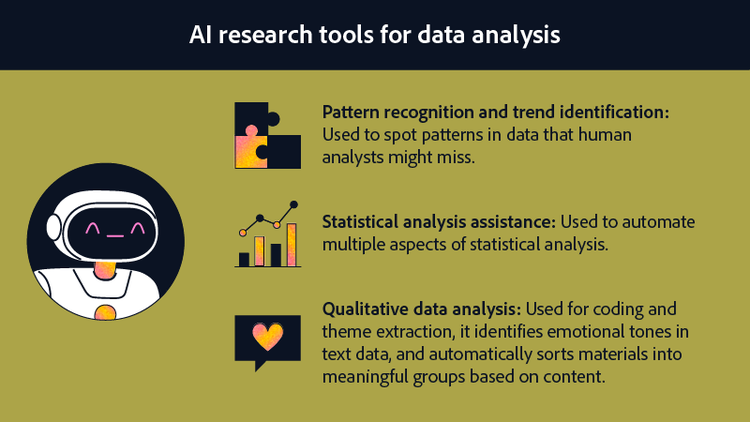
Pattern recognition and trend identification
AI excels at spotting patterns in data that human analysts might miss. When you use AI for data analysis, you gain access to pattern identifying tools that can process vast amounts of information quickly.
Time-series analysis in particular is a research method that can benefit from AI support. AI tools can identify trends, seasonal patterns, and anomalies across extended periods, helping researchers understand how phenomena evolve over time.
Anomaly detection is an AI capability used to flag unusual data points. These anomalies might indicate errors, outliers, or emerging phenomena worthy of further investigation.
Statistical analysis assistance
AI tools can automate many aspects of statistical analysis, from selecting appropriate tests to interpreting results. These systems help researchers who may lack deep statistical expertise to conduct rigorous quantitative analysis.
Visualization generation transforms raw data into charts, graphs, and other visuals that communicate findings effectively. AI can suggest appropriate visualization types based on your data and research questions.
Interpreting complex datasets becomes more accessible with AI tools to help translate statistical results to plain language, assisting researchers as they understand and communicate their findings.
Qualitative data analysis
AI research tools also support qualitative approaches. Coding and theme extraction help researchers analyze interview transcripts, open-ended survey responses, and other text-based data.
Sentiment analysis identifies emotional tones in text data, useful for understanding attitudes, opinions, and reactions. Content categorization automatically sorts materials into meaningful groups based on their content.
These qualitative analysis capabilities prove especially useful for mixed-method research, where researchers need to integrate both quantitative and qualitative insights.
Frequently asked questions
Which AI tool is best for research?
What is the best deep research AI tool?
How can AI be used as a research tool?
What is the 30% rule in AI?
Are AI research tools accurate?
You may also like