



With the rise of artificial intelligence (AI) tools like ChatGPT, Bard, and DALL-E, understanding how to cite AI has become increasingly important. Unlike traditional sources, AI-generated content introduces unique challenges in citation, such as tracking prompts and outputs.
When should AI citations be used?
AI citations should be used in scenarios where AI tools contribute directly to your work. Here are key situations to consider:
- When AI is directly quoted: For example, citing a specific response generated by ChatGPT.
- When AI output is paraphrased: If you rewrite AI-generated content, proper attribution is still necessary.
- When AI is used to generate ideas or content: Acknowledge the tool's role in shaping your work, even indirectly.
By citing AI appropriately, you enhance credibility, demonstrate ethical use of technology, and promote the importance of accurate paraphrasing when adapting AI-generated content.
In academic and professional contexts, proper AI citation is critical to maintain transparency and align with ethical standards. It ensures readers understand the origin of information and the role AI played in producing it.
What does it mean to cite AI?
Citing AI involves attributing content generated by AI tools in the same way you would cite traditional sources. However, unlike books or articles, AI-generated materials often lack human authors and fixed publication dates, requiring tailored citation methods.
Ethical considerations in citing AI
Transparency and credibility are essential when using AI-generated content. Failing to acknowledge AI tools can lead to plagiarism accusations or misrepresentation. Ethical citation practices include:
- Disclosing AI usage: Clearly state when and how AI tools contributed to your work.
- Providing accurate details: Include the AI tool’s name, version, publisher, and the prompt used to generate content.
Understanding how to cite articles accurately is crucial when referencing AI outputs.
Scenarios requiring AI citations
Here are examples of situations where citing AI is necessary:
- Academic papers: When referencing AI-generated research insights or paraphrased text.
- Research projects: Documenting AI-generated data, visuals, or ideas.
- Professional reports: Using AI-generated summaries or analytical content.
Citing AI not only reinforces ethical writing but also ensures compliance with academic or professional standards.
How to cite AI step by step
Like citing document sources such as PDFs and PowerPoint decks, AI citations can be simple if you follow a structured approach. Here’s a step-by-step guide on how to cite AI:
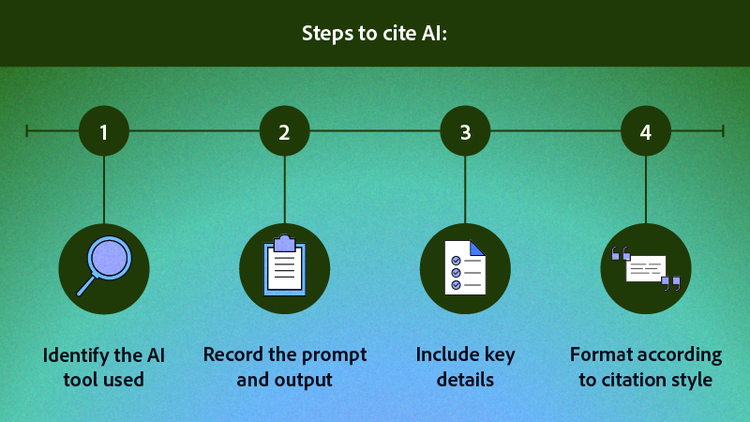
1: Identify the AI tool used
Clearly specify the AI tool, such as ChatGPT, Bard, or DALL-E. Include details like the tool name and version/date to ensure accurate attribution.
2: Record the prompt and output
Keep a record of the exact prompt you used and the AI-generated response. This provides context for your citation and helps others verify the source.
3: Include key details
Every citation should include:
- AI tool name
- Version or date of usage
- Publisher/creator (e.g., OpenAI or Google)
4: Format according to citation style
Follow the required citation format, whether APA, MLA, or Chicago. Each style has unique requirements for citing AI tools; you can refer to the examples below to match the specific style you are using.
By systematically applying these steps, you can ensure your AI citations are precise and complete.
Examples of how to cite AI
To make citing AI actionable, here are examples formatted for APA, MLA, and Chicago styles:
APA format
Reference:
OpenAI. (2023). ChatGPT (Version 4.0) [AI model]. Retrieved from https://chat.openai.com
In-text citation:
(OpenAI, 2023)
MLA format
Works Cited:
OpenAI. ChatGPT. Version 4.0, 2023, https://chat.openai.com.
In-text citation:
(OpenAI)
Chicago format
Bibliography:
OpenAI. ChatGPT. Version 4.0. Accessed October 2023. https://chat.openai.com.
Footnote:
1. OpenAI, ChatGPT, Version 4.0, accessed October 2023, https://chat.openai.com.
These examples demonstrate how to format citations for a 2023 ChatGPT reference. This same structure can be used for other AI sources including Acrobat AI Assistant.
Conclusion
Citing AI sources properly is vital for maintaining transparency and ethical writing practices. Whether using APA, MLA, or Chicago formats, following structured steps ensures accuracy and credibility. AI tools, such as PDF AI from Acrobat, can streamline your content creation and document management process for greater efficiency. When you leverage this technology, you can reference this guide for efficient citations.
Frequently asked questions
Yes, referencing AI is necessary whenever AI-generated content is used, whether directly quoted, paraphrased, or adapted. For instance, citing ChatGPT output clarifies the origin of ideas and upholds academic integrity.
Using AI to assist with citations is legitimate, provided the sources are correctly documented. Ethical considerations include transparency, accuracy, and avoiding misrepresentation.
To cite AI as a source:
1. Identify the AI tool and version/date.
2. Record the prompt and output for context.
3. Format the citation based on the required style (e.g., APA or MLA).
When paraphrasing AI-generated content, the citation process is the same as when it is cited as a reference: ensure the citation includes the tool name, version/date, and publisher. If you quote an AI response directly in your content without paraphrasing, include quotation marks to denote that it is a quote.
You may also like
title
How to cite AI properly
cardImageAltText
A laptop displays sources cited in a paper, including an AI source.
cardImage
Tags
caas:content-type/article,caas:products/acrobat,caas:topic/ai-chat-pdf

