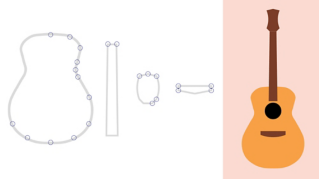


Learn how to create basic shapes using the shape tools.
What you learned: Draw shapes
Shape tools are located in the Tools panel.
To show other shape tools, click and hold the Rectangle tool in the Tools panel.
When you draw shapes, Smart Guides (View > Smart Guides) help by showing the shape size in a measurement label, snapping to other objects, and indicating when an ellipse is a perfect circle or when a rectangle is a perfect square.
Most shapes are Live, which means you can edit them without first switching to a tool after drawing them. Different shapes have widgets for editing corner radius, number of sides, and more.
2
Create lines
Discover how to draw, edit, and re-shape lines.
What you learned: Create lines
A line is a path composed of start and end anchor points, connected by a path.
Draw lines using the Line Segment tool in the Tools panel. Select the Line Segment tool by clicking and holding the Rectangle tool in the Tools panel.
Lines you draw are Live, which means you can edit the length, direction, and angle after drawing them without switching from the Line Segment tool.
Rotate a line by moving the pointer off an end and dragging.
3
Combine shapes
Explore how to combine shapes in different ways using the Shape Builder tool.
What you learned: Combine shapes
Select the shapes you want to combine with the Selection tool in the Tools panel.
Select the Shape Builder tool in the Tools panel. Either drag across the shapes you’d like to combine or press Alt (Windows) or Option (macOS) and drag across or click parts of shapes to remove them.
To move shapes with no fill color, use the Selection tool to drag them by their stroke.
4
Trace to make shapes
Learn how to trace artwork to create shapes you can edit, using the Image Trace command.
What you learned: Trace objects
Add raster images to your Illustrator projects by choosing File > Place.
Select an image with the Selection tool.
Click Image Trace in the Properties panel to the right of the document and choose a trace preset to set trace options. Click Expand in the Properties panel to commit to the tracing and convert to editable vector artwork.
Click and hold the Direct Selection tool, and select the Lasso tool in the Tools panel. Drag around the traced artwork to select it. After you choose Edit > Copy, choose Edit > Paste to paste the artwork.
Click the Group button near the bottom of the Properties panel to group the artwork, treating it as a single object.
Click the color fill in the Properties panel to the right of the document to change its color.

You can control how Adobe websites use cookies and similar technologies by making choices below. But note that if you disable cookies and similar technologies entirely, Adobe websites may not function properly.
Cookies are small text files stored by your web browser when you use websites. There are also other technologies that can be used for similar purposes like HTML5 Local Storage and local shared objects, web beacons, and embedded scripts. These technologies help us do things like remembering you and your preferences when you return to our sites, measure how you use the website, conduct market research, and gather information about the ads you see and interact with.
You can make choices in the menu below about what cookies and other technologies you want us to use on Adobe sites when you visit them from this browser. You can always change those choices later by clicking on the Cookie Preferences link at the bottom of the page.
If enabled:
We can improve your experience by tailoring the site and the content to things we think might be of interest
We can better keep track of your preferences — like what language you prefer to use
We will better understand your likely interests so we can provide you more relevant Adobe ads and content on non-Adobe websites and in non-Adobe apps
It will help us improve the performance of our website and those of our partners who use the Adobe Experience Cloud
If disabled:
We won’t be able to remember you from session to session so the experience may not be tailored to your interests
You’ll still have access to the content of the site but certain features that depend on cookies may not function
You’ll still see ads, they just may not be as relevant to you
General information
You can control how Adobe websites use cookies and similar technologies by making choices below. But note that if you disable cookies and similar technologies entirely, Adobe websites may not function properly.
Cookies are small text files stored by your web browser when you use websites. There are also other technologies that can be used for similar purposes like HTML5 Local Storage, web beacons, and embedded scripts. These technologies help us do things like remembering you and your preferences when you return to our sites, measure how you use the website, conduct market research, and gather information about the ads you see and interact with.
You can make choices in the menu below about what cookies and other technologies you want us to use on Adobe sites when you visit them from this browser. You can always change those choices later by clicking on the Cookie Preferences link at the bottom of the page.
If enabled:
We can improve your experience by tailoring the site and the content to things we think might be of interest
We can better keep track of your preferences — like what language you prefer to use
We will better understand your likely interests so we can provide you more relevant Adobe ads and content on non-Adobe websites and in non-Adobe apps
It will help us improve the performance of our website and those of our partners who use the Adobe Experience Cloud
If disabled:
We won’t be able to remember you from session to session so the experience may not be tailored to your interests
We’ll still count your use of our site and services
You’ll still have access to the content of the site but certain features that depend on cookies may not function
You’ll still see ads, they just may not be as relevant to you
Operate the site and core servicesOperate site and measure engagement
Always active
These cookies are required, and they are used to enable the site and related services core functionality. Without them the site could not operate, so they cannot be disabled.
These cookies enable the site and related services’ core functionality and collect statistics about user engagement, such as counting active use to help us understand trends. These cookies cannot be disabled.
Measure performance
These cookies are used to analyze site usage to measure and improve performance. Without them Adobe cannot know what content is most valued and how often unique visitors return to the site, making it hard to improve information we offer to you.
These cookies are used to analyze site usage to measure and improve performance. Without them Adobe cannot know what content is most valued, making it hard to improve information we offer to you.
Extend functionality
These cookies are used to enhance the functionality of Adobe sites such as remembering your settings and preferences to deliver a personalized experience; for example, your username, your repeated visits, preferred language, your country, or any other saved preference.
Personalize advertising
These cookies are used to enable Adobe and our partners to serve ads more relevant to your interests. Without them you will still see ads, but they might not be as relevant to you.
Personalize advertising
These cookies are used to enable Adobe and our partners to serve ads more relevant to your interests. Without them you will still see ads, but they might not be as relevant to you.