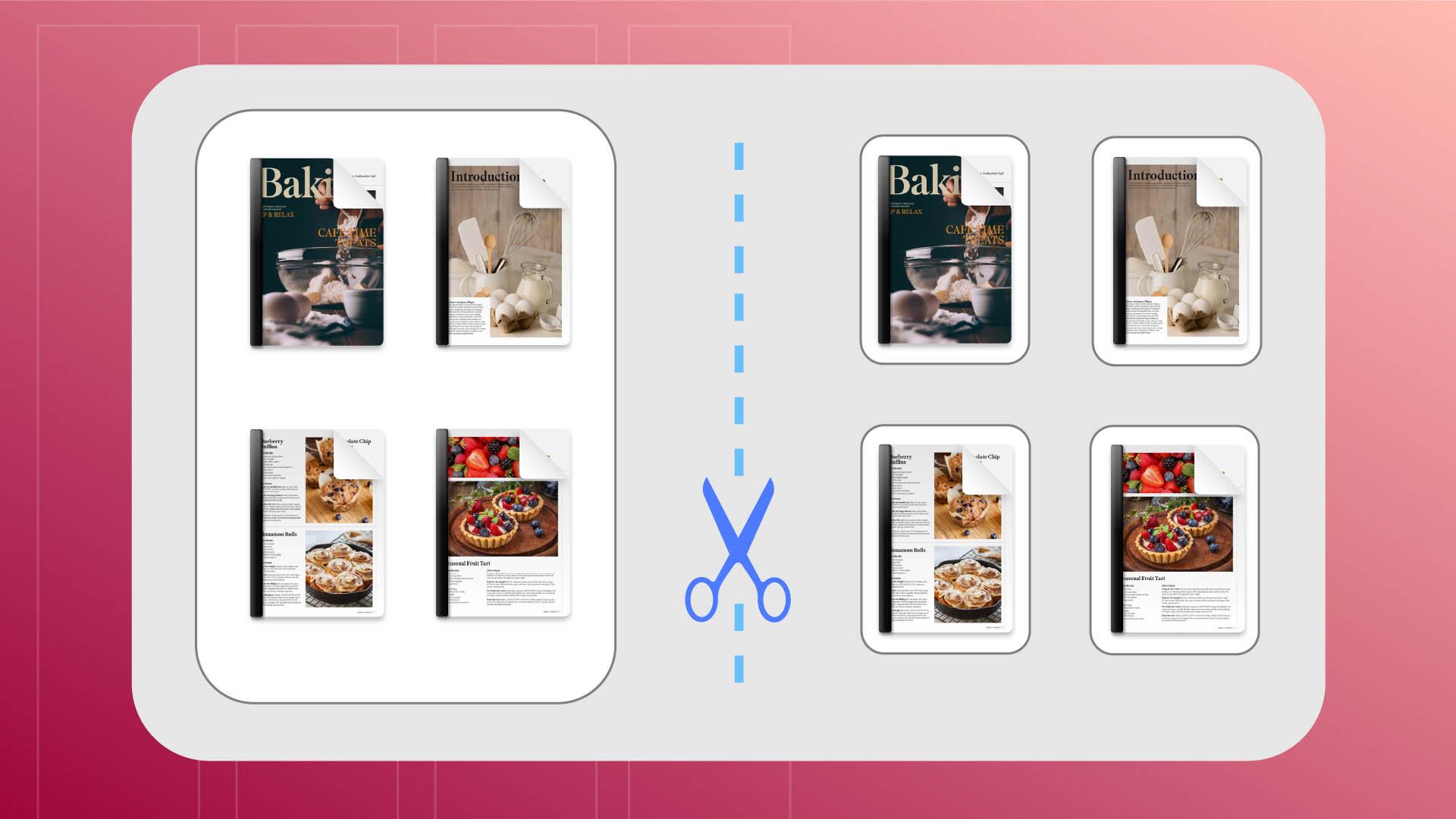
Tirez parti de l’outil Organiser les pages d’Acrobat pour diviser un PDF volumineux en plusieurs fichiers plus faciles à gérer.
Introduction
Acrobat offre de nombreux outils utiles.
L'un d'entre eux permet de scinder rapidement de longs fichiers PDF.
Je m'appelle Sarah.
Si vous voulez savoir comment faire, vous êtes au bon endroit.
Pour commencer, accédez à l'outil Organiser les pages et cliquez sur Ouvrir.
Accédez à l'emplacement d'enregistrement du PDF pour l'importer dans Acrobat.
Les pages du fichier s'affichent.
Scinder un PDF selon le nombre de pages, la taille du fichier ou les signets
Dans la barre latérale, cliquez sur Fractionner.
Ce menu comprend diverses options de fractionnement du fichier.
Vous pouvez le scinder selon un nombre de pages.
Par exemple, si la valeur est 2, le PDF sera scindé en fichiers de deux pages chacun.
Vous pouvez aussi le fractionner par taille de fichier, si vous disposez de cette information, ou par signets de niveau supérieur.
Pour configurer plus en détail le fractionnement du fichier, cliquez sur Options de sortie.
Les nouveaux fichiers sont enregistrés par défaut dans le dossier du fichier d'origine, mais vous pouvez définir un autre emplacement.
Vous pouvez également modifier le libellé des fichiers pour faciliter leur identification.
Fractionner plusieurs PDF en même temps
Si vous avez d’autres fichiers PDF à scinder, vous pouvez les ajouter depuis le menu Fractionner plusieurs fichiers.
Les options précédemment sélectionnées s'appliqueront à tous les fichiers.
Une fois que tout est prêt, cliquez sur Fractionner.
Acrobat enregistre les nouveaux fichiers dans le dossier spécifié.
Et voilà, le PDF a bien été fractionné.
Merci de votre attention.
Remarque : les ressources Adobe Stock sont fournies à des fins d’entraînement uniquement. Voir les conditions
Ce que vous apprendrez
Scinder un PDF selon le nombre de pages, la taille du fichier ou les signets
Pour des résultats plus ciblés, fractionnez votre PDF sur la base du nombre de pages, de la taille du fichier ou des signets de niveau supérieur. Cliquez ensuite sur Options de sortie pour choisir le dossier de destination et définir le libellé des fichiers.
Fractionner plusieurs PDF en même temps
Ajoutez d’autres fichiers PDF et appliquez-leur les mêmes paramètres. Acrobat réalise tout le traitement en une seule étape.
You can control how Adobe websites use cookies and similar technologies by making choices below. But note that if you disable cookies and similar technologies entirely, Adobe websites may not function properly.
Cookies are small text files stored by your web browser when you use websites. There are also other technologies that can be used for similar purposes like HTML5 Local Storage and local shared objects, web beacons, and embedded scripts. These technologies help us do things like remembering you and your preferences when you return to our sites, measure how you use the website, conduct market research, and gather information about the ads you see and interact with.
You can make choices in the menu below about what cookies and other technologies you want us to use on Adobe sites when you visit them from this browser. You can always change those choices later by clicking on the Cookie Preferences link at the bottom of the page.
If enabled:
We can improve your experience by tailoring the site and the content to things we think might be of interest
We can better keep track of your preferences — like what language you prefer to use
We will better understand your likely interests so we can provide you more relevant Adobe ads and content on non-Adobe websites and in non-Adobe apps
It will help us improve the performance of our website and those of our partners who use the Adobe Experience Cloud
If disabled:
We won’t be able to remember you from session to session so the experience may not be tailored to your interests
You’ll still have access to the content of the site but certain features that depend on cookies may not function
You’ll still see ads, they just may not be as relevant to you
General information
You can control how Adobe websites use cookies and similar technologies by making choices below. But note that if you disable cookies and similar technologies entirely, Adobe websites may not function properly.
Cookies are small text files stored by your web browser when you use websites. There are also other technologies that can be used for similar purposes like HTML5 Local Storage, web beacons, and embedded scripts. These technologies help us do things like remembering you and your preferences when you return to our sites, measure how you use the website, conduct market research, and gather information about the ads you see and interact with.
You can make choices in the menu below about what cookies and other technologies you want us to use on Adobe sites when you visit them from this browser. You can always change those choices later by clicking on the Cookie Preferences link at the bottom of the page.
If enabled:
We can improve your experience by tailoring the site and the content to things we think might be of interest
We can better keep track of your preferences — like what language you prefer to use
We will better understand your likely interests so we can provide you more relevant Adobe ads and content on non-Adobe websites and in non-Adobe apps
It will help us improve the performance of our website and those of our partners who use the Adobe Experience Cloud
If disabled:
We won’t be able to remember you from session to session so the experience may not be tailored to your interests
We’ll still count your use of our site and services
You’ll still have access to the content of the site but certain features that depend on cookies may not function
You’ll still see ads, they just may not be as relevant to you
Operate the site and core servicesOperate site and measure engagement
Always active
These cookies are required, and they are used to enable the site and related services core functionality. Without them the site could not operate, so they cannot be disabled.
These cookies enable the site and related services’ core functionality and collect statistics about user engagement, such as counting active use to help us understand trends. These cookies cannot be disabled.
Measure performance
These cookies are used to analyze site usage to measure and improve performance. Without them Adobe cannot know what content is most valued and how often unique visitors return to the site, making it hard to improve information we offer to you.
These cookies are used to analyze site usage to measure and improve performance. Without them Adobe cannot know what content is most valued, making it hard to improve information we offer to you.
Extend functionality
These cookies are used to enhance the functionality of Adobe sites such as remembering your settings and preferences to deliver a personalized experience; for example, your username, your repeated visits, preferred language, your country, or any other saved preference.
Personalize advertising
These cookies are used to enable Adobe and our partners to serve ads more relevant to your interests. Without them you will still see ads, but they might not be as relevant to you.
Personalize advertising
These cookies are used to enable Adobe and our partners to serve ads more relevant to your interests. Without them you will still see ads, but they might not be as relevant to you.