





#1e1e1e

Photography

What is the rule of thirds? A simple guide to composition in photography and design.

The rule of thirds is a classic way to frame photos for impact. Learn how it works, why it is important, and when the exceptions to this composition rule apply.

Explore {{lightroom}}

https://youtu.be/FBHw5dVf5VA

Photography & tutorial by @tk_north

The rule of thirds is one of the simplest and most effective ways to create balanced, eye-catching photographs. By dividing a frame into nine equal parts using two horizontal and two vertical lines, this guideline helps photographers position their subjects in a way that feels natural and visually appealing.

”It’s not really a rule. It’s more of a guideline or best practice,” photographer and designer Shawn Ingersoll says of the rule of thirds.

Does every successful photo follow the rule of thirds? Definitely not. But every skill or art is built on certain foundations and understanding and mastering them are important for improving your abilities. Repetition is king when it comes to honing foundational skills. Practice leads to muscle memory and building trust in your eye, which eventually becomes an instinct for what works and what doesn’t in photography.

“The more you do it, the more it gets ingrained into your head.”

“If you are tuned in to the imagery we see around us, I feel like you sort of absorb [the rule of thirds] even if you can’t put your finger on it,” photographer, author and instructor Khara Plicanic suggests. “But it’s incredibly helpful for people who are starting out and need a practical tool to help them with their composition.”
Photo, using the rule of thirds, of a man and woman hiking on a path
Practicing the rule of thirds taking a picture of a woman standing in a field near the ocean

What is the rule of thirds?

The rule of thirds is a photography composition guideline that divides an image into nine equal parts using two horizontal and two vertical lines. Placing the subject along these lines or their intersections helps create balanced, visually appealing compositions.

How does the rule of thirds work?

To apply the rule, imagine dividing your photo — or even your camera’s viewfinder — into nine equal sections using two horizontal and two vertical lines. This creates a rule-of-thirds grid, which is available as a setting on most cameras and smartphones.

The grid creates four key intersection points, often called “power points,” where you can position your subject or other important elements. Placing your subject on or near these lines helps balance the composition with negative space, guiding the viewer’s eye naturally to the focal point.

Photographer Shawn Ingersoll describes it like this: “This might be a generational thing, but if you think of The Brady Bunch intro where you have the nine identical rectangles, they’re all the same size and it’s three by three — three rows, three columns.”

First-hand advice on using the rule of thirds.

The best way to master the rule of thirds is through practice. Over time, the grid lines and intersection points will become second nature, but until then, these practical tips from professional photographers can help guide your experiments:

  • Turn on your camera's rule of thirds grid: “Switch on your camera’s rule-of-thirds grid so you can see what you’re doing as you shoot,” suggests photographer Khara Plicanic. “Eventually, you get a feel for it.”
  • Take a field trip to practise your rule of thirds: “Go to a park or somewhere and try to take ten good pictures that follow the rule-of-thirds model,” says wedding photographer Anna Goellner. “The more you do it, the more it gets ingrained into your head.”
  • Focus on the eyes: “Choose where you want your point of focus to exist before you’re shooting. I’m always going for the eyes,” advises author and animal photographer Carli Davidson.

When does the rule of thirds not apply?

The rule of thirds is not a strict law, and moving away from an artistic guardrail like this can feel intimidating for beginners. Nevertheless, experienced photographers often break the rule to create powerful and unique compositions. Here are a few situations where ignoring the rule of thirds can work to your advantage:

Photographing a woman standing under a bush
Leveraging the rule of thirds to photograph a woman standing on a rock in the ocean
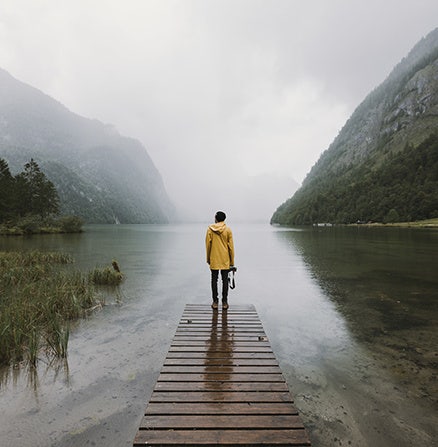
A photographer, standing on a gloomy pier
  • Fill the frame: “Filling the frame is really interesting — when there are parts of an image that aren’t necessarily fully in the frame or when there’s a subject that’s very much in the foreground of the frame,” art director and photographer Alex Str says. “I think those are areas where you can really throw the rule of thirds away. For example, I’ve transitioned lately to portraits of people that are perfectly centred.”
  • Pull back from your subject: “If your subject is going to be a really small part of the image,” photographer Derek Boyd suggests, “sometimes the best way to highlight them is to break the rule of thirds and put them almost dead centre in the image.”
  • Try a different composition style: “Composing a photo in the shape of the letter Z creates a really nice flow because it’s how you naturally read a page,” photographer Sarah Aagesen explains. “The thought is that this draws you from left to right and then down through the image and then back again.”
  • Take multiple shots: “Take a shot with your subject dead centre, take one with them in the upper-right and one with them in the upper left,” Boyd suggests. “Even if you think you got it in the first shot, you should always take two or three more. You can pick which one works better later.”

Fix rule of thirds composition post-photography.

Getting the composition right in-camera is always best, but if you miss the perfect framing, you can still adjust afterwards. Photo editing tools allow you to reframe an image so it follows the rule of thirds, even if you did not apply the guideline while shooting.

Capturing a puppy, the surf, and the ocean stretching to the horizon

How do you add a rule of thirds grid in Photoshop?

In Adobe Photoshop, you can use the built-in rule of thirds grid to guide your edits. Here is how to add a rule of thirds grid in Photoshop:

  1. Open your image and select the Crop Tool.
  2. In the top options bar, click the Overlay dropdown.
  3. Choose Rule of Thirds from the list.
  4. Resize or reposition your crop until your subject aligns with the grid lines or intersections.

This quick edit helps you rebalance a photo, making it more visually appealing. Even if your original shot did not follow the rule of thirds, Photoshop gives you the flexibility to fix it in post.

How do you add a rule of thirds grid in Lightroom?

Lightroom also provides an easy way to refine your photos with the rule of thirds during editing.

Here is how to add a rule of thirds grid in Lightroom:

  1. Import your image and switch to the Develop module.
  2. Select the Crop Overlay tool.
  3. A grid will appear on your photo. By default, Lightroom uses the rule of thirds grid.
  4. Drag the edges of the crop box or reposition your subject so it lines up with the intersections.

Photographer Carli Davidson shares how she uses Lightroom: “I use Lightroom for my quick edits on everything. I go in and I’m cropping things. I’m seeing how the different elements work and I’m playing with my rule of thirds — it’s great for editing the images.”

As you edit, you are also training your eye. It might be hard to spot compositions that work with the rule of thirds at first. But with repetition, it becomes second nature. Eventually, you will not even think about the grid and know what works. Put in the practice, and both your eye and your audience will thank you.

Mastering the rule of thirds.

Mastering the rule of thirds is one of the quickest ways to improve your photography. Whether you use it as a reliable guideline in-camera, choose to break it for creative effect, or fix your composition later in Photoshop or Lightroom, the principle helps train your eye to recognise balance and impact. With practice, applying (and bending) the rule of thirds becomes second nature, giving you the confidence to compose photos that truly draw in your audience. If you are just starting out, following the rule of thirds and other photography tips for beginners can help you build a strong foundation in both shooting and editing.


Contributors

Khara Plicanic, Shawn Ingersoll, Alex Str, Anna Goellner, Carli Davidson, Derek Boyd


https://main--cc--adobecom.hlx.page/cc-shared/fragments/seo-articles/do-more-lightroom-color-blade

https://main--cc--adobecom.aem.page/in/cc-shared/fragments/creativity-for-all/default