
Content as a Service v2 - b2b - Wednesday, September 25, 2024 at 15:13



A learning style is the distinct way people process, interpret, and remember information.
The VARK framework—one of the most widely recognized models—identifies four primary types: visual, auditory, reading/writing, and kinesthetic. Understanding your learning style can dramatically improve study efficiency, helping you retain information faster and perform better academically.
Learning styles are the distinct methods individuals use to absorb, process, and retain new information, commonly classified into visual, auditory, reading/writing, and kinesthetic categories. These different styles help explain why some people grasp concepts quickly through diagrams while others need to hear explanations or work through problems hands-on.
At their core, learning styles represent personal preferences for how information enters and stays in your brain. Just as people have different tastes in music or food, they have different preferences for how they learn best. Some students thrive in lecture halls, absorbing every word a professor speaks. Others find themselves doodling diagrams in the margins of their notebooks, instinctively translating verbal information into visual form.
Understanding your learning style matters for several important reasons. First, it leads to more efficient learning and studying. When you align your study methods with how your brain naturally processes information, you spend less time struggling and more time actually learning. Students who understand their preferences can develop effective study methods that work with their natural tendencies rather than against them.
Second, this self-awareness increases confidence in academic performance. When you know why certain approaches work for you, you can replicate that success across different subjects and challenges. You stop feeling like learning is a mystery and start feeling in control of your education.
Third, understanding learning styles improves communication with instructors and peers. You can advocate for yourself, asking for materials in formats that work best for you or explaining to study partners why you need to approach problems differently.
Fourth, matching your study approach to your learning style improves retention of information. Information that enters your brain through your preferred channel tends to stick better and longer.
Finally, this knowledge gives you the ability to adapt study strategies to different subjects. You might find that your dominant style works perfectly for some courses but needs supplementing for others.
Educational psychology has produced numerous theories about how people learn, each offering valuable insights into the learning process. Among these frameworks, the VARK model stands as one of the most widely recognized and practically applicable approaches to understanding learning preferences.
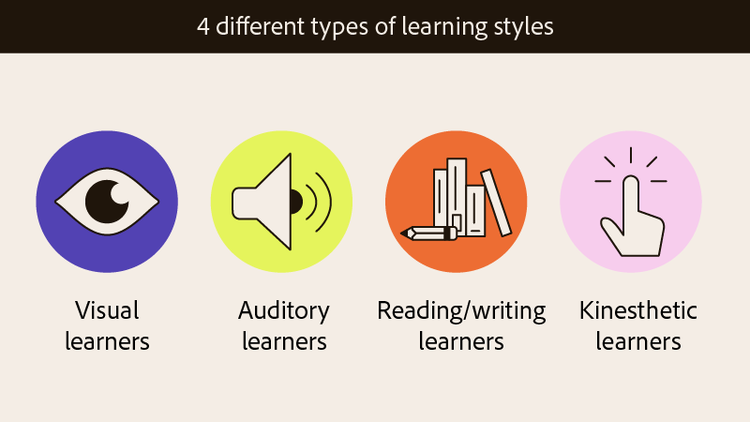
Visual learners absorb information most effectively through seeing and visualizing. They think in pictures and possess strong spatial understanding, often creating mental images to remember concepts.
These learners gravitate toward diagrams, charts, graphs, and maps. When studying history, a visual learner might remember events better through a timeline than a written list. When learning biology, they might recall cell structures by picturing detailed diagrams rather than reading descriptions.
Common characteristics of visual learners include a preference for color-coding and visual organization. They often use highlighters extensively and may create digital flashcards with images and visual cues to reinforce learning. Visual learners frequently sit at the front of classrooms to see the board clearly and minimize distractions.
One challenge visual learners face is processing verbal-only instructions. When someone gives them directions without a map or diagram, they may struggle to follow along. They often find themselves sketching out what others describe verbally, translating words into images they can understand.
Visual learners typically remember faces better than names and can easily recall where information appeared on a page. They often describe memories in vivid visual detail and may use phrases like "I see what you mean" or "Let me picture this."
Auditory learners process information most effectively through listening and verbal communication. They learn best when they can hear explanations, participate in discussions, and engage with material through sound.
These learners thrive in traditional lecture settings and often retain information from conversations long after the discussion ends. They may find themselves remembering not just what was said, but the tone, rhythm, and emphasis of the speaker's voice.
Characteristics of auditory learners include a preference for verbal explanations over written instructions. They often benefit from reading aloud, even when studying alone, and may record lectures to review later. Many auditory learners talk through problems to understand them, essentially teaching themselves by explaining concepts out loud.
Auditory learners possess strong memory for spoken information. They might remember a professor's exact words from a lecture but struggle to recall what was written on the board. They often excel in languages and music, where sound patterns play a central role.
Modern technology offers auditory learners new ways to engage with materials. Tools that allow you to chat with documents through interactive conversations can transform reading into a more dialogue-based experience, helping auditory learners process written content in their preferred verbal format.
Reading/writing learners absorb information most effectively through written words and text-based materials. They prefer interacting with information in written form, whether reading textbooks or taking detailed notes.
These learners excel at processing dense written content that might overwhelm others. They often read quickly and comprehensively, extracting meaning efficiently from articles, books, and written instructions. When given a choice between watching a video explanation or reading an article, they typically choose the written version.
Characteristics of reading/writing learners include exceptional note-taking abilities and a strong preference for lists, definitions, and written summaries. They often rewrite information in their own words to understand it better, finding that the act of writing itself helps cement concepts in memory.
Reading/writing learners frequently create outlines and written study guides. They may feel uncomfortable when information is presented only verbally or visually without accompanying text. They often ask for written follow-ups to verbal discussions and prefer email communication over phone calls.
For reading/writing learners dealing with large volumes of text, tools that offer AI-powered document analysis can help process and summarize complex materials efficiently, allowing them to engage with more content in their preferred written format.
Kinesthetic learners absorb information most effectively through hands-on experience and physical activity. They learn by doing, preferring to engage directly with materials rather than observing or reading about them.
These learners understand concepts best when they can touch, manipulate, or physically interact with what they are studying. A kinesthetic learner studying physics might grasp momentum better by actually pushing objects than by reading equations. In chemistry, they thrive during lab sessions where they can conduct experiments firsthand.
Characteristics of kinesthetic learners include difficulty sitting still during long lectures and a preference for learning environments that allow movement. They often fidget, tap their feet, or doodle while listening—not from lack of attention, but because physical activity helps them focus.
Kinesthetic learners typically remember what they did rather than what they saw or heard. They might forget a lecture's content but vividly recall a hands-on demonstration. They often use phrases like "Let me try it" or "I need to work through this."
These learners benefit from frequent breaks during study sessions and often pace while reviewing material. They excel in fields requiring physical skills, from surgery to carpentry, and often prefer careers that involve movement and hands-on work.
While the VARK model provides a solid foundation for understanding learning preferences, other theories expand the framework to include additional dimensions of how people learn.
Logical or mathematical learners prefer reasoning, patterns, and systematic approaches. They excel at seeing connections between seemingly unrelated concepts and often enjoy puzzles, strategy games, and problem-solving activities. These learners ask "why" frequently and need to understand the underlying logic before accepting information.
Social or interpersonal learners thrive in group settings and collaborative environments. They learn best through discussion, debate, and working alongside others. Study groups energize rather than distract them, and they often understand concepts better after explaining them to peers.
Solitary or intrapersonal learners prefer self-study and independent work. They are introspective and self-motivated, often setting personal goals and tracking their own progress. These learners may find group work frustrating and prefer quiet environments where they can focus deeply.
Naturalistic learners connect learning to the natural world and excel at categorization. They see patterns in nature and often learn best when content relates to living things, natural phenomena, or environmental systems.
These expanded frameworks, offer additional ways to understand learning preferences. However, research consistently shows that most people are multimodal learners, combining elements of several styles depending on the context and subject matter.
Discovering your learning style requires honest self-reflection and willingness to experiment with different approaches. While formal assessments exist, you can begin understanding your preferences through careful observation of your own habits and experiences.
Start by reflecting on past learning experiences. Think about times when you learned something quickly and easily. What made that experience successful? Did you watch someone demonstrate the skill? Did you read instructions carefully? Did you jump in and try it yourself? Patterns in your past successes often reveal your dominant learning style.
Next, experiment with different study methods and observe what works. Spend a week trying visual techniques like mind mapping and color-coding. The following week, focus on auditory approaches like recording yourself explaining concepts. Then try intensive reading and note-taking, followed by hands-on practice. Track which approaches help you retain information best.
Standardized assessments can provide additional insights. The VARK questionnaire, available free online, asks questions about your preferences in various learning situations and identifies your dominant style. The Felder-Silverman Index offers a more detailed analysis across multiple dimensions of learning preference.
Pay attention to how you naturally approach new information. When you get a new appliance, do you read the manual cover to cover, watch a YouTube tutorial, or start pressing buttons to figure it out? Your instinctive approach often reveals your learning preference.
Digital tools can help both identify and support different learning styles. AI tools for student learning can adapt materials to different formats, helping you discover which presentations resonate most strongly with how you learn.

Most learners are multimodal, meaning they benefit from combining multiple approaches rather than relying exclusively on one style. Here are strategies for integrating different learning methods effectively:
Understanding your learning style represents only the first step. The real value comes from applying specific strategies tailored to how you learn best. Different types of learning styles require different study techniques to maximize retention and comprehension.
Study strategies for visual learners:
Study strategies for auditory learners:
Study strategies for reading/writing learners:
Study strategies for kinesthetic learners:

