How to title an essay: 6 examples for essay titles
Your essay title is the first thing readers see, and it shapes their expectations.

What is the purpose of an essay title?
An essay title is far more than a simple label at the top of your page. It serves as a strategic element that influences how readers approach and understand your work. Whether you're writing for academic assessment, professional publication, or personal expression, your title performs several essential functions that can impact your essay's overall success and reception.
Consider the purposes your essay title serves:
- Captures reader attention and creates a strong first impression before they engage with your content
- Previews the essay's main argument, theme, or central focus in a concise format
- Establishes the tone and voice readers should expect throughout the piece
- Helps readers and graders understand the scope and direction of your analysis
- Differentiates your work from other essays on similar topics
- Demonstrates clarity of thought and purpose in your approach to the subject
- Signals to instructors that you've invested care and consideration in your work
- Creates curiosity and gives readers a compelling reason to continue
When instructors grade dozens of essays on the same topic, a thoughtful essay title immediately signals that you've invested genuine care in your work. Whether you’re writing a narrative essay or just learning how to write a synthesis essay, the title shows you understand your own argument well enough to distill it into a few carefully chosen words. Strong titles create curiosity and give readers a reason to continue, while vague or generic titles suggest the essay itself may lack focus or depth.
Beyond academic settings, developing strong titling skills prepares you for professional writing where headlines and subject lines determine whether your work gets read at all. The ability to capture complex ideas in concise, engaging phrases is valuable across careers, from marketing to journalism to research. Learning how to title an essay effectively is a transferable skill that serves writers throughout their academic and professional lives.
A powerful title achieves multiple goals simultaneously. It creates emotional resonance by connecting to experiences or concerns readers care about. It uses specific, concrete language rather than abstract generalities. It employs active, dynamic word choices that suggest movement or change. Most importantly, powerful titles make a clear promise of value, readers understand exactly what insight or information they'll gain by reading further. A powerful title makes someone want to read your first sentence immediately.
How to title an essay: guidelines and tips
Creating an effective essay title requires balancing clarity with creativity. The following guidelines will help you develop essay titles that accurately represent your work while engaging your readers from the first glance. These practical strategies address common questions like "How do you write the title of an essay?" and "What is a good title for an essay?" while providing actionable steps you can apply immediately.
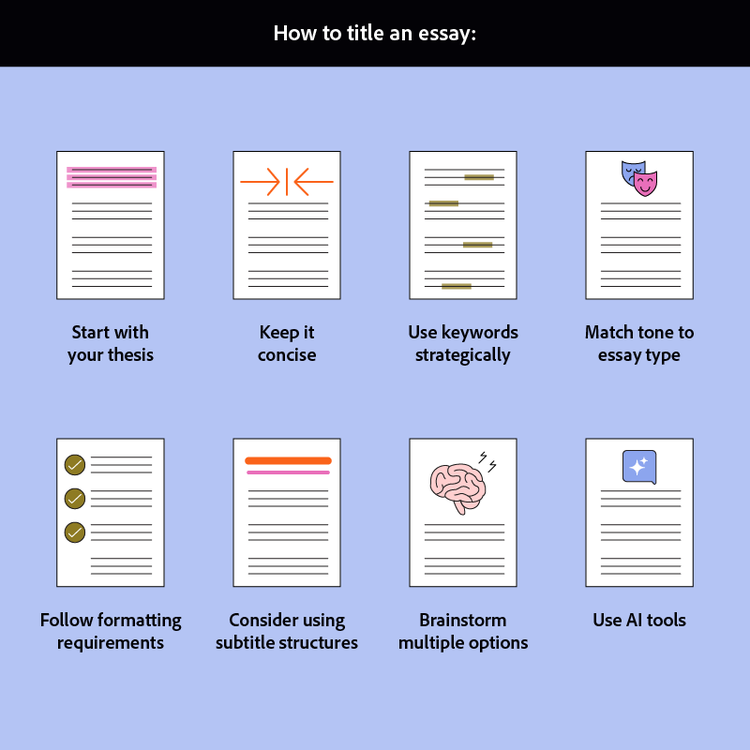
1. Start with your thesis or main argument
Your thesis statement contains the core of what your essay argues or explores. Begin your titling process by identifying the key concepts, terms, and relationships within your thesis. Ask yourself what single idea you most want readers to take away from your work. The most compelling angle of your argument often becomes the foundation for an effective title.
If your thesis argues that social media has fundamentally changed political discourse, your title should reflect that specific focus rather than addressing social media broadly. Extract the essential tension, claim, or insight from your thesis and use it as your starting point. This approach ensures your title accurately represents your content and creates appropriate expectations for readers.
Consider writing your thesis on a separate piece of paper and underlining the three most important words or phrases. These highlighted elements often provide the raw material for your title. You might combine them directly, use them as inspiration for related phrases, or build a question around them.
2. Keep it concise and specific
Effective essay titles typically range from five to fifteen words. Aim for clarity over cleverness, a straightforward title that accurately describes your essay serves readers better than a vague or overly abstract one. Avoid titles so broad they could apply to dozens of different essays on the same general topic.
Instead of "Climate Change and Society," consider "How Rising Sea Levels Threaten Coastal Communities in Bangladesh." The second title specifies exactly what aspect of climate change you're examining and where your analysis focuses. Specificity signals to readers exactly what they'll learn and helps them determine whether your essay addresses their interests.
When drafting essay title ideas, challenge yourself to add one specific detail to any title that feels too general. Replace abstract nouns with concrete examples. Narrow geographic or temporal scope. Identify the particular case study, text, or phenomenon you're analyzing. Each layer of specificity makes your title more informative and engaging.
3. Use keywords strategically
Include subject-specific terminology that reflects your essay's academic field and topic. Keywords help readers immediately identify your essay's focus and relevance to their interests. For digital submissions, strategic keywords also improve searchability, making your work easier to find in databases, online repositories, and academic search engines.
If you're writing about economic policy, include relevant terms like "fiscal policy," "inflation," or "monetary theory" where appropriate. For literary analysis, reference the specific text, author, or critical framework you're employing. These keywords serve as signals to readers familiar with the field while clarifying your focus for general audiences.
Think about what terms someone would use when searching for essays on your topic. Including these naturally in your title helps ensure your work reaches interested readers. However, avoid keyword stuffing, your title should read naturally as a phrase or sentence, not as a list of disconnected terms.
4. Match tone to essay type
Different essay types call for different titling approaches. Formal academic essays and research papers typically require straightforward, professional titles that emphasize precision and scholarly rigor. Personal narratives and creative essays allow for more evocative, literary titles that reflect your unique voice and perspective.
An expository essay explaining a scientific process needs a different tone than a reflective piece about personal growth or even an argumentative essay on AI ethics, for instance. Consider your audience's expectations and your instructor's guidelines when determining the appropriate level of formality. Academic titles often use colons to separate a creative hook from an explanatory subtitle, allowing writers to balance engagement with clarity.
Review examples of titles from published work in your field or essay type. Notice patterns in word choice, length, and structure. These models can inform your own titling decisions while helping you understand genre conventions. What works for a personal college application essay would feel out of place in a peer-reviewed journal article, and vice versa.
5. Follow formatting requirements for APA, MLA, and Chicago style
Citation styles have specific rules for title formatting that you must follow precisely. Understanding how to title an essay in different formats ensures your work meets academic standards and creates a professional impression.
Modern Language Association (MLA) format requires title case with the title centered on the first page—no bold, underline, or italics unless you're referencing another work within your title. In title case, capitalize the first word, the last word, and all principal words (nouns, verbs, adjectives, adverbs). Do not capitalize articles (a, an, the), prepositions, or coordinating conjunctions unless they begin the title. The title appears above your essay text without a separate title page unless your instructor specifies otherwise.
American Psychological Association (APA) format also uses title case but requires bold text, with the title centered on a separate title page. APA titles should be concise and directly reflect the content of your paper. Avoid abbreviations and words that serve no purpose. The title page also includes author name, institutional affiliation, course information, instructor name, and due date on separate lines below the title.
Chicago style uses title case and may include a subtitle separated by a colon. Chicago format often requires a separate title page with the title centered about one-third down the page. The title is not bold in most Chicago applications. Check whether your instructor requires Chicago Notes-Bibliography or Author-Date format, as conventions may vary slightly.
Always verify your instructor's specific requirements, as formatting preferences can vary even within the same style. Some professors have particular expectations that differ from standard guidelines. Incorrect formatting creates an immediate negative impression, regardless of your title's quality, so double-check this detail before submission.
6. Consider using subtitle structures
Many effective essay titles use a two-part structure with a colon separating a creative or attention-grabbing phrase from a more descriptive explanatory component. This format allows you to achieve multiple goals simultaneously capturing interest while providing clarity about your specific focus.
The first part might be a provocative question, a key quote, or an intriguing phrase that creates curiosity. The second part grounds the title in specifics, identifying your subject, scope, or analytical approach. For example, "Breaking Barriers: How Title IX Transformed Women's College Athletics" combines an evocative phrase with clear subject identification.
This structure works particularly well for academic essays where you need to balance scholarly precision with reader engagement. The subtitle ensures readers know exactly what they're getting while the main title provides a memorable hook. Experiment with different combinations to find the right balance for your specific essay.
7. Brainstorm multiple options before deciding
Never settle for your first title idea. Generate at least five to ten different options before selecting your final choice. This brainstorming process helps you explore different angles, tones, and approaches you might not have considered initially. You can combine elements from multiple drafts to create your ultimate title.
Try different formats: questions, statements, commands, phrases with colons. Experiment with different keywords and focal points. Some writers find it helpful to title their essay before writing, using the title as a guide for their argument. Others prefer to wait until after drafting, when they have a clearer sense of their actual content and conclusions.
Share your top title candidates with classmates, writing center tutors, or instructors. Fresh perspectives can help you identify which options communicate most effectively and which might confuse or mislead readers. What seems clear to you as the writer may not land the same way with someone encountering your essay for the first time.
8. Use AI tools to generate essay title ideas
Artificial intelligence can serve as a valuable brainstorming partner when you're struggling to find the right essay title. AI chat tools can help you generate multiple options quickly, giving you raw material to refine and personalize. These tools are particularly helpful when you're experiencing writer's block or want to explore approaches you hadn't considered.
Try prompts like "Generate five academic titles for an essay arguing that renewable energy should replace fossil fuels by 2050" or "Suggest creative titles for a personal essay about overcoming stage fright." Be specific about your essay type, tone, and main argument to get more relevant suggestions. You can also ask AI to generate titles in specific formats, such as question titles or two-part titles with colons.
Generative AI tools can help you identify key themes in your draft that might inspire title ideas. Upload your essay and ask the AI to summarize your main argument or identify your most important points. These summaries often contain phrases and concepts that translate well into titles. AI summary tools can distill lengthy essays into core themes, helping you see your own argument more clearly.
Remember that AI suggestions are starting points, you should always refine and personalize the results to match your specific argument, voice, and assignment requirements. AI-generated titles may be generic or miss nuances in your argument, so use them as inspiration rather than final products. The best titles combine AI efficiency with human judgment and creativity.

6 essay title examples
Different essay types require different approaches to titling. A personal narrative calls for evocative language that hints at your unique experience, while an analytical essay demands precision and academic clarity. Understanding these distinctions helps you craft essay titles that meet genre expectations while showcasing your work effectively. The following essay title examples demonstrate effective titles across six common essay categories, giving you models to adapt for your own writing projects.
Personal essay title examples
Personal essays for creative writing classes or college applications require titles that reflect your authentic voice and hint at the experience you'll share. These titles often use first-person perspective or personal imagery to create immediate connection with readers. When writing a narrative essay, your title should intrigue readers while remaining true to your story's emotional core. The best personal essay titles balance specificity with mystery, giving readers enough to spark curiosity without revealing everything.
Consider these examples:
- "The Summer I Learned to Fail"
- "Finding Home in a Foreign Kitchen"
- "What My Grandmother's Hands Taught Me"
Notice how each title suggests a specific experience while leaving room for curiosity about the details. These titles promise personal insight and emotional resonance while identifying a clear focal point for the narrative.
Analytical essay title examples
Literary analysis and research-based essays need precise, academic essay titles that clearly identify the subject and analytical focus. These titles often include the work being analyzed, the specific element under examination, and sometimes the critical lens being applied. An informative essay requires similar clarity about its subject matter. Effective analytical titles prioritize precision over creativity, ensuring readers know exactly what text and approach to expect.
Here are a few examples that illustrate the guidelines:
- "Symbolism of Light and Darkness in The Great Gatsby"
- "Economic Factors Behind the Industrial Revolution's Rapid Spread"
- "Gender Performance in Shakespeare's Twelfth Night: A Feminist Reading"
These titles immediately tell readers what text or topic you're examining and what aspect you'll analyze. The third example demonstrates how to incorporate a critical framework into your title.
Argumentative essay title examples
Essays that take a clear position on debatable topics benefit from titles that signal your stance while maintaining academic tone. An argumentative essay title should indicate your position without sounding defensive or combative. Strong argumentative titles often include words that signal advocacy or critique, helping readers understand your perspective before they begin reading. Here are a few examples:
- "Why Universal Basic Income Is Essential for the AI Economy"
- "The Case Against Standardized Testing in College Admissions"
- "Defending Free Speech on College Campuses: A Constitutional Argument"
All three of these examples make the essay's position clear while framing the argument in substantive terms. Readers immediately understand what stance you'll defend.
Persuasive essay title examples
Persuasive essays aim to convince readers to adopt a viewpoint or take specific action. Their titles often address readers directly or use compelling language that creates urgency. While similar to argumentative essays, persuasive essay titles may take a more direct, action-oriented approach that emphasizes reader benefit or immediate relevance.
Here are a few titles to consider:
- "Three Reasons Your Campus Should Go Plastic-Free"
- "Why Every Student Should Learn a Second Language"
- "The Hidden Benefits of Volunteering: What You Gain by Giving Back"
These examples speak directly to readers and promise concrete reasons or benefits, encouraging engagement. They frame the essay as offering value to the reader personally.
Comparison essay title examples
Essays examining similarities and differences between subjects need titles that clearly identify both elements being compared and suggest the nature of the comparison. Effective comparison essay titles make the subjects and analytical relationship explicit, such as:
- "Traditional vs. Online Learning: Which Prepares Students Better?"
- "Democracy in Athens and Rome: A Comparative Analysis"
- "Romanticism and Realism: Contrasting Visions of the Natural World"
The first example uses a question format to frame the comparison, while the second and third clearly label themselves as comparative analysis. Each title identifies both subjects being compared.
College application essay title examples
College application essays are high-stakes personal statements that need titles reflecting both your unique story and your readiness for university-level work. These titles should be memorable and personal while remaining professional and polished. Admissions readers review thousands of essays each application cycle, so your title should help yours stand out and remain memorable during committee discussions. Here are a few examples:
- "From Debate Club to Diplomacy Dreams"
- "The Equation That Changed My Perspective"
- "Building Bridges: My Journey as a First-Generation Student"
Each title hints at personal growth and specific experiences while suggesting the larger themes the essay will explore. They balance individuality with the professionalism expected in academic applications.
Frequently asked questions
How do you write the title of an essay?
How to title an essay in MLA?
What is a good title for an essay?
What are good title ideas?
What is a powerful title?
You may also like