Turabian citation: footnotes, bibliographies, and citation examples
Turabian format is a citation style designed specifically for students and researchers writing academic papers, theses, and dissertations, based on the Chicago Manual of Style.

What is the Turabian format?
Turabian style takes its name from Kate L. Turabian, a dissertation secretary at the University of Chicago who spent decades helping graduate students format their academic papers. In 1937, she published "A Manual for Writers of Research Papers, Theses, and Dissertations," which distilled the comprehensive Chicago Manual of Style into a more accessible guide tailored for student researchers. Today, Turabian format remains one of the most widely used citation styles in academic institutions across the United States and beyond.
Whether you are conducting a literature review in the humanities or presenting scientific research findings, Turabian style provides clear guidelines for documenting your sources. Universities frequently require this format for graduate-level work, making it essential knowledge for serious academic writers who need to write a report or complete major research projects.
Here are the fundamental requirements:
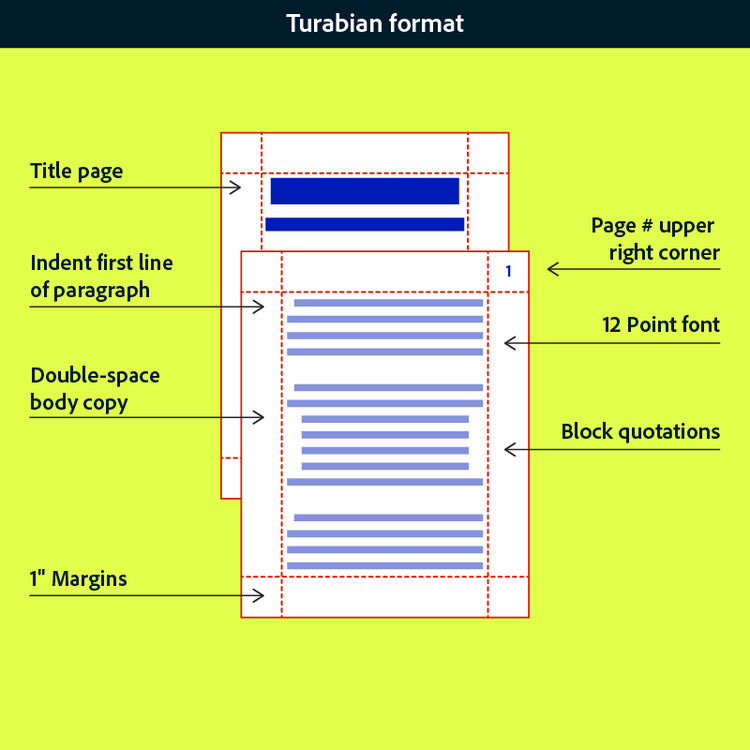
- Margins: Set one-inch margins on all sides of the page
- Font requirements: Use a readable font such as Times New Roman in 12-point size
- Spacing guidelines: Double-space the body text throughout the document
- Page numbers: Place page numbers in the upper right corner, beginning with the second page
- Title page: Create a separate title page with the paper title centered one-third down the page
- Title page information: Include your name, course information, and date on the title page
- Paragraph indentation: Indent the first line of each paragraph by half an inch
- Block quotations: Use block quotations for passages longer than five lines
Turabian citation methods
Turabian offers two distinct citation systems, each designed to serve different academic disciplines and research traditions. The notes-bibliography system uses footnotes or endnotes paired with a comprehensive bibliography, while the author-date system relies on parenthetical citations within the text and a reference list at the end. Your choice between these methods typically depends on your field of study and your instructor's requirements. Understanding both systems ensures you can adapt your Turabian citation approach to the right academic context.

Notes-bibliography
The notes-bibliography system represents the traditional approach to Turabian citation and remains the preferred method in humanities disciplines such as literature, history, philosophy, and the arts. This system allows writers to provide detailed source information in footnotes or endnotes while maintaining a smooth reading experience in the main text. Readers who want additional context can glance at the notes, while those focused on the argument can continue reading uninterrupted.
When using the notes-bibliography method, you place a superscript number at the end of a sentence or clause that contains information from a source. This number corresponds to a note at the bottom of the page (footnote) or at the end of the document (endnote). The bibliography at the end of your paper then lists all sources alphabetically by author's last name. Learning how to cite an article correctly in this Turabian format ensures your research meets academic standards.
For a book citation in the notes-bibliography format, the footnote structure follows this pattern:
First name Last name, Title of Book (Place of Publication: Publisher, Year), page number.
Example: Jane Smith, The History of Modern Architecture (New York: Academic Press, 2022), 145.
Last name, First name. Title of Book. Place of Publication: Publisher, Year.
Example: Smith, Jane. The History of Modern Architecture. New York: Academic Press, 2022.
First name Last name, "Article Title," Journal Name Volume, no. Issue (Year): page range.
Example: John Williams, "Climate Patterns in the Pacific Northwest," Environmental Studies Quarterly 45, no. 3 (2023): 234-256.
"Page Title," Website Name, Month Day, Year, URL.
Example: "Understanding Citation Styles," University Writing Center, March 15, 2024, https://www.example.edu/citations.
Author-date
The author-date system provides a streamlined citation approach favored in the sciences and social sciences, including fields such as biology, psychology, sociology, and economics. This Turabian style method places brief parenthetical citations directly in the text. Researchers in these disciplines often value the efficiency of seeing author names and publication years at a glance.
In the author-date format, you include the author's last name and the year of publication in parentheses immediately after the relevant information. When quoting directly or referencing a specific passage, add the page number after the year. The reference list at the end of your paper provides complete publication details for every source cited.
For a book citation using the author-date method, the in-text citation appears as:
(Last name Year, page number)
Example: (Smith 2022, 145)
Last name, First name. Year. Title of Book. Place of Publication: Publisher.
Example: Smith, Jane. 2022. The History of Modern Architecture. New York: Academic Press.
In-text: (Williams 2023, 240)
Reference list: Williams, John. 2023. "Climate Patterns in the Pacific Northwest." Environmental Studies Quarterly 45, no. 3: 234-256.
In-text: (University Writing Center 2024)
Reference list: University Writing Center. 2024. "Understanding Citation Styles." Accessed March 15, 2024. https://www.example.edu/citations.
The reference list in the author-date system differs from a bibliography in several important ways. Entries emphasize the publication year by placing it immediately after the author's name, and the list includes only sources directly cited in the paper rather than all sources consulted during research.
Both citation methods serve the same fundamental purpose: giving proper credit to the scholars whose work informed your research. Understanding when to use each system helps you meet disciplinary expectations and present your Turabian format work professionally.
Turabian format vs. Chicago style
The relationship between Turabian format and the Chicago Manual of Style often confuses students encountering academic citation for the first time. Kate Turabian created her manual as a simplified, student-focused adaptation of the Chicago style, which means the two systems share the same foundational principles. However, important differences exist in their intended audiences and specific applications.
Chicago style serves as a comprehensive reference for professional editors, publishers, and authors working in commercial and academic publishing. The Chicago Manual of Style spans over 1,000 pages and addresses countless editorial scenarios that most students will never encounter. Turabian style, by contrast, focuses specifically on the needs of students writing research papers, theses, and dissertations. This targeted approach makes the Chicago Turabian format more accessible for academic writers who need practical guidance without overwhelming detail.
Use cases differ between the two styles. Chicago style addresses professional publishing needs, including book production, magazine editing, and commercial content creation. Turabian format concentrates on academic papers, graduate theses, and undergraduate research assignments. When you need to write a research paper for a university course, Turabian typically provides the most relevant guidance.
Formatting differences are subtle but meaningful. While both styles use the same citation systems, Turabian offers simplified instructions for common student scenarios. Chicago provides exhaustive detail for edge cases that rarely appear in academic papers. Turabian's formatting guidance focuses on elements students frequently encounter: title pages, block quotations, tables, and figure captions in academic contexts.
Audience and application distinctions shape each manual's content. Chicago assumes readers are professional editors who need comprehensive rules for every possible situation. Turabian assumes readers are students who need clear, actionable guidance for typical research assignments. This difference in audience affects everything from the organization of topics to the level of detail in explanations.
Key differences between the two styles include:
- Audience focus: Turabian targets students and academic researchers, while Chicago serves professional publishers and editors
- Scope of coverage: Turabian streamlines guidelines to address common student scenarios, whereas Chicago covers virtually every publishing situation
- Formatting simplifications: Turabian offers clearer, more direct instructions for typical academic paper elements
- Examples and applications: Turabian provides examples specifically relevant to academic research rather than commercial publishing
- Length and accessibility: Turabian presents essential information in a more manageable format for student reference
Because Chicago and Turabian share the same foundation and core citation principles, a paper formatted correctly in Turabian style will closely resemble one formatted in Chicago style. When deciding which style to use, consider your context and audience. Students should typically follow Turabian format unless their instructor specifically requires Chicago style. If you plan to submit your work for professional publication, familiarizing yourself with the full Chicago Manual of Style becomes more important.
Generate citations in Turabian format with AI
Creating accurate citations in Turabian format traditionally required careful attention to formatting details and frequent reference to style guides. Today, artificial intelligence tools can streamline this process significantly, helping students and researchers generate properly formatted citations more efficiently. These digital tools for academic success reduce the time spent on mechanical formatting tasks, allowing more focus on research and writing.
Follow these steps to leverage AI for Turabian citation generation:
- Upload or access your source documents in a format that AI tools can read, such as PDF files containing journal articles, book chapters, or research reports
- Use AI features to extract key citation information including author names, titles, publication dates, publishers, and page numbers from your sources
- With AI assistance, format the extracted information according to Turabian requirements, specifying in any AI prompts whether you need notes- bibliography or author-date style citations
- Review and verify each generated citation for accuracy, checking that all elements appear in the correct order with proper punctuation
- Compile your bibliography or reference list using the verified citation data
Modern research assistance technology can analyze documents and identify citation-relevant information automatically. When you chat with PDF files using an AI assistant, you can ask specific questions about publication details or request help formatting citations in Turabian style. A document summarization tool can also help you understand source materials quickly, making it easier to determine which information deserves citation in your paper. And document editing capabilities allow you to annotate sources, highlight key passages, and organize your research materials efficiently. AI-powered features can help you extract information from multiple documents, compare sources, and maintain organized notes for your bibliography or reference list.
The benefits of using AI for Turabian citation extend beyond simple time savings. These tools help maintain consistency across all your citations, reducing the formatting errors that often occur when manually typing dozens of entries. AI can also flag potential issues such as missing information or inconsistent formatting, helping you catch problems before submission.
Understanding how AI complements traditional Turabian format skills makes you a more effective researcher. While AI can accelerate citation formatting, you still need to understand Turabian style principles to verify accuracy and make informed decisions about source documentation. The combination of AI efficiency and human judgment produces the highest quality citations for your academic work.
Frequently asked questions
Is Turabian the same as APA?
Is Turabian Style MLA?
How do I format a Turabian title page?
Can I use Turabian for online sources?
What is the difference between footnotes and endnotes in Turabian?
You may also like