40 Science fair ideas for standout projects.
Fun science fair ideas and board design inspiration for notable projects.




Find brilliant science fair ideas for your next science competition.
Working on a science fair project is a valuable learning experience for students. It encourages them to explore scientific questions and topics and have fun while learning. Students can also participate in science competitions, where strong projects can lead to recognition and may be helpful in scholarship or college applications. Whether you’re brainstorming ideas or looking for simple experiments to understand scientific concepts, choosing the right topic can help you create an impressive project that makes learning science more enjoyable.
How the right science fair board design can make your project shine.
Aside from the project itself, science fair participants also prepare display boards that help them present their work to others. While your experiment is the focus, your display board brings your research, process, and findings in a way that’s easy for your audience to understand. A well-written summary of your experiment with the right style and design can help you present your project more cohesively.
With tools like Adobe Express, you can mix and match different layouts, typography, and visuals to design and organize your display board.
Discover science fair ideas for different skill levels and interests.
Conducting experiments and joining a science fair helps turn questions into hands-on investigations. There are many different experiments you can explore, and having a list of easy and flexible science fair ideas can come in handy. Use the ideas below to narrow down your options and find a project that fits your skill level and curiosity.
These science fair ideas cover a wide range of scientific concepts, from physics to environmental science. A clear presentation can help others better follow your process and understand your results. With a tool like Adobe Express, you can turn your findings and insights into a structured poster, infographic, or display board, allowing you to communicate your work with clarity.
recipe
Simple 5th-grade science fair ideas for learning the basics of science.
Science fairs encourage students to test ideas, observe what happens, and understand how different variables affect outcomes. These science fair project ideas for 5th-grade students are designed to be simple, hands-on, and easy to understand.
Once the experiment is complete, it’s essential to organize findings and show what the student tested, observed, and concluded. A strong science fair board focuses on structure, not solely on decoration. Organizing content into clear sections makes it easier for viewers to follow projects from start to finish. Students can turn their results into well-organized posters or presentation slides using a tool like Adobe Express.
recipe
How to plan a science fair board with Adobe Express.
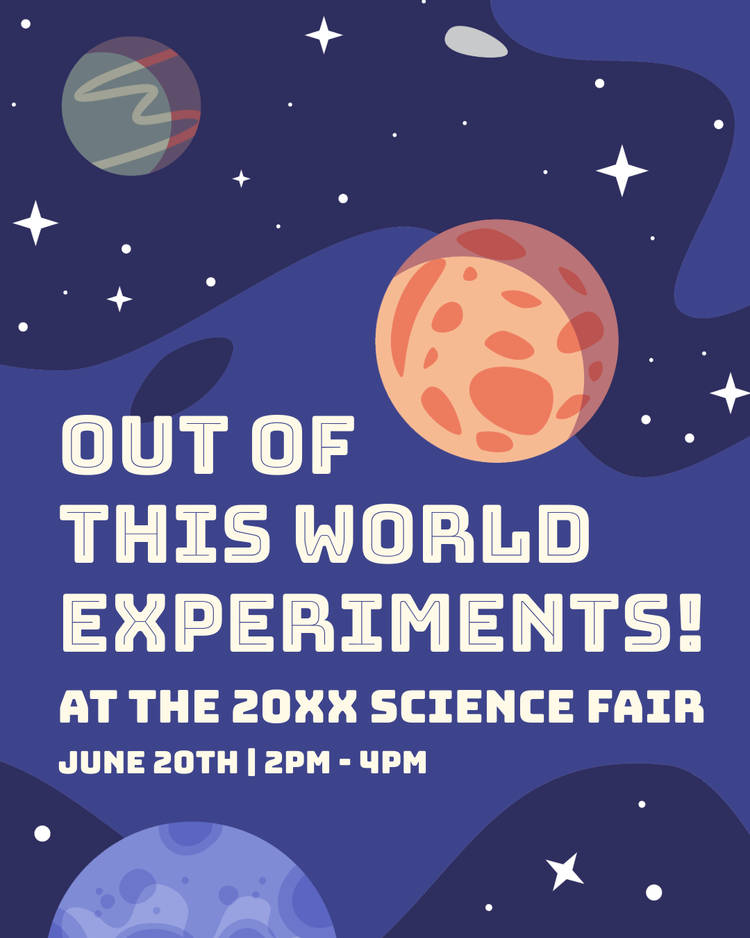
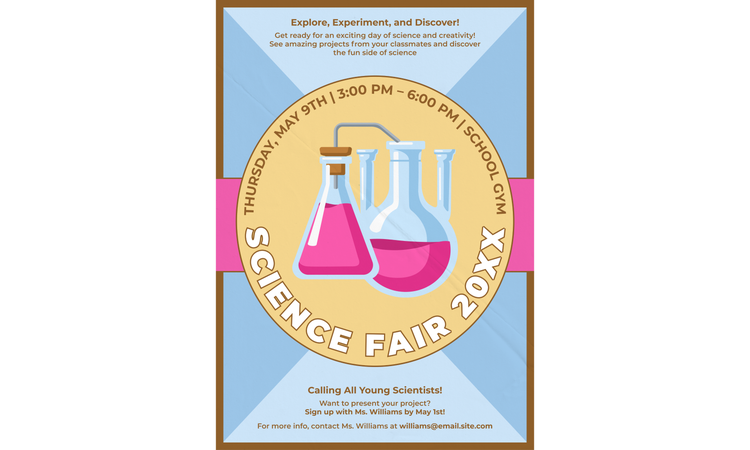
Enhance your project presentation with these science fair board ideas.
The science fair project display board is the main visual aid that presents the details of your experiment and the data you gathered. A thoughtful layout can highlight the most important parts of your project without overwhelming the audience. Here are some science fair board ideas you can try to make sure that your project presentation is polished for your audience and judges.
These ideas can help you make a comprehensive science fair board that clearly presents key information about your project, but it’s also important to check the rules of your science fair to make sure you’re following their guidelines properly.
With Adobe Express, you can prepare a visually compelling display board. It can help you streamline the design process, arrange content, and keep the text and visual elements consistent across your board.
recipe
Make an eye-catching presentation with science fair board decoration ideas.
These science fair board decoration ideas can help you assemble a display board that reflects your project’s theme while making key information more visually engaging. One helpful approach is to choose a single dominant visual style first, then build all decorative elements around it to keep the overall design cohesive.
While decorating your display board is a great way to get your audience’s attention, it’s important to note that adding too many design elements can overcrowd the board and distract from the main content of your project.
Planning your science fair board’s layout digitally before physically assembling it allows you to experiment with spacing, hierarchy, and placement before committing to a final design. It gives you a chance to see how text, visuals, and headings work together and adjust the balance between aesthetics and readability. This early planning step also helps you identify sections that may feel too dense or too empty.
recipe
How to start a science fair project.
Doing a science fair project starts with taking an idea and shaping it into something that you can explore through observation, testing, and evidence. Here are the steps to starting a science project.
1. Decide on a science fair project idea.
Start by picking a topic that you want to cover for your experiment. Science Buddies notes that a good science fair project idea asks a clear scientific question that can be answered by doing experiments or an idea that identifies a problem that can be solved through engineering. Go with a topic that you’re genuinely interested in — this can motivate you to do the project properly.
2. Identify your science project question.
Now that you have a topic in mind, the next step is to figure out what your goal is. What scientific question do you want to ask? What problem do you want to try to solve with your project?
3. Do your background research and make a hypothesis.
Before you start with your experiment, do some background research to see what data has been gathered so far about your chosen topic. This can help you plan your project and ensure that you don’t repeat mistakes from past research and experiments. When you’re done with your research, make a hypothesis to predict the results of your experiment.
4. Test your hypothesis with an experiment.
Your experiment is the stage in your project where you test whether your hypothesis is accurate. According to Science Buddies, your experiment should be a fair test. A fair test involves making sure that you change only one variable at a time while keeping the other conditions the same. Repeat your experiments several times, so you can compare results across different tests.
5. Analyze your data and form a conclusion.
After your experiment, collect your data and analyze it to check if it supports your predictions or not. Draw a conclusion based on the results of your experiment and include it in your report.
6. Make a science fair display board presenting your findings.
The final step for preparing your science fair project is to compile your findings on a science fair display board. The display board should clearly explain what your project is about, how you carried out the experiment, and a presentation of your findings and your conclusion.
Here’s an extra tip: If you’re going to present your project at a science fair, practice answering questions and talking about your science project, so you can build confidence and feel ready to present and discuss it with the judges. Think about the possible questions that they might ask you and list them down. With the Adobe Express card maker, you can create and print out your own cue cards or flashcards to help you practice.
Common mistakes to avoid when preparing your science fair board.
Here are some common mistakes students make when assembling their science fair board and how you can avoid them:
- Overloading the board with too much text.
Presenting your findings in big blocks of text can impact your science fair board’s readability. You can avoid this by breaking your information into shorter paragraphs. Focused sections, bullet points, and clearly labeled headings make the content easier to scan.
You can add illustrations of your step-by-step process instead of relying only on text to explain your procedure. You can also avoid wordy paragraphs by keeping your explanations short and to the point.
- Poor organization and unclear layout.
Your science board should be kept neat and organized, so the information is easy to follow. Science Buddies suggests organizing your information to read like a newspaper, so your audience can read your research from top to bottom, then left to right. Include each step of your project — like the abstract, science question, hypothesis, background research, and more — and clearly label them. Consistent spacing, alignment, and section placement also make it easier to navigate your board.
- Using fonts that are hard to read.
Font choice directly affects how easily your work can be understood. You can use creative fonts to make your board more visually appealing, but don’t use artistic ones that are hard to read, and avoid using more than two or three fonts to keep the text cohesive.
Aside from font choice, you should also use a font size that’s big enough for the text to be readable from at least three feet away. Stick with a font size of at least 16 points for the main body text — anything smaller than that may be hard to read.
- Overcrowding the board with decorations.
Aside from blocks of text, adding too many design elements to your board can overcrowd it. When every section includes colors, textures, or accents, nothing stands out clearly, and the board can start to feel visually overwhelming. You can avoid this by aiming for simpler layouts that enhance your presentation’s visual appeal without sacrificing its readability. Well-placed design choices should support the structure of your board rather than compete with it.
- Not planning the layout in advance.
Assembling your science fair board will take time and require physical materials. Not planning your layout in advance can lead to mistakes that will waste time and resources. It can lead to uneven spacing, misplaced sections, or the need to redo parts of your layout. One way to avoid this is by planning your layout before you set up your display.
Using a tool like Adobe Express allows you to plan out your science fair board digitally. You can experiment with different layouts, adjust spacing, and test how your content fits together. This way, you can refine your design and catch potential issues early.
Other support materials you can make for your science project presentation.
Your display board is a key part of your setup. However, you can use additional materials to share information about your project more efficiently. The materials below are especially useful in busy settings, where not everyone will have the time to read through your entire board.
Check out these other support materials you can prepare to complement your presentation:
- Cards. You can prepare cards with a brief summary or quick facts about your project that you can hand out to attendees. This allows you to easily distribute bite-sized information about your work.
- Banners. Make a banner that clearly shows your project title and decorate it according to your project’s theme. You can make a banner for your display with the Adobe Express banner maker.
- Posters. With eye-catching posters, you can promote your project and draw your audience’s attention to your display.
- Flyers. Handing out flyers with quick information about your project is useful for reaching people who may not stop for a full explanation but are interested enough to learn more later. Use the flyer maker to design your flyers.
- Letters. A letter introducing your project can make it easier for the judges and attendees to understand your experiment. Adobe Express has over a thousand letter templates you can customize to suit your project’s theme and purpose.
- Photo collage. If you want to make your presentation more visually appealing, try arranging photos of your experiment in a photo collage.
- Brochures. Brochures with eye-catching designs allow you to organize your project into sections that readers can go through at their own pace. They’re useful for summarizing key points while still leaving room for visuals, data, and brief explanations.
With tools like Adobe Express, you can adapt the same content across different formats, so all of your materials stay consistent.
Make your science fair project presentation stand out with Adobe Express.
A well-designed science fair board can help highlight your key findings more effectively, which is especially important if you’re participating in a science competition. With Adobe Express, you can explore thousands of professionally designed templates that you can customize until you find the right layout for your science fair presentation.
Start designing well-structured science fair boards today with Adobe Express.
Discover more you might like.
You might also like...