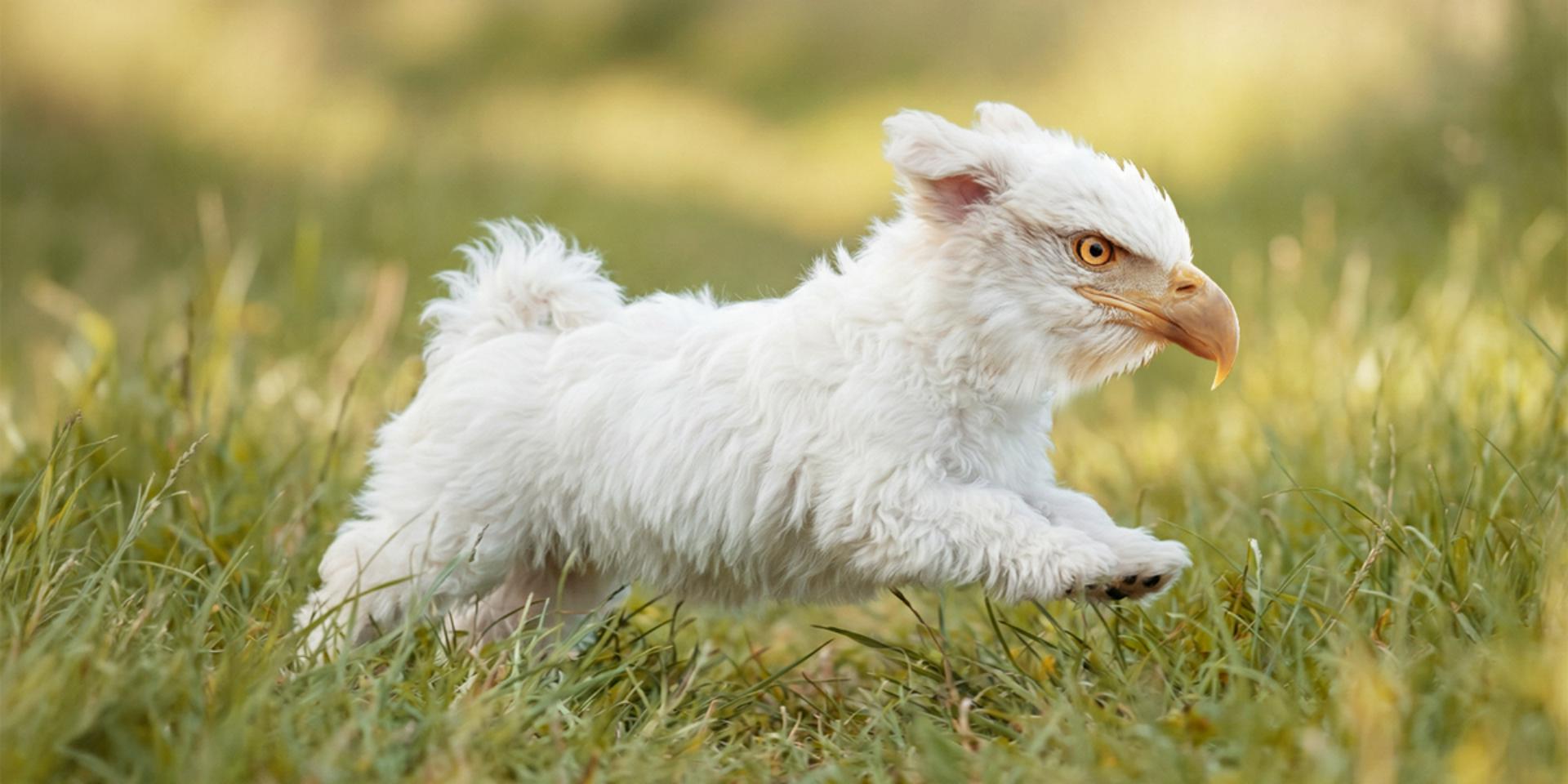
Apprenez à fusionner deux animaux en utilisant sélections, masques de fusion et ajustements colorimétriques.
Publié le
Apprenez à fusionner deux animaux pour créer une nouvelle créature. Dans cet exemple, nous combinons la tête d’un aigle avec le corps d’un chien en utilisant sélections, masques de fusion et ajustements colorimétriques.
Dans ce tutoriel accessible aux débutants, vous apprendrez à créer un animal hybride.
Nous commencerons par préparer nos deux sujets avant de positionner et intégrer la tête d'un aigle sur le corps d'un chien.
Ensuite, vous découvrirez comment harmoniser l'ensemble pour obtenir une composition cohérente et crédible.
Ce type de montage demande à la fois technique et créativité tout en restant très ludique à réaliser.
Alors, pour donner vie à vos propres créatures hybrides, lancez le tutoriel dès maintenant.
Rien de plus surprenant que de voir un chien avec une tête d’aigle. En bousculant les lois de la nature avec un montage photo vos créations marqueront les esprits.
Dans ce tutoriel, après avoir sélectionné les deux sujets (la tête de l'aigle et le corps du chien), vous utiliserez des masques de fusion pour faire fusionner les deux et effacer les parties qui dépassent. Avec différents calques de réglages, la tête de l’aigle adoptera ensuite les ombres et les reflets du corps du chien.
Ces compétences en compositing vous serviront à imaginer des univers fantastiques ou des illustrations conceptuelles frappantes. Vous saurez isoler et intégrer n'importe quel sujet dans un environnement étranger de manière fluide.
Ce que vous allez apprendre
Dans ce tutoriel pratique, vous découvrirez comment :
Isoler les sujets pour pouvoir les fusionner de manière non destructive,
Utiliser les masques de fusion pour effacer les frontières entre les sujets,
Exploiter la Correction sélective et la Correspondance de couleur pour unifier les tons discrètement.
À propos de l’artiste
Julien Tabet est un artiste digital français. Son travail explore la rencontre entre la nature et l’imaginaire, donnant naissance à des compositions poétiques. S’inspirant du monde animal et du surréalisme, il crée des images visuellement saisissantes, portées par une palette de couleurs harmonieuse. Grâce à une maîtrise affirmée de Photoshop, il transforme ses idées les plus imaginatives en œuvres numériques d’une grande précision.
You can control how Adobe websites use cookies and similar technologies by making choices below. But note that if you disable cookies and similar technologies entirely, Adobe websites may not function properly.
Cookies are small text files stored by your web browser when you use websites. There are also other technologies that can be used for similar purposes like HTML5 Local Storage and local shared objects, web beacons, and embedded scripts. These technologies help us do things like remembering you and your preferences when you return to our sites, measure how you use the website, conduct market research, and gather information about the ads you see and interact with.
You can make choices in the menu below about what cookies and other technologies you want us to use on Adobe sites when you visit them from this browser. You can always change those choices later by clicking on the Cookie Preferences link at the bottom of the page.
If enabled:
We can improve your experience by tailoring the site and the content to things we think might be of interest
We can better keep track of your preferences — like what language you prefer to use
We will better understand your likely interests so we can provide you more relevant Adobe ads and content on non-Adobe websites and in non-Adobe apps
It will help us improve the performance of our website and those of our partners who use the Adobe Experience Cloud
If disabled:
We won’t be able to remember you from session to session so the experience may not be tailored to your interests
You’ll still have access to the content of the site but certain features that depend on cookies may not function
You’ll still see ads, they just may not be as relevant to you
General information
You can control how Adobe websites use cookies and similar technologies by making choices below. But note that if you disable cookies and similar technologies entirely, Adobe websites may not function properly.
Cookies are small text files stored by your web browser when you use websites. There are also other technologies that can be used for similar purposes like HTML5 Local Storage, web beacons, and embedded scripts. These technologies help us do things like remembering you and your preferences when you return to our sites, measure how you use the website, conduct market research, and gather information about the ads you see and interact with.
You can make choices in the menu below about what cookies and other technologies you want us to use on Adobe sites when you visit them from this browser. You can always change those choices later by clicking on the Cookie Preferences link at the bottom of the page.
If enabled:
We can improve your experience by tailoring the site and the content to things we think might be of interest
We can better keep track of your preferences — like what language you prefer to use
We will better understand your likely interests so we can provide you more relevant Adobe ads and content on non-Adobe websites and in non-Adobe apps
It will help us improve the performance of our website and those of our partners who use the Adobe Experience Cloud
If disabled:
We won’t be able to remember you from session to session so the experience may not be tailored to your interests
We’ll still count your use of our site and services
You’ll still have access to the content of the site but certain features that depend on cookies may not function
You’ll still see ads, they just may not be as relevant to you
Operate the site and core servicesOperate site and measure engagement
Always active
These cookies are required, and they are used to enable the site and related services core functionality. Without them the site could not operate, so they cannot be disabled.
These cookies enable the site and related services’ core functionality and collect statistics about user engagement, such as counting active use to help us understand trends. These cookies cannot be disabled.
Measure performance
These cookies are used to analyze site usage to measure and improve performance. Without them Adobe cannot know what content is most valued and how often unique visitors return to the site, making it hard to improve information we offer to you.
These cookies are used to analyze site usage to measure and improve performance. Without them Adobe cannot know what content is most valued, making it hard to improve information we offer to you.
Extend functionality
These cookies are used to enhance the functionality of Adobe sites such as remembering your settings and preferences to deliver a personalized experience; for example, your username, your repeated visits, preferred language, your country, or any other saved preference.
Personalize advertising
These cookies are used to enable Adobe and our partners to serve ads more relevant to your interests. Without them you will still see ads, but they might not be as relevant to you.
Personalize advertising
These cookies are used to enable Adobe and our partners to serve ads more relevant to your interests. Without them you will still see ads, but they might not be as relevant to you.