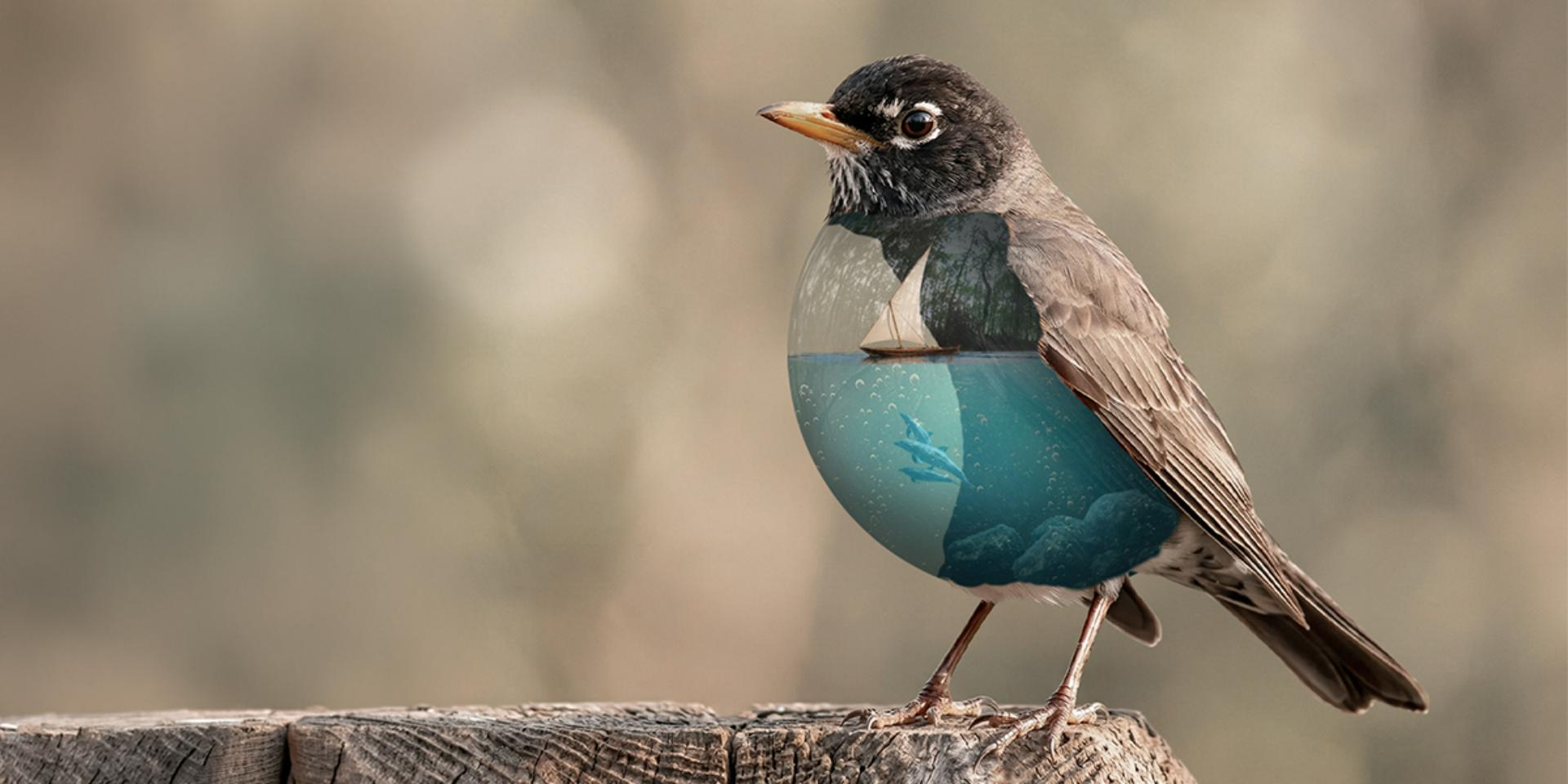
Découvrez comment transformer un animal en un monde aquatique afin de lui donner un visuel unique.
Publié le
Transfigurez le corps d’un oiseau en un véritable monde aquatique en utilisant les calques de remplissage, les masques de fusion et l'outil pinceau pour créer une composition fantastique.
Dans ce tutoriel, vous apprendrez à transformer un animal en monde aquatique.
Nous commençons par préparer l'image et isoler le sujet de son arrière-plan.
Puis, nous créerons un volume intérieur en creusant visuellement la structure de l'animal.
Nous viendrons ensuite intégrer un effet d'aquarium avec l'eau et ses premiers éléments.
Enfin, nous composerons l'ensemble en ajoutant différents détails pour construire une scène riche et cohérente.
Ce travail de composition complet vous permettra de développer des techniques avancées et de pousser vos créations beaucoup plus loin.
Alors, pour repousser les limites de votre créativité, lancez le tutoriel dès maintenant.
Dans le domaine de la création numérique, ce qui distingue un simple montage d'une œuvre immersive, c'est la capacité à faire croire à l'impossible. Que ce soit pour explorer une idée surréaliste, illustrer un univers fantastique ou simplement repousser les limites de votre créativité, rien n'est plus saisissant qu'une image où le familier se transforme en quelque chose d'entièrement nouveau.
Avec ce tutoriel, vous apprendrez à métamorphoser un oiseau en un monde aquatique vivant et détaillé, en combinant sélections précises, calques de remplissage et masques de fusion. Vous découvrirez comment sculpter le volume à l'aide de l'outil Pinceau, intégrer des éléments marins pour construire une composition. Il ne vous restera plus qu'à laisser votre imagination plonger pour pousser la transformation encore plus loin.
Ce que vous allez apprendre
Dans ce tutoriel pratique, vous découvrirez comment :
Réaliser des sélections précises pour isoler et préparer votre sujet en vue de la transformation,
Appliquer des calques de remplissage et des masques de fusion pour intégrer les éléments aquatiques de façon naturelle et cohérente,
Utiliser l'outil Pinceau pour modeler le volume, accentuer les ombres et donner de la profondeur à la composition,
Assembler et harmoniser l'ensemble des éléments pour construire une scène réaliste et immersive.
À propos de l’artiste
Julien Tabet est un artiste digital français. Son travail explore la rencontre entre la nature et l’imaginaire, donnant naissance à des compositions poétiques. S’inspirant du monde animal et du surréalisme, il crée des images visuellement saisissantes, portées par une palette de couleurs harmonieuse. Grâce à une maîtrise affirmée de Photoshop, il transforme ses idées les plus imaginatives en œuvres numériques d’une grande précision.
You can control how Adobe websites use cookies and similar technologies by making choices below. But note that if you disable cookies and similar technologies entirely, Adobe websites may not function properly.
Cookies are small text files stored by your web browser when you use websites. There are also other technologies that can be used for similar purposes like HTML5 Local Storage and local shared objects, web beacons, and embedded scripts. These technologies help us do things like remembering you and your preferences when you return to our sites, measure how you use the website, conduct market research, and gather information about the ads you see and interact with.
You can make choices in the menu below about what cookies and other technologies you want us to use on Adobe sites when you visit them from this browser. You can always change those choices later by clicking on the Cookie Preferences link at the bottom of the page.
If enabled:
We can improve your experience by tailoring the site and the content to things we think might be of interest
We can better keep track of your preferences — like what language you prefer to use
We will better understand your likely interests so we can provide you more relevant Adobe ads and content on non-Adobe websites and in non-Adobe apps
It will help us improve the performance of our website and those of our partners who use the Adobe Experience Cloud
If disabled:
We won’t be able to remember you from session to session so the experience may not be tailored to your interests
You’ll still have access to the content of the site but certain features that depend on cookies may not function
You’ll still see ads, they just may not be as relevant to you
General information
You can control how Adobe websites use cookies and similar technologies by making choices below. But note that if you disable cookies and similar technologies entirely, Adobe websites may not function properly.
Cookies are small text files stored by your web browser when you use websites. There are also other technologies that can be used for similar purposes like HTML5 Local Storage, web beacons, and embedded scripts. These technologies help us do things like remembering you and your preferences when you return to our sites, measure how you use the website, conduct market research, and gather information about the ads you see and interact with.
You can make choices in the menu below about what cookies and other technologies you want us to use on Adobe sites when you visit them from this browser. You can always change those choices later by clicking on the Cookie Preferences link at the bottom of the page.
If enabled:
We can improve your experience by tailoring the site and the content to things we think might be of interest
We can better keep track of your preferences — like what language you prefer to use
We will better understand your likely interests so we can provide you more relevant Adobe ads and content on non-Adobe websites and in non-Adobe apps
It will help us improve the performance of our website and those of our partners who use the Adobe Experience Cloud
If disabled:
We won’t be able to remember you from session to session so the experience may not be tailored to your interests
We’ll still count your use of our site and services
You’ll still have access to the content of the site but certain features that depend on cookies may not function
You’ll still see ads, they just may not be as relevant to you
Operate the site and core servicesOperate site and measure engagement
Always active
These cookies are required, and they are used to enable the site and related services core functionality. Without them the site could not operate, so they cannot be disabled.
These cookies enable the site and related services’ core functionality and collect statistics about user engagement, such as counting active use to help us understand trends. These cookies cannot be disabled.
Measure performance
These cookies are used to analyze site usage to measure and improve performance. Without them Adobe cannot know what content is most valued and how often unique visitors return to the site, making it hard to improve information we offer to you.
These cookies are used to analyze site usage to measure and improve performance. Without them Adobe cannot know what content is most valued, making it hard to improve information we offer to you.
Extend functionality
These cookies are used to enhance the functionality of Adobe sites such as remembering your settings and preferences to deliver a personalized experience; for example, your username, your repeated visits, preferred language, your country, or any other saved preference.
Personalize advertising
These cookies are used to enable Adobe and our partners to serve ads more relevant to your interests. Without them you will still see ads, but they might not be as relevant to you.
Personalize advertising
These cookies are used to enable Adobe and our partners to serve ads more relevant to your interests. Without them you will still see ads, but they might not be as relevant to you.