What are in-text citations?
Strengthen your academic writing with proper citations. Learn how to credit sources correctly and maintain academic integrity in every paper you write.

To properly cite sources, there are two methods every student should learn: the bibliography that lists all of your reference material, and in-text citations. In-text citations are brief references placed within the body of academic writing that point readers to full source details in the bibliography.
Understanding how to format in-text citations correctly is a fundamental skill for any research paper or academic project.
What are in-text citations?
Every piece of academic writing builds on the work of others. When you incorporate ideas, data, or direct words from external sources, in-text citations serve as the bridge between your writing and the original material. Unlike footnotes or endnotes, which appear at the bottom of a page or end of a document, in-text citations are integrated directly into your sentences or placed in parentheses immediately after the borrowed material.
These citations accomplish two critical goals: they acknowledge the intellectual contributions of other researchers and writers, and they provide readers with a clear path to verify your claims by consulting the original sources. In-text citations also protect you from plagiarism, the serious academic offense of presenting someone else's work as your own. Even when you paraphrase or summarize information rather than quoting directly, proper citation is required.
You should use in-text citations whenever you:
- Include direct quotes, using the exact words from a source
- Paraphrase information, restating ideas in your own words
- Summarize content, condensing main points from a source
- Reference data, statistics, or research findings
- Cite ideas, theories, or arguments developed by others
- Mention specific facts that aren't common knowledge
Every in-text citation corresponds to a full entry in your reference list or works cited page at the end of your document. This two-part system allows readers to quickly identify your source while reading and then locate complete publication details if they want to explore the original material further.
Key components of in-text citations
It’s important to understand how to create accurate in-text references regardless of the citation style you're using. While specific formatting varies between styles like American Psychological Association (APA) and Modern Language Association (MLA), the core components of in-text citations remain consistent.
The fundamental elements that may be found in in-text citations include:
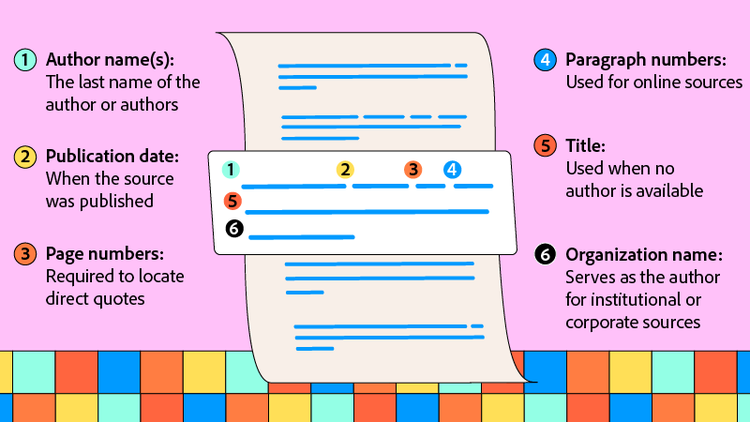
- Author name(s): The last name of the author or authors who created the source material
- Publication year or date: When the source was published, which helps readers locate the correct edition
- Page numbers: Required for direct quotes to pinpoint the exact location of borrowed text
- Paragraph numbers: Used for online sources that lack traditional page numbers
- Title: Used when no author is available, typically shortened for brevity
- Organization name: Serves as the author for institutional or corporate sources
Different citation styles have specific rules for formatting these components. APA style emphasizes the publication year, placing it immediately after the author's name. MLA style prioritizes page numbers, typically omitting the year from in-text citations entirely. Understanding which style your instructor or publication requires is essential before you begin writing.
When you're working with multiple sources or complex documents, artificial intelligence (AI) tools can help you quickly locate and verify citation information. You can chat with your documents to extract author names, publication dates, and other citation details efficiently. This technology is particularly helpful when working with lengthy academic papers or unfamiliar source materials where manually searching for citation information would be time-consuming.
The precision of your in-text citations directly affects your credibility as a writer. Missing or incorrect components can make it difficult for readers to locate your sources, undermining the trustworthiness of your work.
Types of in-text citations
Citation methods vary based on how you use sources in your writing. Understanding the three main types of in-text citations helps you choose the most effective approach for each situation in your academic work.

1. Parenthetical citations
Parenthetical citations are references placed entirely within parentheses at the end of a sentence, before the period. This is the most common citation method when the author's name isn't naturally part of your sentence structure.
Use parenthetical citations when you want to emphasize the information itself rather than who wrote it. This approach keeps your writing flowing smoothly while still providing proper attribution.
In APA style, parenthetical citations include the author's last name, a comma, and the publication year: (Johnson, 2022). For direct quotes, add a page number: (Johnson, 2022, p. 45). In MLA style, the format includes only the author's last name and page number without a comma: (Johnson 45).
For example, a parenthetical citation might appear as: Recent studies indicate that citation practices vary significantly across academic disciplines (Martinez, 2023).
2. Narrative citations
Narrative citations incorporate the author's name directly into your sentence, with only the date or page number appearing in parentheses. This approach emphasizes the author and works well when discussing a researcher's specific contributions or credentials.
Use narrative citations when you want to highlight who conducted the research or developed the ideas you're discussing. This method creates a more conversational tone and helps establish the authority behind the information.
In APA style, the year follows the author's name in parentheses: Martinez (2023) found that citation practices vary significantly across academic disciplines.
In MLA style, only the page number appears in parentheses: Martinez argues that citation practices vary significantly across academic disciplines (78).
3. Block quotes
Block quotes are extended quotations set apart from the main text using special formatting. These quotes are used for longer passages that require their own visual space on the page.
In APA style, use block quotes for passages of 40 words or more. In MLA style, block quotes are required for prose quotations longer than four lines. Block quotes are indented from the left margin, do not use quotation marks, and place the citation after the final punctuation mark.
Block quotes should be used sparingly and only when the exact wording is essential to your argument. When working with lengthy source materials, you can summarize sources to determine which passages truly warrant full quotation versus paraphrasing.
For example, a block quote might present a key theoretical framework or a passage whose specific language is crucial to your analysis. The extended format helps readers understand that this material deserves special attention.
How to do in-text citations (with examples)
Citation format varies depending on the type of source you're referencing. Understanding how to cite different source types ensures your academic writing stays consistent and accurate. The following examples demonstrate how to cite common sources you'll encounter.
Book citations
Books are among the most frequently cited sources in academic writing. For a parenthetical citation from a book, include the author's last name and year: (Thompson, 2021). When quoting directly, add the page number: (Thompson, 2021, p. 156).
For narrative citations, incorporate the author into your sentence: Thompson (2021) argues that effective communication requires understanding your audience. When including a direct quote in a narrative citation: Thompson (2021) states that "audience analysis is the foundation of persuasive writing" (p. 156).
Always include page numbers when quoting directly from a book, as this allows readers to locate the exact passage you referenced.
Website citations
Online sources present unique citation challenges because they often lack traditional page numbers. When a website has an identifiable author, cite them as you would any other source: (Garcia, 2023) or Garcia (2023) reported that digital literacy rates continue to increase.
When an organization serves as the author, use the organization's name: (National Writing Institute, 2022). For subsequent citations of the same organizational source, you may abbreviate if the abbreviation is well-known.
When page numbers aren't available, use paragraph numbers if they're visible: (Garcia, 2023, para. 4). This helps readers locate specific information within longer web articles.
Journal and article citations
Academic journals follow similar citation patterns to books. Include the author and year: (Williams & Chen, 2022). For direct quotes, add the page number: (Williams & Chen, 2022, p. 234).
When citing articles from academic journals, your bibliography entry will include additional details like the volume number and issue number. However, the in-text citation remains brief, containing only the information needed to connect readers to the full reference.
Podcast citations
Audio sources like podcasts require slightly different approaches. Cite the host or speaker and the year: (Rodriguez, 2023) or Rodriguez (2023) discussed the evolution of academic publishing in a recent episode.
When referencing a specific moment in a podcast, include a timestamp in your reference list entry to help readers locate the exact segment. This is particularly important when quoting or closely paraphrasing spoken content.
No author citations
When no author is identifiable, use a shortened version of the title in your citation. For APA style, use quotation marks for article titles and italics for book or report titles: ("Understanding Citations," 2023). For MLA style, use the same formatting conventions: ("Understanding Citations" 12).
Keep shortened titles to the first few words—enough for readers to locate the full entry in your reference list. As AI tools become more prevalent in research, you may also need to cite AI-generated content following emerging guidelines from major style organizations.
Preserving citation accuracy
When sharing your work or submitting assignments, document formatting can cause appearances to shift between programs and devices. Converting your documents to a stable format helps protect your carefully formatted citations. You can convert your documents to PDF to preserve formatting and maintain consistency for anyone reviewing your work.
Frequently asked questions
How do I do an in-text citation in MLA?
How do I do in-text citations in APA 7?
How do I cite 3 authors in in-text citations?
Do I need a citation for every sentence when paraphrasing?
What's the difference between a citation and a reference?
Can I use in-text citations for images or figures?
What happens if I forget to include an in-text citation?
You may also like